Automated Nuisance Calls: How Unwanted Direct Marketing Calls Lead to Fraud and Criminal Activity

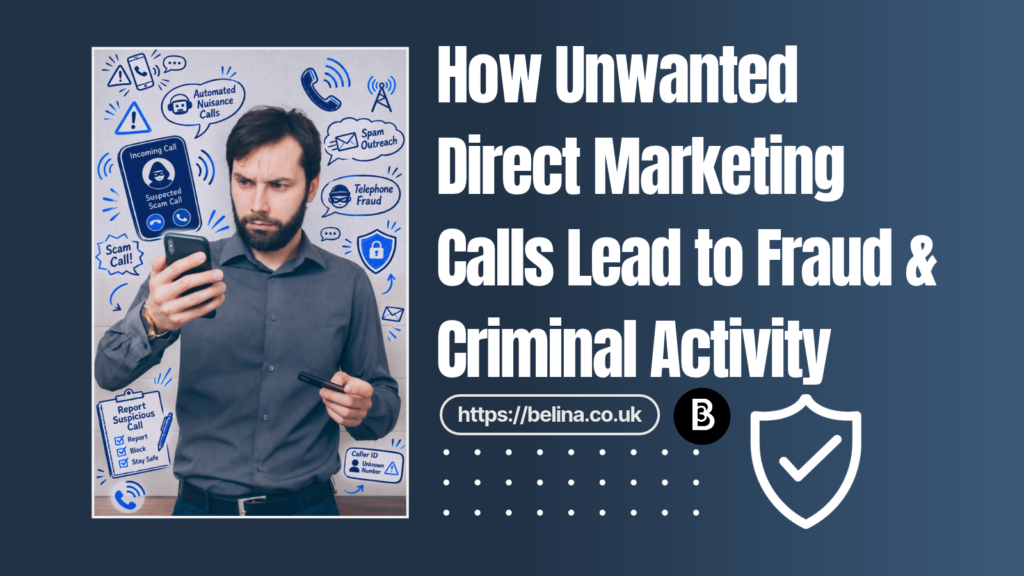
Automated nuisance calls prompted a fresh warning from the ICO on 9 October 2026 after complaints reached their highest level since 2021.
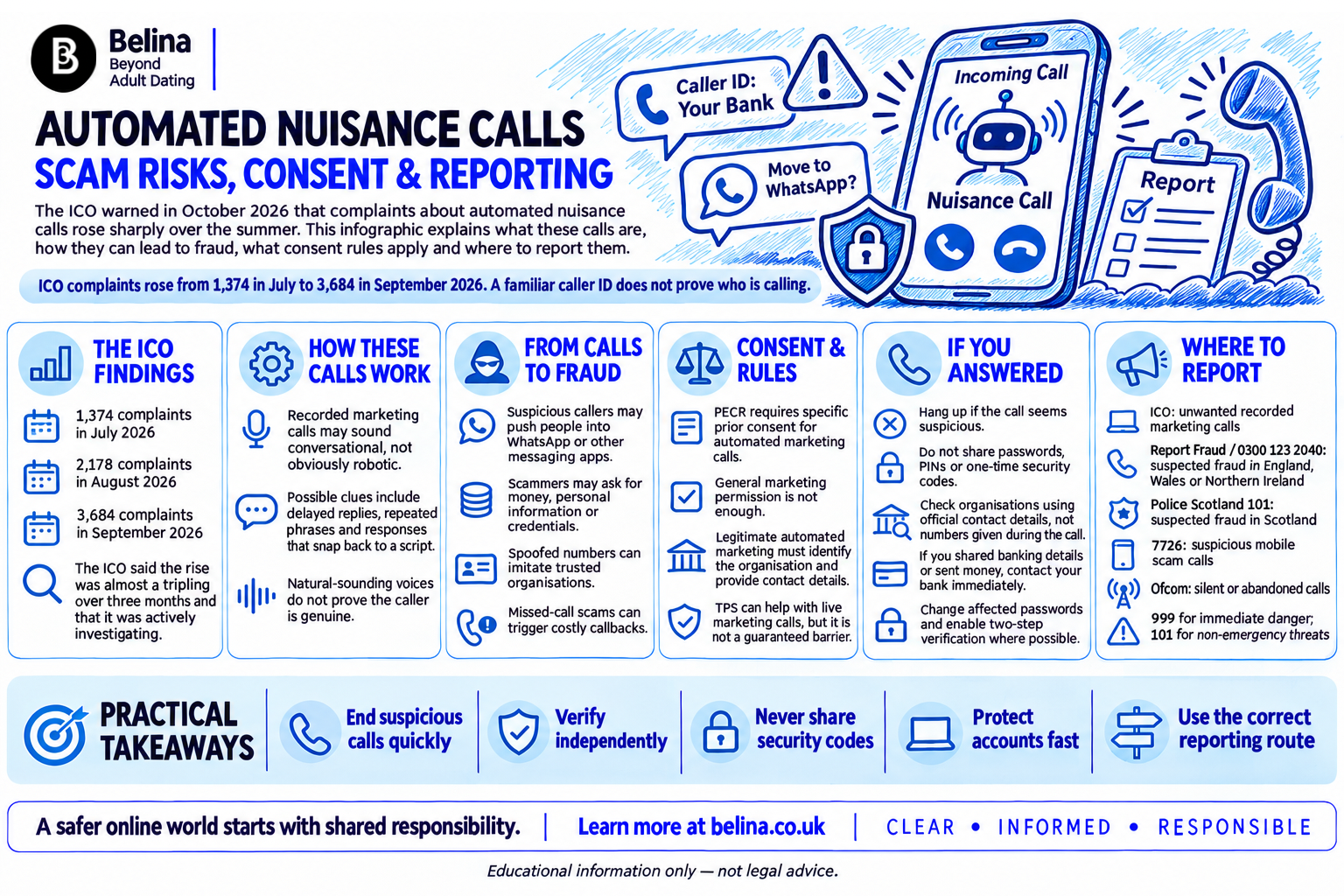
The Information Commissioners Office (ICO) reported a sharp increase during July, August and September, alongside concerns about calls that draw people towards requests for private information or fraudulent schemes.
Unsolicited marketing calls and fraudulent scams raise different legal questions. This article explains the ICO’s findings, how recorded calls can sound conversational, your right to consent and the appropriate reporting routes.
It also sets out what to do after sharing information or sending money.
Key Takeaways
- ICO complaints rose from 1,374 in July to 3,684 in September 2026.
- Automated marketing calls require specific prior consent.
- A familiar caller ID does not prove who is calling.
- Report nuisance marketing to the ICO and suspected fraud to the police.
- Contact your bank promptly if a caller has obtained money or banking information.
The ICO Findings
The ICO’s October announcement recorded;
| Number of Complaints | Month | Year |
| 1,374 | July | 2026 |
| 2,178 | August | 2026 |
| 3,684 | September | 2026 |
It described the rise as almost a tripling over three months and said it was actively investigating.
- those figures count complaints, not all calls made or all people affected.
- many incidents go unreported.
Therefore, the figures cannot establish the total volume of automated nuisance calls or the proportion involving fraud.
The ICO also highlighted calls that encourage people to join WhatsApp groups, disclose information or engage with fraudulent schemes.
Its warning connects unwanted telephone contact with possible further harm;
It does not classify every automated call as a scam.
Automated Nuisance Calls
An automated marketing call plays recorded material rather than relying entirely on a live conversation, however;
- a recording does not always sound like a fixed announcement.
- software can present selected responses in a way that resembles an ordinary exchange.
A 2025 ICO enforcement action provides a documented example.
Home Improvement Marketing Ltd and Green Spark Energy Ltd received fines of £300,000 and £250,000 respectively for unlawful automated marketing calls.
Agents abroad used avatar software to play scripted lines recorded by voice actors, creating the impression of UK-based callers.
The ICO identified possible clues including delayed responses, repeated phrases and answers that return to a fixed script.
These can help describe a call, but they cannot reliably identify every recording.
Nor does a natural-sounding voice establish that a caller is genuine.
- Automated nuisance calls do not all use generative AI or cloned voices.
In these enforcement cases, the evidence described prerecorded clips.
Keeping that distinction clear avoids attributing every suspicious conversation to a technology that has not yet been identified.
From Calls to Fraud
Telephone contact can lead to another channel where the caller asks for money, credentials or further engagement. Moving a conversation into a messaging app does not establish legitimacy.
Equally, the app itself does not make an ordinary conversation fraudulent;
- the claims and requests require scrutiny.
The Financial Conduct Authority describes investment schemes that use WhatsApp, Telegram or Discord groups to create an appearance of exclusivity.
In a pump-and-dump scheme, organisers promote an investment to raise its price before selling for their own benefit.
This is a documented scam mechanism, not a finding that every call mentioned in the ICO announcement involved that scheme.
Other calls impersonate trusted organisations.
Ofcom’s guidance on scam types explains number spoofing;
- criminals alter the number displayed on the recipient’s screen.
- a UK number or apparent bank number therefore cannot authenticate a caller.
Ofcom also describes automated missed-call scams designed to prompt a costly return call.
The risk comes from calling the unfamiliar number back. Do not assume that the missed call represents a genuine enquiry or an urgent obligation to respond.
Marketing and Consent
The Privacy and Electronic Communications Regulations 2003, commonly called PECR, set specific requirements for automated direct marketing.
The ICO’s telephone marketing guidance explains that the person must specifically consent to receiving automated marketing calls from that caller.
General marketing permission or permission for live calls does not suffice.
Consequently, “you gave us your number” does not answer the consent question.
The caller needs permission for this form of marketing.
Legitimate automated marketing must also identify the organisation and provide the required contact information.
A convincing introduction cannot substitute for those requirements.
The Telephone Preference Service, or TPS, records an objection to unsolicited live sales and marketing calls. Registration is free, but it is not a technical barrier that prevents every incoming call. Automated nuisance calls already engage a stricter consent requirement;
- a person does not need TPS registration before raising a complaint about unlawful recorded marketing.
Ofcom explains that it can take up to 28 days for calls to reduce after TPS registration.
It also distinguishes the consumer service from the Corporate TPS for corporate subscribers.
Choose the appropriate register and withdraw any existing permission directly where necessary. Registration cannot force criminals to follow the rules.
What Constitutes Fraud
For England, Wales and Northern Ireland, the Fraud Act 2006 covers fraud through false representation, failure to disclose information when a legal duty requires disclosure, and abuse of position. Each requires dishonesty and an intention to make a gain or cause another person a loss or risk of loss.
The Crown Prosecution Service explains that an actual gain or loss need not occur for these offences. A failed dishonest attempt can therefore still warrant reporting.
Scotland has a different criminal-law framework;
- do not assume the Act supplies a single UK-wide definition.
Unwanted contact alone does not establish those elements.
A marketing call may breach PECR without proving a fraud offence.
Conversely, a caller who dishonestly impersonates an organisation to obtain money may raise a fraud concern as well as a nuisance-call complaint.
Describe the actual claims, requests and events when reporting automated nuisance calls.
You do not need to decide the criminal charge yourself.
Responding to Calls
If a call seems suspicious, end it. You do not need to remain on the line to determine if a human or recording is speaking. Ofcom recommends checking the organisation independently, using contact details from its official website or an existing account statement rather than a number supplied during the call.
- Do not disclose passwords,
- PINs or one-time security codes to an unexpected caller.
Familiar personal details do not authenticate the speaker: criminals can obtain information from public sources and data breaches.
Pressure to act immediately or keep the conversation secret adds a reason to stop and verify.
For an investment approach, the FCA recommends checking the firm and using independently verified contact details. A genuine company name or reference number can itself become part of an impersonation scam.
Copying those details does not make the person on the phone its representative.
Blocking and screening can reduce interruptions from automated nuisance calls.
However, review the consequences before silencing every unknown caller: that setting can also hide legitimate calls. Check voicemail and ask your provider about available options rather than assuming any filter offers complete protection.
After Sharing Information
Act on what happened, not just the fact that you answered.
If you sent money or disclosed banking information, contact your bank or card provider immediately through its official app, the number on your card or another independently verified channel.
Where your bank supports it, 159 can connect you safely.
Ask what it can do to secure the account and address the transaction; recovery is not guaranteed.
If you disclosed a password or lost account access, follow the provider’s recovery process.
The National Cyber Security Centre’s recovery guidance recommends changing the affected password and any reused passwords, checking security settings and enabling two-step verification.
A compromised email account can expose other accounts, so include it in the review.
Keep relevant call logs, messages, payment references and the caller’s claims. Record the date, time and displayed number, but label that number as displayed rather than verified.
Do not delay contacting the bank while assembling a perfect evidence file.
If the caller persuaded you to install software or follow a link, explain that clearly to your bank and provider. Ofcom’s response guidance advises avoiding banking apps on a potentially affected phone until you know it is safe. Do not give the original caller further access to “fix” the problem.
Reporting the Calls
Automated nuisance calls can require more than one report because marketing enforcement, criminal investigation and network action serve different purposes. Sending information to one organisation does not automatically notify the others.
ICO Marketing Complaints
Use the ICO’s nuisance-call reporting form for unwanted recorded marketing calls. Include the time, number, organisation claimed and subject of the call where available.
The ICO uses reports to investigate patterns and take enforcement action.
Its form states that it does not respond to complaints individually; reporting is not a promise of personal compensation.
Fraud and Threats
Report suspected fraud or cybercrime in England, Wales or Northern Ireland through Report Fraud or call 0300 123 2040. In Scotland, contact Police Scotland on 101.
Report Fraud offers separate routes for suspicious contact and a fraud or cybercrime incident, so describe any money lost, information disclosed or account access involved.
Call 999 for immediate danger.
For threatening calls without an emergency, contact police on 101 and ask your phone provider about its nuisance or malicious calls team.
A marketing complaint does not replace an urgent safeguarding response.
Networks and Ofcom
For a suspicious mobile call, Report Fraud’s instructions say to text the word Call followed by the number to 7726. This free route alerts your network.
For landline or withheld-number calls, ask the provider how to report them.
Ofcom handles reports of silent or abandoned calls.
These can arise when dialling systems connect no available agent or mistake a person for an answering machine.
Silence alone does not establish fraud.
Report the experience accurately, without assuming the displayed number identifies the organisation responsible.
Conclusion
Automated nuisance calls require a response that matches the problem. Specific consent governs recorded marketing; deception aimed at money or property can raise a separate fraud concern.
The ICO’s complaint figures justify attention, but they do not show that every unwanted call involves a criminal scam.
For escorts and prospective clients, publishing or exchanging a telephone number does not remove marketing protections or require a response to every caller.
Keep passwords and verification codes private, check unexpected claims independently and use the correct reporting route.
If contact concerns a listing on this platform or someone claiming to represent this belina, consult the Help & Support page.
Frequently Asked Questions
What is classed as a nuisance call?
The term covers unwanted calls such as live sales calls, recorded marketing and silent or abandoned calls. Some also involve scams or threats, which need different reporting routes. Automated nuisance calls generally involve unwanted recorded contact; assess any suspected fraud separately from the interruption itself.
Why am I suddenly receiving a lot of spam calls?
Your number may appear on marketing lists or public sources, or criminals may obtain it through a data breach. A sudden increase alone does not prove that a particular website leaked it or that your phone has been hacked. Check account alerts, block suspicious numbers and report recurring calls.
What happens if I answer a spam call and say hello?
Simply saying hello does not, by itself, establish that someone has accessed your bank or phone account. If the call seems suspicious, hang up. The next steps depend on anything else you disclosed, authorised or installed. Do not share security codes or continue talking because you have already answered.
How do I stop nuisance calls on my phone?
Use call blocking or screening, ask your provider about its services and register with the appropriate TPS service. Withdraw unwanted marketing permissions from genuine organisations. Report unlawful automated nuisance calls to the ICO and suspected mobile scam calls to your network through 7726. No single step guarantees complete prevention.
Where do I report automated nuisance calls or suspected phone fraud?
Report unwanted automated marketing to the ICO. Use Report Fraud for fraud in England, Wales and Northern Ireland, or Police Scotland on 101 in Scotland. Report silent or abandoned calls to Ofcom and suspicious mobile calls to 7726. Contact your bank immediately if money or banking details are involved.