
Ultimate Guide To Online Safety For User to User Engagement

Escorts and users of adult classified services face digital risks involving fraudulent advertisements, identity theft, harassment, privacy breaches and unlawful exploitation.
As online platforms continue to connect people through profiles, listings and private communications, understanding these risks has become an essetial part of responsible user-to-user services.
For independent escorts, online safety extends beyond protecting the integrity of a listing or advertisement. Personal information, photographs, financial details and private conversations can expose individuals to fraud, impersonation, coercion and other forms of abuse. Therefore, recognising suspicious activity early is an important part of maintaining personal security.
Furthermore, UK legislation establishes responsibilities for regulated online services and protections for individuals. The Online Safety Act 2023 introduces duties for qualifying services, while the Data Protection Act 2018 works alongside UK data protection legislation to regulate the handling of personal information.
The Sexual Offences Act 2003 also addresses sexual offences, including certain forms of exploitation and control. Consequently, users of adult classified platforms should understand both the legal boundaries of independent advertising and the warning signs of unlawful activity.
This guide explains how escorts and other users can recognise online threats, protect their privacy, understand their rights and report suspicious behaviour. It also examines the responsibilities of digital platforms, including content moderation, complaints, safeguarding and accountability.
Key Takeaways
- Escorts should understand the risks invloved with using adult classified sites.
- Protect personal information and recognise suspicious behaviour early.
- Report suspected fraud, exploitation and illegal content promptly.
- Reporting systems should be clear, accessible and easy to use.
- Users have statutory rights udner the data protection act 2018
- Independent escorts should retain control over their listings and decisions.
- Online platforms must address applicable safety and safeguarding obligation for all users.
- Exploitation, coercion, fraud, underage activity, and illegal content are a criminal offence.
Online Safety for Escorts
A fake profile appears.
A scam payment request is sent.
Private information gets exposed.
An account is impersonated.
Or a conversation suddenly feels unsafe.
Modern user-to-user platforms allow people to communicate, advertise, share content, upload images, exchange information, and interact with strangers instantly. That convenience creates opportunity, but it also creates risk.
For users, online safety is no longer just a technical issue It affects:
- privacy
- identity
- security
- reputation
- finances
- safeguarding
- legal implications
The internet has changed significantly over the past few years,
users must now be far more aware of risks associated with online platforms.
- scams
- impersonation
- fraud
- exploitation
- harassment
- data misuse
- fake profiles
- privacy risks
At the same time, UK legislation is becoming stricter. The Online Safety Act 2023 and The Data Protection Act 2018 are increasing expectations for user-to-user services: moderation, safeguarding and reporting illegal content, are now legal requirement.
For users, the message is straightforward ”online safety is an integral part of the user experience”.
This guide explains how you can protect yourself on sites including, adult classifieds, marketplaces, social, forums and community driven environments.
User to User Engagement
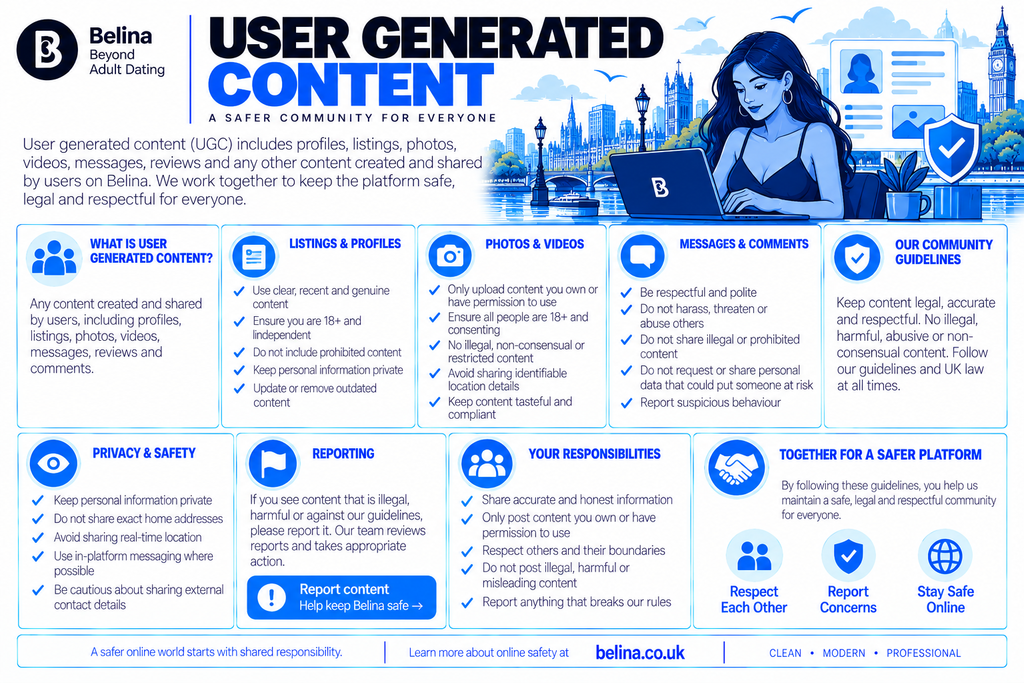
User-to-user engagement occurs when individuals create, publish, upload, send or share content that other users may encounter. Examples include profiles, advertisements, images, messages, reviews and community discussions.
However, user-generated environments can introduce risks involving impersonation, harassment, fraud and unlawful content. Therefore, safer engagement depends on both platform safeguards and responsible user behaviour.
For independent escorts, recognising suspicious activity early is particularly important because personal information, photographs and contact details may be exposed to individuals with malicious intent, an example of this, is the 2026 case of Benjamin William Day a 20 year old Worcester Univeristy Student who murdered 24year old Maria Saceanu (sex worker) in cold blood.
UGC content includes the following:
- profiles
- listings
- images
- messages
- comments
- reviews
- livestreams
- advertisements
- community posts
If users interact with content created by other users, the platform contains user-to-user functionality.
This is important because user-generated environments naturally create opportunities for:
- scams
- fake identities
- impersonation
- exploitation
- harassment
- privacy breach
- abuse
- fraud
- illegal content
Staying safe online is partly shaped by the platform, user behaviours is contributing factor.
Safer engagement starts with reconinsing risk early.
Adult Classified Platforms
Adult classified platforms require appropriate safeguards to manage risks associated with user-generated content. In particular, services used by escorts should recognise the potential consequences of impersonation, harassment, exploitation, blackmail and unauthorised disclosure of personal information.
Furthermore, users should take care when uploading photographs, sharing locations, communicating privately or responding to payment requests.
A responsible platform should provide accessible reporting systems, clear terms of service, appropriate moderation procedures and transparent complaint routes.
Users in adult environments often face increased risks involving:
- exploitation
- impersonation
- exposure
- harassment
- fraud
- coercion
- blackmail
- third party control
That is why users must be extra careful with:
- personal information
- uploaded images
- payment requests
- location sharing
- private communication
- suspicious behaviour
What a responsible platform should provide:
- reporting systems
- strict moderation
- terms of service
- privacy policy
- safeguarding guidance
- clear complaint and appeal routes
Trust becomes difficult when users feel uncertain about platforms ability to render support.
The Online Safety Act 2023
The Online Safety Act 2023 establishes duties for regulated online services. In particular, providers must assess relevant risks and take proportionate steps to address illegal content under the duties that apply to their services. These obligations do not mean every unpleasant interaction constitutes a criminal offence.
Moreover, users should expect clear explanations of platform rules, reporting processes and complaints routes. Effective moderation can reduce harm; however, no service can guarantee that every interaction will be safe.
For escorts and other users, the practical response remains straightforward: identify suspicious conduct, avoid sharing unnecessary information and report potentially illegal activity through the appropriate channel.
The law raises expectations around:
- protecting users
- removing illegal content
- accessible reporting systems
- complaints and appeals
- content moderation
- record keeping and audit trails
- demonstrating ongoing compliance.
This does mean that every unpleasant interaction becomes a criminal offfence.
It does not guarantee perfect moderation.
And it does not remove the need for users to act cautiously.
Platforms are increasingly expected to explain:
- how moderation works
- how reports are handled
- what behaviour is prohibited under the Community Guidelines
- how users can raise concerns
Reporting
Users should be able to locate a reporting route quickly when they encounter suspicious or potentially illegal content. For example, they may need to report impersonation, threatening messages, fraud, stolen photographs or suspected exploitation.
After receiving a report, a platform should assess the information against applicable law and its own rules. Where appropriate, moderators can request more details, restrict content, preserve records and explain the next steps. In addition, users should have access to relevant complaints procedures if they disagree with a decision.
A report button is your first point of call, if you are subjected to the ensuing risk;
- scams
- fake profiles
- harassment
- exploitation concerns
- underage indicators
- stolen images
- suspicious behaviour
- privacy violations
Once a report is submitted, the platform should acknowledge the complaint, explain how it will be handled, provide indicative timeframes where appropriate, and take action when content breaches the law or platform rules. Complaints and appeals processes must be accessible to all users, thus ensuring moderation decisions can be reviewed fairly and transparently.
Strong reporting systems improve:
- user trust
- platform safety
- moderation efficiency
- early risk detection
Weak reporting systems create frustration and reduce confidence in the platform.
Users should always feel confident in reporting suspicious behaviour.
If something appears unsafe, illegal, exploitative, or deceptive, report it.
Where immediate danger exists, contact the emergency services:
Police Call: 999
Refuge For Women and Children Against Domestic Abuse
Website: www.nationaldahelpline.org.uk/
24/hrs Helpline Call: +44 (0) 808 2000 247 freephone
Modern Slavery & Human Trafficking
Website: www.modernslavery.gov.uk/
Modern Slavery Helpline Call: +44 (0) 800 0121 700
Samaritans is the charity that helps prevents suicide
Website: www.samaritans.org/
Suicide Helpline Call: free on 116 123
National Ugly Mugs (NUM) fighting violence against sex workers
Website: https://nationaluglymugs.org/
Free phone: +44 (0) 800 464 7669
Mind UK is a charity helping those fighting mental health
Website: www.mind.org.uk/about-us/
Mental Health Helpline Call: +44 (0) 300 102 1234
National Health Service (NHS): Sexual Health Services.
Website: www.nhs.uk/
Call: 111 or Report online: https://111.nhs.uk/
18 Types of Illegal Content
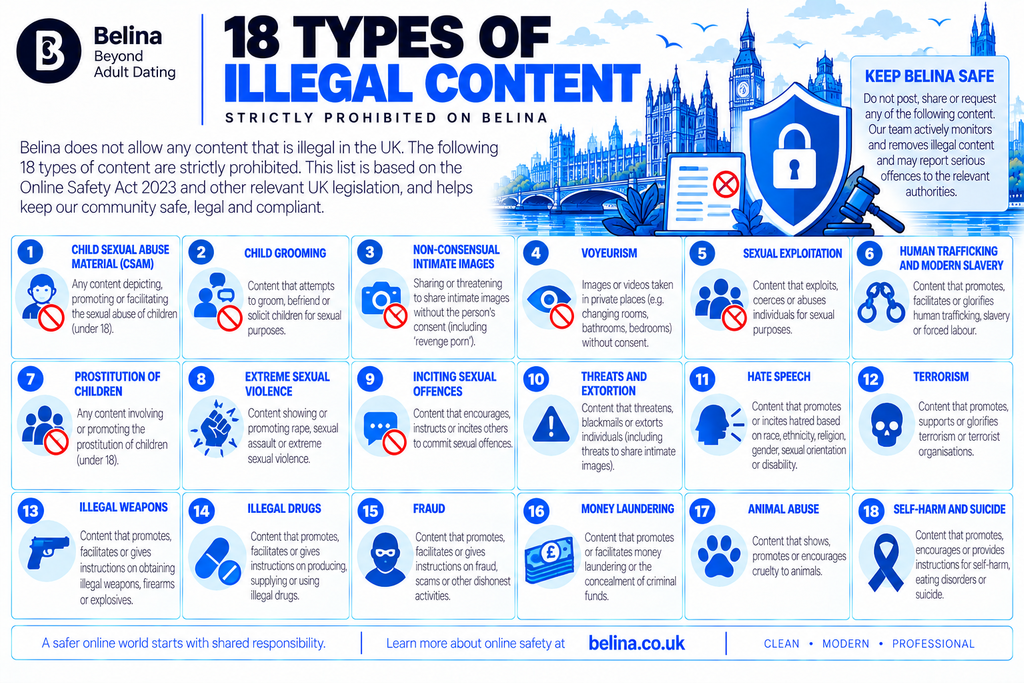
Illegal content concerns material connected with criminal offences; it does not include every opinion or unpleasant message. Consequently, online services should use the relevant Ofcom guidance and applicable legislation when they assess risks and respond to reports.
The existing list in this article describes several overlapping forms of illegal content and harmful conduct. It should not claim to list exactly 18 statutory offence categories without checking the current Ofcom framework.
- Terrorism
- Child sexual exploitation and abuse (CSEA)
- Grooming
- Image-based child sexual abuse material (CSAM)
- Child sexual abuse material (CSAM) URLs
- Hate
- Harassment, stalking, threats and abuse offences
- Controlling or coercive behaviour
- Intimate image abuse
- Extreme pornography offence
- Sexual exploitation of adults
- Human trafficking
- Unlawful immigration
- Fraud and financial services offences
- Proceeds of crime
- Drugs and psychoactive substances
- Firearms, knives and other weapons
- Encouraging or assisting suicide (or attempted suicide)
- Foreign interference offence
- Animal cruelty
- Cyber flashing
Online services will assess the risk of harm, decide the appropriate measures to take, implement them and record findings in a audit trail, a risk assessment must then be updated and reviewed annually and when (OFCOM) makes revisions to new identified risk profiles.
It is the responsibility of the platform to remove illegal content and escalate serious offences to the police or law enforcement.
Users are not expected to become legal experts before reporting concerns, if something appears seriously harmful or suspicious, report it.
Privacy Implications
Independent escorts and other users may provide personal information when creating accounts, publishing listings, uploading photographs or submitting reports. Consequently, poor data handling can expose individuals to identity theft, impersonation, fraud and harassment.
For example, publicly sharing home addresses, identity documents, banking information or precise locations may create unnecessary risks.
Therefore, users should limit the personal information they disclose and review the platform’s Privacy Policy before submitting sensitive details.
- usernames
- passwords
- IP address
- email address
- Images
- GPS location
- bank details
- support correspondence
Privacy failures can breed grounds for risks involving:
- identity theft
- impersonation
- fraud
- harassment
- blackmail
- reputation damage
This is why users should refrain from sharing:
- indentity documents
- home addresses
- workplace details
- bank info
- travel info
- private images
The less unnecessary information users expose publicly, the lower the risk of misuse.
Rights of The Data Subject
The UK GDPR and Data Protection Act 2018 give individuals important rights over personal information, subject to statutory conditions and exceptions. Therefore, data controllers must provide accessible information about their processing and appropriate ways to exercise those rights. Belina explains its practices in its Privacy Policy.
For independent escorts who publish front end information, these protections are particularly relevant because even limited disclosures can reveal sensitive personal details. Moreover, users should check which data appears publicly and which information the service processes internally.
The core statutory rights are:
- Right to be informed: users have the right to receive clear, transparent, and accessible information about how their personal data is collected, used, stored, shared, and protected. This information must normally be provided at the time personal data is obtained.
- Right of access: users have the right to obtain confirmation as to whether personal data concerning them is being processed and, where that is the case, access to that personal data together with supplementary information about the processing.
- Right to rectification: users have the right to require inaccurate personal data concerning them to be corrected without undue delay. They may also request that incomplete personal data be completed.
- Right to erasure (“right to be forgotten”): users have the right to have personal data erased without undue delay in certain circumstances, including where the data is no longer necessary for the purpose for which it was collected, consent has been withdrawn, or the processing is unlawful.
Exercising Your Data Rights
- Right to restrict processing: users have the right to require a controller to limit the processing of personal data in specific situations, such as where the accuracy of the data is contested or the processing is unlawful but the individual opposes erasure.
- Right to data portability: users have the right to receive personal data concerning them in a structured, commonly used, and machine-readable format and to transmit that data to another controller where technically feasible.
- Right to object: users have the right to object, on grounds relating to their particular situation, to the processing of their personal data where processing is based on public interest, official authority, or legitimate interests. They also have an absolute right to object to direct marketing.
- Rights relating to automated decision-making and profiling: users have the right not to be subject to a decision based solely on automated processing, including profiling, where that decision produces legal effects concerning them or similarly significantly affects them, except in limited circumstances provided by law.
It is important for the platform to only collect the information that it needs, data minimization ensures that processing of unnecessary user information is kept at a minimum.
Responsibilities of The Data Controller
A data controller determines why and how it processes personal information. Consequently, it must apply the data protection principles to its operations, maintain appropriate security measures and demonstrate accountability, these duties also apply when thrid party service providers process information on its behalf.
- Lawfulness, Fairness and Transparency: the controller must process personal data lawfully, fairly, and transparently. Users must understand what data is collected, why it is collected, and how it will be used.
- Purpose Limitation: Personal data must only be collected for specified, explicit, and legitimate purposes and not used in ways that are incompatible with those purposes.
- Data Minimisation: only personal data that is adequate, relevant, and necessary for the stated purpose should be collected and processed.
- Accuracy: reasonable steps must be taken to ensure personal data is accurate and, where necessary, kept up to date.
- Storage Limitation: personal data should not be kept longer than necessary for the purpose for which it was collected, unless retention is required by law.
- Integrity and Confidentiality: appropriate technical and organisational measures must be implemented to protect personal data against:
- Unauthorised access
- Accidental loss
- Destruction
- Damage
- Disclosure
7. Accountability: the controller must be able to demonstrate compliance with data protection law and maintain records, policies, procedures, and evidence of compliance.
8. Responding to Data Subject Rights: the controller must have procedures to:
- Provide access to personal data
- Correct inaccurate data
- Delete data where applicable
- Restrict processing
- Facilitate data portability
- Handle objections
- Review automated decisions
9. Security by Design and by Default: privacy and security protections should be built into systems from the outset, not added later.
10. Data Breach Management: the controller must:
- Detect and investigate personal data breaches.
- Notify the ICO where required.
- Notify affected individuals when the breach presents a high risk to their rights and freedoms.
11. Processor Oversight: there third parties process data on behalf of the controller (e.g., hosting providers, email providers, age-verification providers), the controller remains responsible for ensuring appropriate contracts and safeguards are in place.
12. International Transfers: personal data transferred outside the UK must be protected by an approved transfer mechanism and appropriate safeguards.
In practice, transparent privacy notices, access controls, retention limits and effective procedures for user requests all contribute to accountability. Likewise, controllers should review their safeguards as their service and the risks associated with it evolve.
Independent Escorts and Safeguarding
Independent escorts should control their own listings, communications and decisions without coercion or third-party control. Belina’s Posting Guidelines describe its policy for independent advertising. However, platform rules do not replace statutory law, and the applicable offences differ across UK jurisdictions.
The Sexual Offences Act 2003 addresses several offences relevant to exploitation in England and Wales, including causing or inciting prostitution for gain and controlling prostitution for gain. The Modern Slavery Act 2015 addresses trafficking and modern slavery offences in England and Wales. Therefore, this section should distinguish the relevant offences rather than suggest that a single rule operates identically throughout the UK.
The Sexual Offences Act 2003, contains several offences relating to the following categories:
1. Prostitution Exploitation and Control Offences
causing or inciting prostitution for gain: a person commits an offence if they intentionally cause or encourage another person to become involved in prostitution for financial gain.
controlling prostitution for gain: a person commits an offence if they exercise control, direction, or influence over another person’s prostitution for financial benefit.
keeping, managing, acting or assisting in the management of a brothel: It is an offence to keep, manage, or assist in managing premises used as a brothel.
2. Trafficking and Exploitation Offences
The original Act contained trafficking offences, many of which have since been supplemented or replaced by the Modern Slavery Act 2015. Belina also publishes a Modern Slavery Statement as a pre-launch policy notice. However, the Act remains part of the wider legal framework against:
- Human trafficking.
- Sexual exploitation.
- Coercion and abuse.
- Organised exploitation of vulnerable persons.
3. Child Protection Offences
- Sexual activity with a child.
- Causing or inciting a child to engage in sexual activity.
- Child grooming.
- Arranging or facilitating child sexual offences.
- Sexual communication with children.
- Abuse of positions of trust.
These types of offences can carry penalties up to lifetime Imprisonment.
4. Consent and Coercion
A key principle of the Act is that:
- Consent must be freely given.
- Consent obtained through threats, coercion, force, intimidation, or exploitation may be invalid.
Typical Penalties
Penalties vary depending on the offence, but include:
- Unlimited fines.
- Community orders.
- Sexual Harm Prevention Orders.
- Registration as a sex offender.
- Imprisonment ranging from months to life imprisonment for the most serious offences.
These principles are why an “Independent Use” policy is not merely a platform preference—it is closely aligned with UK legislation aimed at preventing third-party control.
Fraud Prevention
The Fraud Act 2006 establishes several offences invloving fraud, including fraud by false representation, failure to disclose information where there is a legal duty, and abuse of position.
For escorts and users of classified platforms, suspicious behaviour may include stolen photographs, fabricated payment confirmations, false identities and attempts to obtain confidential information.
Users should be cautious of anyone who:
- Uses stolen photographs or fake identities.
- Misrepresents their age, location, circumstances, or intentions.
- Provides false information to influence decision-making.
- Requests money using misleading or deceptive claims.
- Sends altered screenshots or fabricated proof of payment.
- Attempts to obtain passwords, verification codes, banking information, or personal data.
- Creates multiple accounts to deceive users or avoid enforcement action.
- Uses pressure, urgency, emotional manipulation, or intimidation to influence decisions.
- Conceals important information that may affect a user’s ability to make an informed choice.
Similary not all fraud involves direct financial loss. Some schemes are designed to obtain personal information, compromise accounts, facilitate identity theft, build trust for later exploitation, or gather information about an individual’s location, habits, or circumstances.
If you suspect a user, listing, profile, communication, image, or transaction may be fraudulent, preserve any available evidence and report the matter through the platform’s reporting system. Early reporting helps mantain platform integrity, supports investigations, and may assist in identifying wider patterns of criminal activity.
Complaints And Appeals
Moderators can make mistakes, for instance; they may remove a legitimate listing, restrict an account or misunderstand the context of a report. Consequently, accessible complaints and appeals procedures play an important role in fair platform governance.
Users should be able to explain their concerns, submit relevant evidence and request a review where the applicable process allows it. In-turn, platforms should explain their decisions clearly and retain suitable records of the outcome.
Users should be able to:
- challenge moderation outcomes
- raise concerns
- request reviews
- report unfair treatment
- question data handling
- and not to be subjected to automated decision making.
Fair moderation improves trust, users are more likely to trust a platform when:
- rules are understandable
- decisions are explained
- review routes exist
- complaints are acknowledged.
Registered users who wish to appeal a decision or judgement made to their account, can exercise their right to intervention in writing. Where the account remains active and not suspended due any account violation active users may appeal a decision by following up with the submitted (ticket number) or raising a new one under the help section within the user account.
Non-registered users may report suspicious activity or raise a complaint through the help and support page.
Law enforcement and Official Referrals can enquire by email: help@contactbelina.com
Conclusion
The internet has created unprecedented opportunities for communication, commerce, and personal freedom. It has also created environments where deception, exploitation, abuse, and criminal activity can occur at a scale and speed that would have been difficult to imagine only a generation ago.
Most users will never encounter the most serious forms of harm, however, the risks that do exist are often hidden behind ordinary interactions, familiar platforms, and seemingly routine online activity.
Fraud, coercion, identity misuse, exploitation, privacy breaches, and unlawful content rarely present themselves openly, more often, they emerge gradually through behaviour, patterns, and warning signs that are easy to overlook until significant harm has already occurred.
For this reason, online safety should not be viewed as a matter of convenience or platform preference. It is a fundamental part of responsible participation in the digital environment.
Effective reporting systems, proportionate moderation, transparent governance, and informed users all contribute to reducing risk and maintaining trust. Belina’s Safety Hub brings together related safety and platform guidance. Belina’s moderation, reporting tools and safety guidance can reduce risk, but they cannot guarantee user safety, so users should remain cautious when interacting with others.
The legal framework surrounding online services continues to evolve in response to these challenges. Yet legislation alone cannot create safer online environments.
Meaningful protection depends upon consistent standards, responsible decision-making, and a willingness to act when concerns arise.
Ultimately, safer online spaces are built through accountability.
Users must remain alert to the risks that exist, platforms must take reasonable steps to prevent misuse, and those who seek to exploit, deceive, or harm others should expect their actions to be identified, challenged, and addressed.
The consequences of inaction can extend far beyond a single account, message, or transaction. In many cases, they affect real people, real lives, and real-world outcomes.
Frequently Asked Questions
Users should report the 17 types of illegal content:
- Terrorism
- Child sexual exploitation and abuse (CSEA)
- Grooming
- Image-based child sexual abuse material (CSAM)
- Child sexual abuse material (CSAM) URLs
- Hate
- Harassment, stalking, threats and abuse offences
- Controlling or coercive behaviour
- Intimate image abuse
- Extreme pornography offence
- Sexual exploitation of adults
- Human trafficking
- Unlawful immigration
- Fraud and financial services offences
- Proceeds of crime
- Drugs and psychoactive substances
- Firearms, knives and other weapons
- Encouraging or assisting suicide (or attempted suicide)
- Foreign interference offence
- Animal cruelty
Ofcom can change or updates risk profiles, this list may be supplemented annually, to report an issue or raise a concern, assistance can found on the help & Support page.
Ofcom’s Illegal Content Codes of Practice provide guidance on how regulated online services should manage illegal content, moderation systems, reporting processes, complaints, and user safety obligations. Readers of this arcticle may wish to gain further information on the OFCOM Official Website.
Independent advertisers control their own listing, communication, availability, and decisions without third-party control or coercion, this platform is for independent use only. The Sexual Offences Act 2003 sets provisions for those who solicit or incite another indvidual for the intent of profifiting for monetary gain.
Our internal moderators will review the content, assess if any platform rules or the law has been broken, investigate the account involved, and take moderation action where appropriate, if needed escalate to the police or law enforcement.
Users who believe a decision affecting their account, listing, or content was made in error may submit an appeal through the Help & Support page. Appeals are reviewed using available evidence, moderation records, and relevant information. Decisions may be upheld, modified, or reversed following the review.
Users have rights to request deletion, correction, or access to their personal information under (UK) data protection law. To permantently delete your account with us, simply login and navigate to the account settings.
No. If someone is in immediate danger, users should contact the police.