Birmingham Escorts: A Comprehensive City Guide to Birmingham

Birmingham escorts form part of a wider discussion about independent adult services, local legislation and personal safety in England’s second-largest city. This guide provides practical information for visitors, residents and those considering independent work in Birmingham.
From nightlife and cultural attractions to crime statistics, transport, housing and healthcare, the article explores essential aspects of life in the city. In addition, it examines the legal framework surrounding independent escorting, alongside Birmingham’s diverse population, economic landscape and public safety considerations.
Key Takeaways
- Birmingham has over 1.18 million residents and one of England’s youngest populations.
- West Midlands Police recorded 103.7 crimes per 1,000 residents in 2024/25.
- Independent Birmingham escorts operate within specific UK legal restrictions.
- The city offers major NHS hospitals, extensive rail links and an expanding Metro network.
Demographics
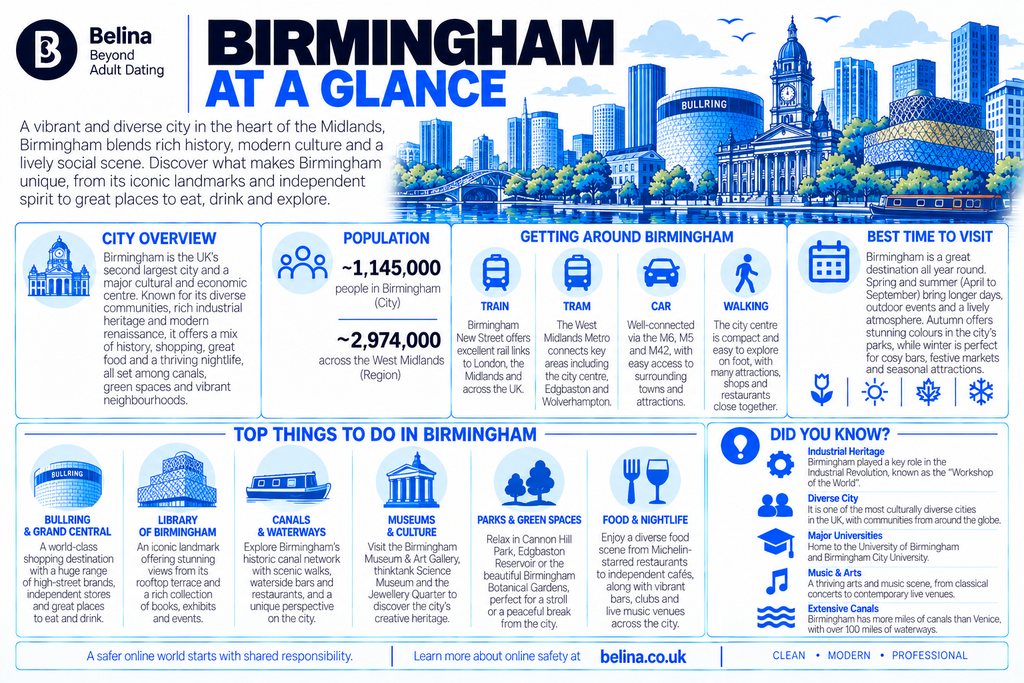
Birmingham is the UK’s second largest city by population. As of 2025, approximately 1.18 million people live within the city boundaries — growing by roughly 7,941 per year. Furthermore, the wider West Midlands Combined Authority area covers a total population of approximately 2.9 million.
The city has a median age of just 34 years — well below the national average of 40. As a result, Birmingham has the youngest demographic profile of any major city in England. The largest age group falls between 20 and 24, accounting for 8.1% of the total population.
In terms of gender, the split is broadly balanced: 51.2% female and 48.8% male. The population has grown by 6.7% since 2011, slightly outpacing both the West Midlands region (6.2%) and England overall (6.6%). Projections from Birmingham City Council suggest further growth to 1,186,000 by 2028 and 1,230,000 by 2038.
Cultural and Ethnic Diversity
Birmingham is, by some measures, the most ethnically diverse major city in England. As of the 2021 census, 51.4% of residents are from Black, Asian, or Minority Ethnic (BAME) backgrounds — making it the first major UK city where the white British population is no longer in the majority.
Source: Birmingham City Council census data
- White: 48% (down from 57.9% in 2011)
- Asian or Asian British: 31% — the largest minority group, with Pakistani residents making up 18.4%, Indian 6.1%, and Bangladeshi 3.3%
- Black or Black British: ~7%
- Mixed or Multiple heritage: ~5%
- Other: ~4%
Birmingham is also the city with the largest Muslim population in the UK. This diversity shapes the city’s food, culture, festivals, and economic identity in ways that are genuinely distinctive.
Economy and Education
- Average salary: approximately £29,500 per year, below the national average
- Average property price: approximately £232,000
- Home ownership: 53.5%, compared to 62.3% across England
- Private rental: 23% of households; social rental: 23.5%
- The service sector employs 88% of the working population
- The city’s economy grew by 9.7% between 2021 and 2022
Birmingham is home to three universities — the University of Birmingham, Birmingham City University, and Aston University — with a combined student population exceeding 90,000. Consequently, students make up a significant share of the city’s economically active population.
Crime Rates and Safety
Crime in Birmingham is not evenly distributed. For example, inner-city wards, including Handsworth, Lozells, Newtown and parts of Small Heath, record higher crime levels than several outer suburbs. However, patterns vary by offence type, reporting period and neighbourhood. Check the latest Police.uk area data before drawing conclusions about a particular location.
- Violence and sexual offences — the most common crime type, with 58,482 offences in 2026 (a rate of 47 per 1,000)
- Possession of weapons — 2.66 per 1,000, which is 3.13 times the national average, with 3,300 reports in the 12 months to March 2026
- Robbery — 2.87 per 1,000, a CrimeRate Index of 2.45 times the national average
- Vehicle crime — 2.10 times the national average, with 11,243 reports
- Theft from the person — the highest rate in the West Midlands
- Bicycle theft — the least common crime type
Nightlife districts, particularly Broad Street, see elevated public order and theft-from-person incidents during evenings and weekends. For street-level data by area, see Police.uk — West Midlands compare your area.
Key Nightlife Districts
Broad Street The best-known nightlife corridor in Birmingham. Broad Street attracts a young, mixed crowd to a string of bars and clubs, including Revolution, Bambu, and O’Neill’s Irish Bar. It runs from the International Convention Centre end through to Five Ways and is the most accessible nightlife strip in the city.
Digbeth Digbeth has grown into Birmingham’s most exciting nightlife area in recent years. Home to the alternative Custard Factory and a younger, more eclectic crowd, it is the true hub of the city’s underground scene. In addition, Digbeth was previously named the “Coolest Neighbourhood in Britain” by The Sunday Times and continues to attract artists, designers, and creative businesses.
The Jewellery Quarter A more relaxed, upscale destination. The Jewellery Quarter suits after work drinks and intimate evenings. Notably, The Jam House on St Paul’s Square — a live music bar with Jools Holland as musical director — offers blues, funk, and jazz in an elegant Georgian setting.
Southside and the Gay Village Birmingham has a vibrant LGBT+ community. The Gay Village in Southside is home to a variety of late night clubs, drag nights, and bars, with the Nightingale Club standing as the biggest LGBTQ+ venue in the Midlands.
Brindleyplace and the Mailbox A more refined waterfront setting, ideal for early evening dining and cocktails. The Mailbox area includes Pennyblacks and the Edgbaston Cocktail Lounge — an Art Deco interior popular for special occasions.
Notable Venues
Lab 11 — Digbeth’s top techno venue; warehouse-style with international DJs and all-night events
Tunnel Club — beneath the railway arches; drum & bass, jungle, and techno across seven rooms
The Night Owl — Digbeth’s soul, funk, and Motown venue; vinyl-only nights, open until 4am
Mama Roux’s — New Orleans-inspired venue with live bands and three rooms of music
Rosies — Broad Street favourite; five themed rooms including a rooftop terrace
XOYO Birmingham — house, techno, and hip-hop with top DJ bookings in Digbeth
The Jam House — live jazz, blues, and funk in the Jewellery Quarter
Nightingale Club — the largest LGBTQ+ venue in the Midlands
Police and Emergency Services
Birmingham has an extensive network of NHS hospitals and emergency services. In addition to Queen Elizabeth Hospital Birmingham, patients may be able to access emergency care at Heartlands Hospital and Good Hope Hospital, depending on their needs. These hospitals are part of University Hospitals Birmingham NHS Foundation Trust.
However, the appropriate service depends on the patient’s age, symptoms, medical needs and location. Therefore, consult NHS urgent care guidance when choosing a service, call NHS 111 when unsure and dial 999 in a life-threatening emergency. You can also report crime online via West Midlands Police.
Travel & Transport Links
Birmingham sits at a major transport junction in England. Consequently, it has extensive road, rail, tram, bus and air connections across the West Midlands and beyond. The regional Transport for West Midlands service provides journey planning, route information and ticketing guidance.
Furthermore, the city’s stations and local transport services connect central Birmingham with surrounding neighbourhoods and towns. Check live.
Birmingham has three major city-centre rail stations:
- Birmingham New Street — the main intercity terminus with direct services to London Euston (~1 hr 20 mins), Manchester, Bristol, Leeds, and Edinburgh
- Birmingham Snow Hill — Chiltern Railways services to London Marylebone (~2 hrs) and West Midlands Railway Cross City Line
- Birmingham Moor Street — Chiltern Railways and Cross City Line interchange
The Cross City Line is the busiest suburban rail line in the UK outside London. It runs through the city centre every few minutes, from Lichfield in the north to Redditch in the south.
Tram — West Midlands Metro
The West Midlands Metro currently operates 35 stops across 14.9 miles of track, connecting Birmingham city centre to Wolverhampton via West Bromwich and Wednesbury. In addition, the Birmingham Eastside extension opened to a temporary terminus at Millennium Point in April 2026, adding tram access to Moor Street Station, Birmingham City University, and Digbeth.
A £1.3 billion expansion programme is underway, with a future network of 80+ stops planned to serve Birmingham Airport, the NEC, HS2 Curzon Street station, Solihull, and Brierley Hill.
Bus
TfWM operates an extensive bus network across the city. Integrated ticketing is available via the Swift Pay As You Go card, which offers discounted fares across buses and the Metro tram.
Airport
Birmingham Airport (BHX) is located approximately 9 miles south-east of the city centre, next to the National Exhibition Centre (NEC). It serves over 140 destinations and connects directly to Birmingham International station via a free air-rail link. Rail services to New Street take approximately 10 minutes.
Road
Birmingham sits at the intersection of the UK’s motorway network:
- M6 — north to Manchester, south to London
- M5 — south-west to Bristol and the South West
- M42 — east to Coventry, the M1, and the East Midlands
- A38(M) — the Aston Expressway into the city centre
Walking
Birmingham’s city centre is largely walkable. Broad Street, Brindleyplace, the Jewellery Quarter, and Digbeth are all within 20 minutes on foot from New Street. A Voi e-scooter scheme operates across the city centre. For cycling routes and hire options, see TfWM active travel guidance.
Political Situation
Birmingham City Council is the largest local authority in Europe, with 101 councillors across 69 wards. Labour is the dominant party. However, governance has been turbulent in recent years.
In September 2023, Birmingham City Council issued a Section 114 notice — the largest municipal financial failure in UK history — triggered in part by a £760 million equal pay liability. Government commissioners were appointed to oversee council finances and recovery. A significant programme of service reductions, asset sales, and restructuring has been underway since. For full context, see BBC News — Birmingham City Council bankruptcy.
Despite the financial crisis, Labour retains control of the council. The Council Leader is John Cotton (Labour).
West Midlands Combined Authority
At the regional level, Richard Parker (Labour) was elected Mayor of the West Midlands in May 2024. He defeated Conservative incumbent Andy Street by just 1,508 votes — one of the closest mayoral contests in UK devolution history. Parker heads the West Midlands Combined Authority, which controls a £1.2 billion budget, with £404 million directed toward transport delivery and economic development.
National Politics
Birmingham’s parliamentary constituencies are predominantly Labour-held, particularly in inner-city areas including Ladywood, Hodge Hill, Erdington, and Small Heath. Outer suburban constituencies such as Sutton Coldfield have historically returned Conservative MPs, though the 2024 general election shifted several seats across the wider West Midlands.
Tourism
Birmingham offers museums, galleries, restaurants and cultural attractions throughout the year. For example, visitors can explore the Jewellery Quarter’s industrial heritage, visit cultural collections and enjoy the city’s canal network. The official Visit Birmingham tourism website provides current visitor information.
Alternatively, destinations such as Cadbury World and the Black Country Living Museum offer different perspectives on the region’s manufacturing history. In addition, Birmingham’s theatres, live music venues and galleries contribute to its established cultural identity.
Food and Drink
Birmingham has more Michelin-starred restaurants outside London than any other UK city. Notable venues include Opheem, Adam’s, and The Wilderness. In addition, the city is home to the legendary Balti Triangle — a cluster of South Asian restaurants along Ladypool Road and Stratford Road in Sparkhill, widely regarded as the birthplace of the Balti curry.
Conclusion
Birmingham remains one of England’s largest and most culturally diverse cities, combining a young population, established industries and a growing visitor economy. Despite financial challenges facing Birmingham City Council, the city continues to attract residents, students, businesses and tourists.
Furthermore, its extensive transport network, major NHS hospitals and international airport provide essential connections and public services. Cultural attractions, nightlife districts and historic landmarks also contribute to Birmingham’s distinctive identity.
For Birmingham escorts working independently, understanding the local environment is equally important. The Sexual Offences Act 2003 and related legislation establish legal boundaries for certain activities associated with sex work. In addition, organisations such as National Ugly Mugs and NHS sexual health services provide access to specialist information and support.
Looking ahead, investment in the West Midlands Metro and wider transport infrastructure is expected to improve regional connectivity. Ultimately, Birmingham offers a combination of economic activity, cultural diversity and essential services, alongside challenges that residents and visitors should understand.
Frequently Asked Questions
Birmingham offers numerous opportunities to meet women through social events, nightlife and shared interests. Popular social areas include Broad Street, Digbeth and Brindleyplace, where visitors can explore bars, restaurants and entertainment venues. Alternatively, organised singles events, hobby groups and dating activities provide opportunities to meet new people.
Adults visiting Birmingham can enjoy canal-side dining, escape rooms, live music, comedy clubs and cultural attractions. The Jewellery Quarter offers independent restaurants and historic landmarks, while Digbeth is known for creative entertainment venues. Additionally, the city hosts concerts, theatre performances and seasonal festivals.
Singles in Birmingham frequently socialise in nightlife districts such as Broad Street, Digbeth and the Jewellery Quarter. These areas feature restaurants, bars and entertainment venues. Furthermore, organised speed-dating events, social clubs and community activities offer alternatives to traditional nightlife.
There is no definitive UK ranking for cities with the most women currently available for dating. The Office for National Statistics publishes marital and civil partnership data, but its definition of single does not establish someone’s current relationship status. Rankings also depend on population size and the age groups compared.
A city with more female than male residents does not necessarily have more single women. Population ratios vary by age, geographical boundaries and census year. The Office for National Statistics provides population estimates by sex and age for local authorities in England and Wales, allowing comparisons using consistent measures.
Rather than treating entire neighbourhoods as unsafe, visitors should assess their surroundings and exercise caution around isolated streets, poorly lit areas and crowded nightlife locations. West Midlands Police recommends planning journeys, using licensed transport and remaining alert to drink spiking and theft. Consult the West Midlands Police nightlife safety guidance.