
Liverpool Escorts: The Comprehensive City Guide to Liverpool Merseyside

Liverpool escorts operate within a city shaped by maritime history, cultural diversity and a thriving visitor economy. Situated on the River Mersey in northwest England, Liverpool combines historic landmarks, renowned music venues and established transport connections with the practical demands of modern urban life.
Beyond its famous waterfront and football heritage, Liverpool offers a distinctive social environment, supported by universities, healthcare services and a regional economy. Furthermore, understanding local crime statistics, housing costs, transport and legal responsibilities can help residents, visitors and independent advertisers make informed decisions.
This comprehensive guide examines Liverpool’s demographics, public safety, nightlife, tourism and essential services, alongside the legal considerations affecting independent escorting in England.
Key Takeaways
- Liverpool had 508,961 residents in 2024 and a median age of approximately 35.
- Merseyside recorded nearly 9,000 fewer crimes in 2024 than in 2023.
- Merseyside Police pioneered a hate-crime approach to crimes against sex workers.
- Liverpool offers major NHS hospitals, rail connections and cultural attractions.
Population and Demographics
Liverpool is one of England’s most storied and densely populated cities. As of 2024 ONS estimates, the city’s population stands at 508,961. As a result, it ranks as the second-most densely populated English core city, with around 4,551 people per km². The wider Liverpool City Region — which includes Wirral, Knowsley, Sefton, St Helens, and Halton — has a combined population of around 1.48 million.
The city also skews notably young. The median age is 35.1 years, which sits well below the UK average of 40.7. In terms of gender, the split is broadly balanced at 51.2% female and 48.8% male. Furthermore, the population has grown by around 9.3% over the past decade, and projections suggest continued growth to approximately 561,000 by 2040.
A City Shaped by Migration
Liverpool remains predominantly White British. However, it is also one of the UK’s most historically diverse cities (source: Liverpool City Council):
- White: 84.0% (77.3% White British/English/Welsh/Scottish/NI)
- Asian or Asian British: ~5%
- Black or Black British: ~3%
- Mixed/Multiple heritage: ~4%
- Other: ~4%
Notably, Liverpool is home to the oldest Black African community in the UK, with roots traceable to at least 1730. Many of its members are descended from sailors, traders, and freed enslaved people. In addition, the city hosts the oldest Chinese community in Europe, centred on Nelson Street’s Chinatown.
Economy & Education
Source: Total Population UK – Liverpool
The student population stands at around 29,800. Consequently, students account for 38.7% of the economically inactive working-age population — a figure that reflects the scale of the University of Liverpool and Liverpool John Moores University
Average salary: approximately £31,933/year
Average property price: approximately £223,517
Unemployment: 3.9% — broadly in line with the national average of 3.8%
86.9% of residents hold at least a Level 1 qualification; by contrast, 7.9% have no qualifications at all, compared to 6.6% nationally
Ethnic and Cultural Diversity
Liverpool remains predominantly White British, though it is one of the UK’s most historically diverse cities (source: Liverpool City Council demographic headline indicators):
- White: 84.0% (77.3% White British/English/Welsh/Scottish/NI)
- Asian or Asian British: ~5%
- Black or Black British: ~3%
- Mixed/Multiple heritage: ~4%
- Other: ~4%
Liverpool is home to the oldest Black African community in the UK, with roots traceable to at least 1730 — many descended from sailors, traders, and freed enslaved people. It also hosts the oldest Chinese community in Europe, centred on Nelson Street’s Chinatown.
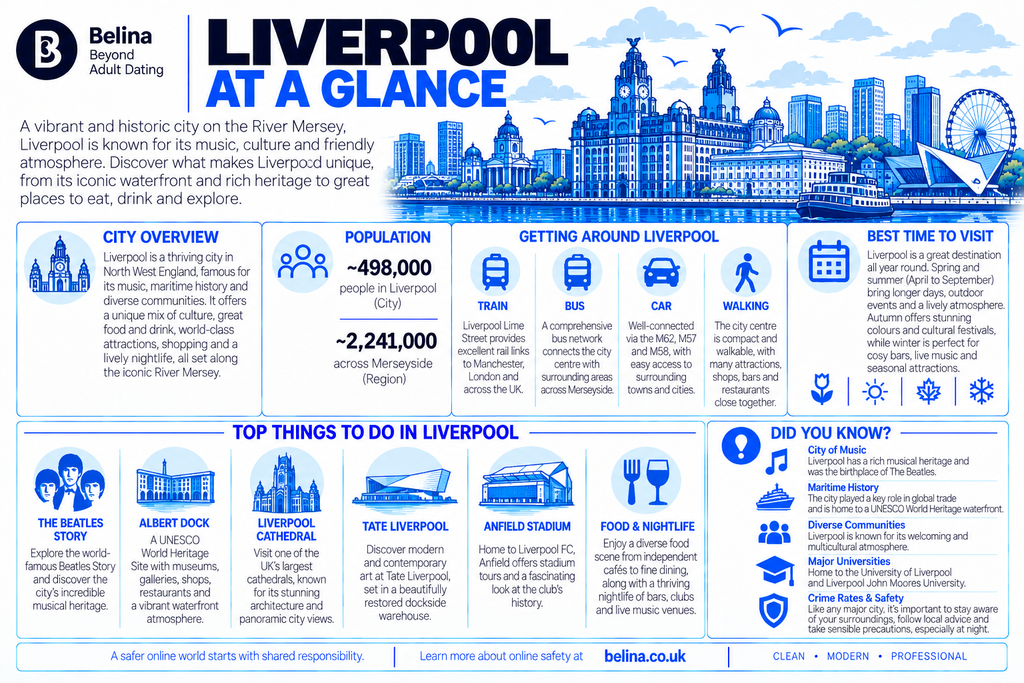
Employment and Education
Source: Total Population UK – Liverpool
- Average salary: approximately £31,933/year
- Average property price: approximately £223,517
- Unemployment: 3.9% (broadly in line with the national average of 3.8%)
- 86.9% of residents hold at least a Level 1 qualification; 7.9% have no qualifications (vs. 6.6% nationally)
- The student population is significant at around 29,800, accounting for 38.7% of the economically inactive working-age population — reflecting Liverpool’s two large universities (University of Liverpool and Liverpool John Moores University)
Crime Rates and Safety
Liverpool’s crime picture is mixed. Although the city has seen meaningful improvements in recent years, it still reports higher rates for some offences than comparable areas. For example, crime levels differ considerably between busy city-centre wards and quieter residential neighbourhoods. Therefore, visitors should consult Police.uk’s local crime information for a more detailed picture of individual areas.
Overall Crime: The crime rate in Liverpool for 2024/25 was approximately 92.7 crimes per 1,000 people, down from 100.8 the previous year — a significant improvement. Total offences recorded by Merseyside Police across the force area in 2024/25 stood at around 135,059. Overall crime across Merseyside fell by almost 8% in 2024, with nearly 9,000 fewer crimes compared to 2023.
Notably:
- Residential burglary dropped more than 20% (April–December 2024 vs. the same period the prior year)
- Vehicle crime fell by over 22%
- Road traffic collisions reduced by more than 9%
- Anti-social behaviour fell by nearly 4% across the 25 hotspot areas
Most Common Crime Types
Source: CrimeRate – Liverpool & CrimeTrends UK
- Violence and sexual offences are the most common category, with over 25,000 offences recorded — approximately 1.4 times the national average per 1,000 people
- Drug offences are notably elevated: a crime rate of ~13 per 1,000, roughly 4.2 times the national average
- Public order offences run at approximately 11 per 1,000 people
- Theft from the person is the least common crime category
Geographic Variation
There is a stark contrast between the safest and most dangerous areas of the city. The Central ward records the highest crime counts (over 2,100 offences in a recent period), while Woolton in the southern suburbs records among the lowest. The nightlife districts — Ropewalks, Concert Square, Mathew Street — naturally see elevated evening crime, predominantly public order and theft offences. Suburban areas like Woolton, Allerton, and Mossley Hill are considerably safer. For a street-level breakdown, see Police.uk – Compare your area.
Liverpool Escorts and Nightlife
Liverpool’s nightlife draws visitors to its music venues, waterfront restaurants and late-night districts. For instance, Concert Square and Ropewalks offer busy bars and clubs, while Mathew Street is associated with the city’s live-music history. Meanwhile, Albert Dock provides a different setting for evening dining. Visitors can consult VisitLiverpool for local attractions and event information.
Key Nightlife Districts
Concert Square / Ropewalks The beating heart of Liverpool’s nightlife. Concert Square is surrounded by bars, beer gardens, and clubs including McCooley’s, Soho, and Einstein Bier Haus. The Ropewalks area extends out with dozens of bars, late-night venues, and clubs catering to every taste.
Mathew Street The “soul of the city” for music lovers. Home to the world-famous Cavern Club — where The Beatles famously played — as well as a string of bars and pubs that keep the live music tradition alive.
Albert Dock A more refined, scenic setting along the waterfront. Excellent for early-evening dining and drinks with waterfront views before moving into the city centre.
Baltic Triangle Liverpool’s creative and cultural quarter. Home to Camp and Furnace (one of the city’s top event spaces, hosting club nights, live music, and events like Bingo Lingo), Baltic Market (street food and bars in an industrial warehouse setting), and a growing cluster of independent bars and creative venues.
Notable Venues
- Cavern Club – Iconic live music, seven nights a week
- Camp and Furnace – Eclectic club nights and events
- Electrik Warehouse – Three floors of rave, rock, and indie
- Elysium – Top DJs, live sports, quality sound system
- INK Bar – R&B and house music
- Roxy Ball Room – Competitive gaming (bowling, beer pong, arcades) meets nightlife; three city centre venues
- Pins on Duke Street – Bowling, karaoke, and a rooftop bar
Independent Escorts — Research-Based Estimate
No official figure exists for the number of independent escorts operating in Liverpool. This group is not registered or tracked by any government body. Therefore, the following is a reasoned estimate. It is built by combining (cross-referencing) national research data with Liverpool’s population, in line with the methods used by academics studying hard-to-count populations.
National Baseline
Estimates of the total number of sex workers in the UK range from 72,800 to 105,000. The upper figure reflects growth driven by the cost-of-living crisis. Meanwhile, the English Collective of Prostitutes puts the current UK total at approximately 100,000. Furthermore, a 2025 ResearchGate analysis that combines several research methods arrives at a central estimate of 102,000. For this guide, a working figure of 100,000 is used.
Population Proportioning
Liverpool’s population of ~509,000 makes up approximately 0.75% of the UK’s ~68 million. A straight population share would therefore give around 750 sex workers in the city. However, sex work tends to concentrate in urban areas with port histories, active night economies, and higher levels of deprivation. Liverpool has a long record of prostitution, historically rooted in its seafaring economy. As a result, applying a conservative urban uplift of 1.3–1.5× — consistent with how researchers treat UK port cities — gives a range of approximately 975–1,125 total sex workers in Liverpool.
Indoor vs Street Split
According to National Ugly Mugs, sex workers are ten times safer working indoors than on the streets. Consequently, the indoor sector accounts for an estimated 80–85% of all UK sex work. Applying that proportion to Liverpool gives an indoor estimate of approximately 780–955 individuals.
It is important to distinguish between selling sexual services and public solicitation, because UK law treats them differently:
- Selling sexual services in private is not itself illegal.
- Soliciting for sexual services in a street or public place is illegal.
- Loitering or persistently soliciting in a street or public place for the purposes of prostitution is also an offence.
The relevant legislation includes:
- Section 51A of the Sexual Offences Act 2003 (inserted by the Policing and Crime Act 2009): makes it an offence for a person in a street or public place to solicit another person for the purpose of obtaining that person’s sexual services as a prostitute (commonly known as kerb crawling).
- The Street Offences Act 1959 (as amended): makes it an offence for an adult to persistently loiter or solicit in a street or public place for the purposes of prostitution.
Independent vs Managed
Of those working indoors, academic research and sector organisations estimate that 50–70% work independently — meaning one person, from one premises. This is the legally permissible model under the Sexual Offences Act 2003, as opposed to working through agencies or informal multi-person arrangements. Applying 60% as a midpoint therefore produces the following estimates:
| Basis | Estimate |
| Low end | ~400 |
| Central estimate | ~500 |
| High end | ~600 |
Of those, 88% of UK sex workers are women, 6% men, and 4% transgender. This suggests approximately ~440 female independent escorts within the central estimate. In addition, this is a snapshot figure — the population shifts frequently, with notable turnover throughout the year.
The Merseyside Model
Liverpool is widely regarded as one of the safer UK cities for sex workers. In 2006, Merseyside Police became the first force in the UK to classify crimes against sex workers as hate crimes, which resulted in a significantly higher conviction rate for offenders. Furthermore, the Armistead Project — run by Mersey Care NHS — provides front-line support including condoms, referrals to needle exchange services, and routes out of sex work for those who want them.
This estimate should be treated as an informed approximation only, not a verifiable statistic.
Healthcare and Emergency Services
Liverpool has several major NHS hospitals serving different medical needs. In particular, the Royal Liverpool University Hospital and Aintree University Hospital provide emergency care, while specialist hospitals serve children and other patient groups. However, services differ by location. As a result, anyone seeking urgent but non-life-threatening guidance should consult NHS 111; call 999 in a life-threatening emergency.
Policing in Liverpool is the responsibility of Merseyside Police, under Police and Crime Commissioner Emily Spurrell (Labour). Key police stations serving the city include:
- Liverpool City Centre Police Station — Canning Place, L1 (the primary city-centre station)
- Admiral Street Police Station — Toxteth/south Liverpool
- Wavertree Police Station — serving the eastern inner city
- Norris Green Police Station — north Liverpool
- Allerton Police Station — south Liverpool
In an emergency, always dial 999. For non-emergency policing matters, call 101. You can also report crime online via Merseyside Police.
Transport Across Merseyside
Liverpool has extensive rail, bus and road connections across Merseyside and beyond. In addition, Merseyrail links central Liverpool with surrounding communities, while Lime Street serves many longer-distance journeys. For route planning, travellers can use Merseytravel and check services before departure.
Rail
- Liverpool Lime Street — the main intercity terminus, with direct services to London Euston (~2 hrs), Manchester, Birmingham, Leeds, and beyond via Avanti West Coast, Transpennine Express, and Northern
- Liverpool Central — underground station serving the Northern and Wirral Lines
- Liverpool James Street — Wirral Line services
- Liverpool South Parkway — southern gateway with connections to Manchester Airport
- Merseyrail — the electrified urban rail network, running across the city region with frequent services and flat-fare integrated ticketing
A record £1.6 billion investment in city-region transport was announced in December 2025, including new rail stations, rapid transit links, and smart ticketing across the entire network.
Bus
Merseytravel operates an extensive bus network. A city-wide maximum £2 single fare applies across all operators within the region, significantly reducing the cost of travel.
Ferry
The iconic Mersey Ferry runs from Pier Head to Woodside (Birkenhead) and Seacombe on the Wirral, operating daily as both a commuter service and a tourist attraction. Isle of Man ferry services also depart from the Pier Head terminal.
Airport
Liverpool John Lennon Airport (LPL), approximately 8 miles south of the city centre, serves a wide range of European and domestic destinations. Direct bus (the 80A and 86A) and taxi services connect the airport to the city centre. Manchester Airport (approximately 35 miles away) provides significantly more long-haul options and is accessible by rail via Liverpool South Parkway.
Road
Liverpool sits at the intersection of major motorways:
- M62 — east to Manchester, Leeds, and Hull
- M57/M58 — orbital routes around the city
- A5036 — to the port at Seaforth Docks (Liverpool2 deep-water terminal)
The Mersey Tunnels (Queensway and Kingsway) link Liverpool to the Wirral.
Active Travel
The city centre is compact and walkable. A cycle hire scheme operates across the centre, and the £50m+ city centre connectivity programme has improved walking and cycling routes, particularly along the waterfront and through the Knowledge Quarter. See Liverpool City Council’s transport masterplan for upcoming improvements.
Local Government and Politics
Liverpool is one of the most consistently Labour-dominated major cities in the UK.
City Council
Liverpool City Council operates on a leader-and-cabinet model (the directly elected mayoralty was abolished after the 2023 elections). The council has 85 seats, currently dominated by:
- Labour: 59 seats (administration)
- Liberal Democrats: 13 seats
- Green Party: 4 seats
- Liberal: 3 seats
- Your Party: 3 seats
- Independent: 3 seats
The Council Leader is Liam Robinson (Labour), in post since May 2023. The Lord Mayor (a ceremonial role) is currently Barbara Murray (Labour), appointed May 2025. The council meets at the historic Town Hall on High Street. Source: Liverpool City Council – Wikipedia
Liverpool City Region
At the regional level, Steve Rotheram (Labour) serves as Mayor of the Liverpool City Region Combined Authority, having been re-elected for a third term in May 2024. The Combined Authority brings together Liverpool, Knowsley, Sefton, St Helens, Wirral, and Halton.
National Politics
At Westminster, Liverpool’s parliamentary constituencies return predominantly Labour MPs. The city’s working-class roots, trade union history, and experience of Thatcherite deindustrialisation in the 1980s have cemented a strong left-of-centre political identity that spans generations.
Background: Governance Reform
Liverpool attracted national attention when, in 2021, an independent government inspection found serious governance failures at the council. This led to the appointment of government commissioners to oversee council functions — a process that formally concluded once reforms were implemented. The city has since returned to full democratic self-governance.
Tourism and Cultural Attractions
Liverpool attracts visitors through its music heritage, museums, football culture and waterfront architecture. For example, Albert Dock provides access to cultural venues, while Mathew Street remains closely linked to The Beatles. Furthermore, the city’s museums and galleries cover maritime history, visual art and local identity. The official VisitLiverpool guide provides further visitor information.
Key Attractions
The Royal Albert Dock A UNESCO World Heritage Site and the jewel of Liverpool’s waterfront. The stunning Grade I-listed complex of Victorian warehouses now houses museums, galleries, restaurants, shops, and bars. It is the starting point for most visitors’ exploration of the city.
The Beatles Story Located at the Albert Dock, this is the world’s largest permanent exhibition dedicated to the Fab Four. Fully immersive and popular with visitors of all ages.
Mathew Street & the Cavern Club The spiritual home of Merseybeat, where The Beatles performed almost 300 times. The Cavern Club continues to host live music daily.
Merseyside Maritime Museum Also at the Albert Dock, this free museum explores Liverpool’s incredible maritime heritage — from its role in the transatlantic slave trade (which it confronts directly) to the Titanic connection and the city’s commercial shipping history.
International Slavery Museum Part of the Maritime Museum (third floor), this is one of the most important museums in the world addressing the history and legacy of the transatlantic slave trade.
Museum of Liverpool A free, modern museum on the Pier Head chronicling the history, culture, and identity of the city and its people.
Tate Liverpool The northern outpost of the national Tate gallery network, hosting major exhibitions of modern and contemporary art.
Anfield Stadium Tour & Goodison Park Liverpool FC’s iconic Anfield stadium (currently being expanded) and Everton FC’s historic Goodison Park are major draws for football tourism.
Liverpool Cathedral & Metropolitan Cathedral Two extraordinary cathedrals sit at either end of Hope Street. Liverpool Anglican Cathedral is the largest cathedral in the UK; the Metropolitan (“Paddy’s Wigwam”) is a striking modernist landmark.
The Three Graces (Pier Head) The Royal Liver Building, Cunard Building, and Port of Liverpool Building form one of the most iconic waterfront skylines in Europe.
Practical Information for Visitors
- Best time to visit: Year-round, with spring (April–June) offering good weather for outdoor exploration
- Getting around: The compact city centre is very walkable; Merseyrail and buses cover wider attractions efficiently
- Free attractions: Many of Liverpool’s world-class museums (Museum of Liverpool, Merseyside Maritime Museum, International Slavery Museum, Walker Art Gallery, World Museum) are free of charge
- Liverpool Tourist Pass: Available for visitors planning multiple paid attractions — see VisitLiverpool for details
- Accommodation: A wide range of hotels and serviced apartments spans the city centre, Albert Dock, and surrounding areas, catering to all budgets
- Local food: Try Scouse — the hearty lamb or beef stew that gave Liverpudlians their nickname — in a traditional pub
Conclusion
Liverpool is a city of compelling contrasts. It carries the weight of a turbulent industrial past — deindustrialisation, economic decline, governance failures — yet meets that history with a resilience and civic pride that is palpable at street level. Its demographics are young and diversifying, its crime picture is improving meaningfully, and its cultural offer rivals any city in the UK outside London.
For visitors, it is affordable, walkable, and extraordinarily well-provisioned with free world-class museums, a vibrant waterfront, and a nightlife scene that genuinely lives up to its reputation. For residents and workers alike, the picture is more nuanced — strong public infrastructure and improving safety sit alongside persistent deprivation, below-average wages, and drug-related crime that remains a significant challenge.
What sets Liverpool apart from comparable northern English cities is character. Nowhere is this more evident than in its treatment of independent escorts and sex workers. The pioneering Merseyside Model — unique in the UK — classifies crimes against sex workers as hate crimes, producing conviction rates and a policing culture that prioritises safety and dignity over criminalisation. Combined with the Armistead Project’s dedicated outreach services and the city’s exceptional hospital network, Liverpool offers an environment where an estimated 500 independent escorts can operate under the Sexual Offences Act 2003 with greater practical safety and institutional support than almost any comparable UK city.
With £1.6 billion of transport investment committed, a rebuilt Royal Liverpool University Hospital operational, and a City Region mayor with a clear growth agenda, the trajectory is positive. Liverpool is not a city that has finished becoming what it is going to be — and for all of its communities, that is cause for optimism.
Frequently Asked Questions
Liverpool offers several popular places to meet singles, including Concert Square, the Baltic Triangle, Ropewalks and the Albert Dock waterfront. These areas feature bars, restaurants, live music and social venues. Alternatively, organised speed-dating events, community groups and cultural activities provide opportunities to meet people outside traditional nightlife. Visit the official Liverpool events guide for upcoming activities.
Tinder, Bumble, Hinge and Facebook Dating offer free ways to connect with potential partners, although features and restrictions differ. Facebook Dating is a free option for eligible Facebook users, while other services offer optional paid subscriptions. The most suitable platform depends on location, age preferences and relationship intentions.
Tinder is among the most widely used dating apps in the UK, alongside Hinge and Bumble. According to Ofcom’s online dating research, Tinder reached approximately 1.9 million UK adults in May 2024. However, reliable Liverpool-specific rankings are unavailable, so national popularity does not establish which app leads locally.
The 333 rule is an informal dating guideline, although its meaning varies between sources. One interpretation recommends exchanging three messages, allowing three days for a response and evaluating communication before investing further effort. It is not an official dating-app policy, and genuine connections depend more on mutual interest, communication and respect than fixed numerical rules.
Tinder, Feeld and other adult dating platforms are commonly associated with casual dating. However, their audiences and features differ, and no platform guarantees a suitable match. Adults seeking casual connections should communicate their intentions clearly, respect consent and protect their personal information.