

Fake Weight Loss Injections Worth £2 Million Seized in Birmingham Raid


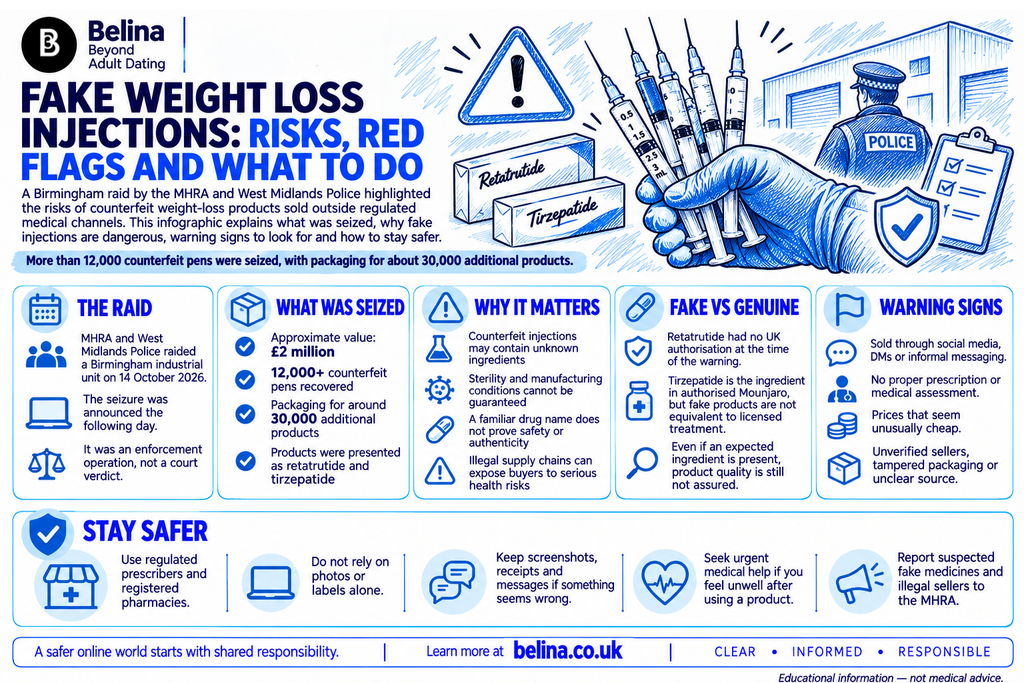
Fake weight loss injections worth approximately £2 million were the target of an MHRA and West Midlands Police raid on a Birmingham industrial unit on 14 October 2026. Officers seized more than 12,000 counterfeit pens and packaging for around 30,000 additional products.
- Medicines and Healthcare products Regulatory Agency (MHRA)
The MHRA announced the seizure the following day. Its warning focused on products presented as retatrutide and tirzepatide, their unknown quality and the criminal trade supplying them. This article examines the operation, earlier enforcement action and the differences between counterfeit products and legitimate prescribed treatment.
Key Takeaways
- Officers seized more than 12,000 counterfeit pens during the Birmingham raid.
- The MHRA valued the seized weight loss medicines at approximately £2 million.
- Packaging represented around 30,000 further products, not 30,000 filled pens.
- Retatrutide lacked UK authorisation at the time of the MHRA warning.
- A genuine ingredient does not establish a counterfeit product’s sterility.
- The MHRA accepts reports about suspected fakes and illegal online sellers.
Fake Weight Loss Injections
The Birmingham operation targeted an industrial premises rather than a clinical service. MHRA enforcement official Tim Duffield described the warehouse as filthy and warned that investigators could not guarantee the contents or exclude harmful contamination.
The distinction between finished products and packaging is important. Officers recovered more than 12,000 pens; the packaging suggested capacity for further products. Adding those figures together and describing them as completed injections would misrepresent the announcement.
Likewise, the £2 million figure represents the regulator’s approximate valuation. It does not establish the number of patients who received fake weight loss injections, the amount customers paid or the profits of a named defendant.
The release does not name suspects or announce charges arising from this particular raid. It describes an enforcement seizure, not a court verdict.
Retatrutide and Tirzepatide
The two drug names in the announcement do not share the same regulatory position. The MHRA explicitly warned that retatrutide had no UK authorisation and that suppliers selling it outside legitimate clinical trials acted illegally.
Tirzepatide, by contrast, is the active ingredient in Mounjaro. The MHRA authorised Mounjaro for adult weight management in November 2023, with defined eligibility criteria and use alongside dietary and activity changes.
That authorisation covers an assessed medicinal product. It does not extend to anything bearing the word “tirzepatide”. An unauthorised manufacturer cannot borrow a licensed medicine’s safety evidence simply by printing its ingredient name on a box.
The Birmingham announcement also does not establish that every seized pen contained the substance its label claimed. Readers should therefore distinguish the advertised identity of a product from laboratory confirmation of its contents.
This distinction explains why fake weight loss injections cannot serve as equivalent substitutes for prescribed medicines. A familiar drug name provides no independent assurance about manufacture, strength or quality.
Earlier Enforcement Operations
The Birmingham raid followed several earlier MHRA operations. Together, the announcements document enforcement against manufacturing and distribution, rather than isolated misleading advertisements.
Northampton warehouse
In October 2025, the agency reported dismantling an illicit production facility in Northampton. Officers recovered empty pens, chemical ingredients, manufacturing equipment and finished products. They also seized approximately £20,000 in cash suspected of links to medicines trafficking.
That announcement described a suspected production operation. Equipment, packaging and stock gave investigators evidence beyond the appearance of a single pen.
February searches
In February 2026, the MHRA reported searches of two premises and the recovery of almost 2,000 doses awaiting dispatch. Officers also seized suspected pharmaceutical ingredients, packaging, manufacturing equipment and commercial vehicles.
The agency linked that investigation to its earlier enforcement work. However, the public announcements do not justify assuming that every later seizure involved the same suspects or distribution chain.
May arrests
On 28 May 2026, officers raided an estate near Northampton and recovered around 12,000 doses of unlicensed weight-loss medicines. They arrested two men on suspicion of offences under the Human Medicines Regulations 2012. The following day’s announcement stated that enquiries continued.
Arrests establish neither guilt nor a completed prosecution. These reports nevertheless show why the investigation of fake weight loss injections extends upstream to premises, equipment and supply networks.
A Separate Pharmacy Alert
A different MHRA warning on 24 February 2026 concerned potentially counterfeit Mounjaro pens supplied by The Private Pharmacy Clinic in Birmingham. The regulator contacted certain patients as a precaution.
The warning identified 15mg pens bearing batch number D873576. That number legitimately belonged to genuine 7.5mg pens; the notice did not implicate those genuine 7.5mg products.
Tests found tirzepatide in the identified counterfeit pens. However, the MHRA could not confirm sterility because it did not know the manufacturing conditions. At publication, the regulator reported no patients requiring treatment after using the identified fakes.
This alert demonstrates a specific point about fake weight loss injections: finding the expected ingredient does not establish acceptable quality. Injection products also require appropriate manufacturing standards.
The February patient alert and October warehouse raid are separate announcements. Their shared Birmingham location does not establish a connection between the pharmacy and the later seizure.
Packaging and Product Quality
MHRA guidance on GLP-1 medicines warns that counterfeit pre-filled pens can closely resemble licensed products. It also warns about unauthorised powders sold in vials for mixing before injection.
Consequently, judging fake weight loss injections by a photograph has serious limits. A clear label does not demonstrate sterility. A professional-looking box does not prove that the seller obtained stock through a legitimate supply chain.
Nor does a side effect establish authenticity. Nausea, appetite changes or a lack of noticeable effects cannot identify the substance inside a pen. A product’s apparent effect and its manufacturing quality are different questions.
The February alert illustrates the problem with treating batch numbers as universal reassurance. Investigators identified a genuine number on counterfeit pens of a different strength. The combination of product, strength and supply information determined the scope of that warning.
Online Advertising Scrutiny
The investigation of fake weight loss injections sits alongside a separate regulatory concern: advertising prescription-only medicines to the public.
The Advertising Standards Authority’s guidance, updated in May 2026, explains that the prohibition covers social media marketing, including relevant influencer and affiliate promotions. A popular post does not become acceptable merely because it resembles a personal recommendation.
The ASA also reported that some consumers interpreted weight-loss treatment adverts as invitations to purchase rather than seek a medical consultation. Some did not understand that the injections required prescriptions.
These advertising issues do not prove that a promoted product is counterfeit. A legitimate provider can breach advertising rules, while a criminal seller can imitate legitimate branding. Reporting should keep those distinctions intact.
The MHRA investigates medicine safety and illegal supply; the ASA addresses advertising standards. Their work concerns different parts of the same information environment, where promotional claims can reach people before balanced clinical advice does.
What Remains Unknown
The published account of the Birmingham raid leaves important questions unanswered. It does not disclose a full laboratory analysis, the number of customers supplied, or a patient-by-patient assessment of harm. It also does not identify every website or social account associated with the seized stock.
Those gaps limit the conclusions readers can draw about fake weight loss injections from this operation. The seizure establishes the recovery of products described by the regulator as counterfeit; it does not support an invented death toll or a claim that every pen contained a particular contaminant.
Packaging quantities likewise cannot measure the size of the entire illegal market. They describe one operation’s recovered materials. Broader estimates would need evidence about other suppliers, sales and distribution.
Further announcements may clarify the investigation. Until then, the distinction between confirmed findings, suspected offences and unanswered questions remains essential to accurate coverage.
Genuine Medicines and Risks
Counterfeiting is not the only medicine-safety issue, but it should not obscure the benefits and known risks of legitimate treatment. Prescribers assess those risks against a patient’s circumstances.
In January 2026, the MHRA strengthened pancreatitis warnings for GLP-1 medicines and dual GLP-1/GIP medicines. The update highlighted rare reports of severe cases, including necrotising and fatal pancreatitis.
In February, it also warned about a very rare association between semaglutide and NAION, an eye condition that can cause vision loss.
Those warnings concern recognised medicines and ongoing safety monitoring. They do not establish the contents of fake weight loss injections, and the October raid does not justify describing all prescribed treatment as counterfeit or unsafe.
The distinction also applies to brand names. Ozempic and Wegovy contain semaglutide, while Mounjaro contains tirzepatide. Their authorised uses and prescribing requirements are not interchangeable.
Getting Medical Help
Anyone concerned about fake weight loss injections should contact a pharmacist or prescriber before using the suspect product. Keep the packaging and explain where it came from. Do not attempt to repair a faulty pen or extract its contents.
Seek urgent medical attention for signs of infection or a serious reaction after an injection. Call 999 for breathing difficulties, collapse or other life-threatening symptoms. Severe persistent abdominal pain needs immediate assessment; sudden loss of vision needs urgent eye casualty or A&E care.
A person taking a genuine prescribed medicine should not stop solely because an unrelated counterfeit seizure appears in the news. Discuss concerns with the treating clinician and follow any specific safety alert that applies to the actual product.
Reporting Suspected Products
The MHRA provides separate reporting routes for fake weight loss injections and suspected sellers:
- Use Yellow Card for suspected side effects, counterfeit products or defective medicines.
- Use the suspicious online seller service for websites or social accounts that may supply medicines illegally.
- Check the Not Recommended list for websites the MHRA has flagged.
The seller-reporting service accepts anonymous reports. Relevant details can include the website address, account name, packaging photographs and purchase messages. Absence from a warning list does not certify a seller as legitimate.
Reporting supports regulatory investigation; it does not replace medical care. Yellow Card cannot provide an individual diagnosis or emergency treatment.
Conclusion
The Birmingham seizure exposes a supply problem with fake weight loss injections: recognisable drug names and convincing packaging can accompany products outside regulated manufacture. The confirmed evidence concerns counterfeit stock and an enforcement operation, not every person receiving legitimate treatment.
For independent escorts and sex workers, the relevance is access to accurate health information and appropriate care, as for any other adult. The story provides no evidence that this occupation caused exposure to the seized products. Belina’s online safety guide offers related guidance on suspicious online approaches, while medical decisions belong with qualified healthcare professionals.
Anyone who suspects a counterfeit should seek advice about the product and report it through the MHRA’s appropriate route. Clear evidence, prompt care and accurate reporting provide a stronger response than fear or speculation.
Frequently Asked Questions
What does going off Ozempic or Wegovy do to your body?
Appetite can increase and weight can return as the medicine’s effects diminish. In the STEP 1 extension study, participants who had taken semaglutide regained about two-thirds of their previous weight loss during the following year. The study also stopped lifestyle support, involved a subset of 327 participants and excluded diabetes. It does not predict every patient’s outcome. People using Ozempic for diabetes also need a plan for blood-glucose management.
What is a cheaper alternative to Mounjaro?
Options may include orlistat or another prescribed weight-management treatment, depending on suitability and local access. The NHS explains that these medicines work differently; a cheaper medicine is not automatically an equivalent replacement. Discuss affordability with the prescriber before changing treatment. Fake weight loss injections and products sold without appropriate authorisation do not provide a safe substitute.
How much is Mounjaro at Boots?
Boots Online Doctor’s published prices, checked on 2 November 2026, list £179 for 2.5mg, £199 for 5mg, £259 for 7.5mg, £299 for 10mg, £319 for 12.5mg and £339 for 15mg. Its treatment listing describes these as single-pen packages. Prices can change, and prescribing requires clinical assessment. A prescriber determines the appropriate strength; price alone should not determine a dose.
What happens when you stop taking GLP-1?
The outcome depends on the medicine and reason for treatment. Appetite suppression can lessen, weight may return and blood glucose may rise in someone receiving diabetes treatment. The NHS recommends support after stopping weight-loss medicines. Discuss a treatment and follow-up plan with the prescribing clinician rather than replacing a prescribed product with an unverified alternative.
Why are people stopping Wegovy?
People can stop for different reasons, including side effects, cost, pregnancy planning, treatment response or a clinician’s advice. These reasons do not establish a single nationwide trend. The patient leaflet advises discussing treatment changes with a doctor and identifies symptoms that require urgent action. Reports of individual experiences cannot show how commonly each reason occurs across all patients.
Can you smell when someone is on Ozempic?
There is no reliable smell test that identifies someone’s use of Ozempic. Semaglutide can cause gastrointestinal symptoms, including burping or reflux, but many conditions and foods can cause similar symptoms. An odour cannot establish medication use, dose or the authenticity of a product. Persistent or concerning symptoms deserve a medical assessment rather than assumptions about another person’s treatment.
Can Wegovy do permanent damage?
Rare serious complications can cause lasting harm. MHRA warnings include severe pancreatitis and the very rare eye condition NAION, which can cause lasting vision loss. This does not mean most patients experience permanent injury. Seek urgent medical attention for severe persistent abdominal pain; sudden vision loss or rapidly worsening eyesight requires urgent eye casualty or A&E assessment.
What is the poor man’s alternative to Ozempic?
That phrase has no medical definition. Online discussions sometimes apply similar labels to supplements such as berberine, but they are not equivalent to semaglutide. The US National Center for Complementary and Integrative Health describes inconclusive weight-loss evidence and potential medicine interactions. A clinician can discuss lower-cost, evidence-based options appropriate to the condition requiring treatment.
Why do I feel so good on Wegovy?
Some people may feel better as appetite control or weight-related health improves, but that explanation cannot establish the cause of an individual’s experience. Wegovy is not a treatment for euphoria or a general mood enhancer. Discuss marked or unusual mood changes with a clinician, especially alongside major sleep changes or impulsive behaviour. Feeling good also cannot confirm that an unverified product is genuine.