Ofcom CSAM Requirements: Tighten for the Detection and Prevention of Child Sexual Abuse Material

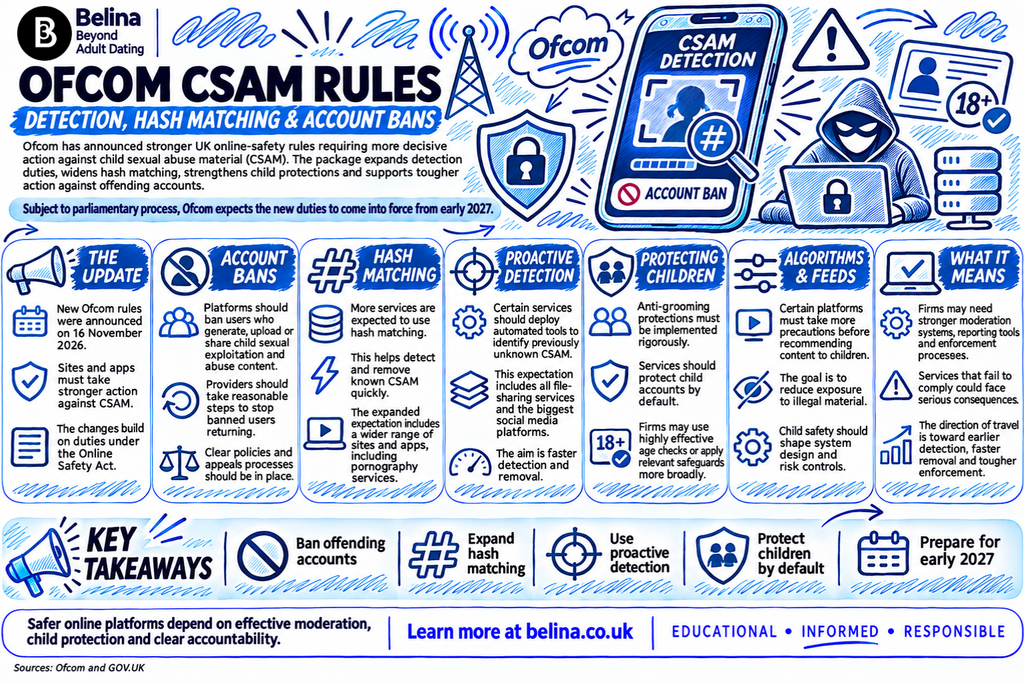
Ofcom CSAM requirements will expand how regulated online services detect child sexual abuse material and restrict accounts involved in its distribution. On 16 November 2026, the regulator announced additional measures covering known abuse images, previously unidentified material and users who generate or circulate child sexual exploitation content.
The measures build on existing Online Safety Act duties. However, they do not all take effect immediately: Ofcom expects the new requirements to begin in early 2027, subject to the parliamentary process. Their application will depend on each service’s size, functions and assessed risks. ofcom.org.uk
Key Takeaways
- Ofcom will expand detection measures for child sexual abuse material.
- Requirements differ according to service size, functions and assessed risks.
- Account bans will target users involved in child sexual exploitation.
- Detection systems need safeguards against errors and wrongful restrictions.
- Users can report concerns to platforms, police and specialist organisations.
What Ofcom Announced
The package strengthens Ofcom’s Illegal Content Codes of Practice. It addresses three connected problems: the continued circulation of known abuse material, the appearance of previously unidentified images and the ability of people involved in exploitation to retain or replace their accounts.
Platforms already need to assess the risk of child sexual abuse material appearing on their services and take proportionate steps to address it. Those steps can include moderation, reporting processes, removal procedures and detection technology.
The new package goes further. Ofcom wants relevant services to identify more material proactively and take stronger action against the accounts responsible.
However, the announcement does not impose an identical technical system on every website. Different recommendations apply to different services. The detailed codes establish those distinctions. Additional Safety Measures
How Compliance Works
Ofcom’s codes describe measures that providers can follow to meet the relevant legal duties. When a provider follows the applicable recommendations, it receives the compliance protection attached to those measures.
Alternatively, a provider can adopt different measures that fulfil the statutory duties. It must document that approach and explain how its safeguards achieve compliance.
Consequently, choosing another technical system does not remove the obligation to address identified risks.
Providers must also consider privacy and freedom of expression. A detection system can identify illegal material while still creating problems if it repeatedly removes lawful content or restricts accounts incorrectly.
The legal framework also requires providers to review their risk assessments. Relevant changes to a service can alter the risks it presents. Introducing new upload, discovery or communication functions can therefore require further assessment.
The central requirement concerns effective, proportionate protection rather than adopting technology without evaluating its performance. ofcom.org.uk
Detecting Known Images
Hash matching helps services recognise abuse material that specialists have already identified.
A hash acts as a digital fingerprint. A platform compares content against records of known illegal material and uses a match to support its moderation response.
The Internet Watch Foundation maintains an analyst-verified image hash list. Participating organisations can use that information to identify previously confirmed abuse images and prevent further circulation.
This approach reduces reliance on users discovering and reporting each copy individually. However, a known-content database cannot, by itself, identify every new abuse image. Material that has not entered the database presents a different detection problem. iwf.org.uk
The expanded Ofcom CSAM requirements extend hash-matching recommendations to specified services with a high risk of image-based abuse material. These include services above the relevant user threshold, file-storage or file-sharing services, and services whose principal purpose involves regulated pornography. ofcom.org.uk
Finding Unknown Material
Ofcom also addresses image-based child sexual abuse material that existing hash databases do not recognise.
Its proactive-technology code recommends text-matching technology or application-specific machine learning where technically feasible. These tools can help identify material that lacks a previously recorded fingerprint.
The relevant recommendations concern publicly communicated, regulated user-generated content that UK users can encounter. They do not establish a blanket requirement to inspect every private or encrypted conversation.
Furthermore, providers must assess the technology before relying on it. Relevant considerations include data quality, accuracy, bias, testing, maintenance and safeguards against misuse.
Human review and feedback also form part of the framework. An automated alert identifies a potential concern; the provider still needs procedures that support reliable decisions and correct mistakes.
These requirements recognise that detection technology needs continuing assessment. Installing a tool does not establish that it will perform accurately across every type of content or service. ofcom.org.uk
Which Services Qualify
The proactive-detection recommendations distinguish between service size and risk.
They cover:
- Large user-to-user services with a medium risk of image-based CSAM.
- Services with more than 700,000 monthly active UK users and a high risk.
- File-storage or file-sharing services with a high risk.
The code defines a large service as one with more than seven million monthly active UK users.
These thresholds explain why a claim that every website must scan everything would misrepresent the package. The recommendations target defined combinations of scale, functionality and risk.
Nevertheless, falling outside one technical measure’s scope does not remove other online-safety duties. A provider must assess the provisions that apply to its service as a whole.
A business description alone cannot settle that question. Providers need to examine their actual functions, the content users can encounter and the risks their assessments identify. ofcom.org.uk
Bans and Exceptions
The account-banning measure applies across services covered by the user-to-user code. It addresses users who generate, upload or share child sexual exploitation and abuse content. It also covers certain users who receive and view CSAM.
The measure includes safeguards. A provider can decide against banning a recipient who promptly reports the material through an appropriate route and deletes it where possible.
The code also recognises specific circumstances involving children, including grooming. Those exceptions do not make the material lawful.
For adults, bans should normally remain permanent, subject to exceptional circumstances. Providers should address other accounts they reasonably know belong to the banned user and take reasonable steps to prevent renewed access.
These decisions require the relevant assessment of illegality. An unsupported accusation does not automatically establish an offence, and providers need safeguards against incorrect decisions. ofcom.org.uk
Human Review
Detection technology can make mistakes. Ofcom’s guidance therefore emphasises oversight rather than treating every automated result as conclusive.
Providers should consider a system’s performance, error patterns and wider safeguards when deciding how much human review they need.
The prevalence of illegal material also affects the interpretation of results. Even a tool with strong accuracy can produce a significant proportion of incorrect alerts when it examines large volumes of predominantly lawful content.
Ofcom allows providers to remove suspected material temporarily while a reviewer examines it. If the review identifies lawful content, the provider should restore it through the appropriate process.
Accurate review also helps prevent incorrect referrals to law enforcement. Identifying a potential concern and establishing grounds for further action require distinct decisions.
Data-protection obligations continue to apply throughout this work. More extensive detection does not remove the requirement to handle personal information lawfully. ofcom.org.uk
Evidence About AI
AI-generated abuse forms part of the evidence behind the wider regulatory concern.
The IWF’s 2026 report describes material it identified during 2025. It assessed 8,029 AI-generated images and videos as realistic child sexual abuse material that year.
Within that total, it identified 3,443 AI-generated child sexual abuse videos, compared with 13 in 2024.
Those figures need careful interpretation. They describe material that the IWF identified and assessed. They do not measure every image or video across the internet, and they do not establish a complete total for 2026.
Nevertheless, the findings demonstrate the additional detection challenge that newly generated material presents. Services cannot address that challenge solely by recognising previously catalogued images.
The evidence also reinforces the distinction between preventing the recirculation of known material and identifying content that specialists have not previously assessed. iwf.org.uk
Grooming Protections
The package also strengthens protections against grooming.
For the relevant protective measures, services must either use highly effective age assurance to identify children’s accounts or apply the protections to all users.
That distinction gives providers an alternative to identifying each account holder’s age. However, choosing that alternative requires them to extend the relevant safeguards across their users.
The package also addresses recommendations that could expose children to certain illegal content. These measures concern how services distribute and amplify material, alongside what users initially upload.
Therefore, the announcement extends beyond removing individual images. It also addresses contact between accounts and the systems that introduce users to content.
Providers must consider those systems together. Content removal alone cannot address every risk that account access, recommendations or unwanted contact can create. Additional Safety Measures
What Happens Next
The implementation timetable remains an essential qualification. Ofcom expects the additional measures to take effect in early 2027, subject to Parliament.
The regulator also plans further consultation by spring 2027 on specified technologies for tackling a broader range of illegal content. That represents a future policy step rather than a completed requirement.
Separately, Ofcom announced its decision on intimate-image hash matching in May 2026. Readers should distinguish that earlier development from the November CSAM announcement.
These dates separate existing duties, newly announced measures and proposals that still require further consultation or parliamentary scrutiny. ofcom.org.uk
Reporting CSAM
Users should choose a reporting route that matches the concern. Suspected child sexual abuse imagery, grooming and adult intimate-image abuse require different forms of assistance.
Child Abuse Images
Report suspected online child sexual abuse images or videos through the Internet Watch Foundation reporting portal. The IWF accepts anonymous reports and assesses material for removal action.
It also accepts reports involving relevant AI-generated or other non-photographic child sexual abuse imagery.
Provide the webpage address or location of the material. Do not download, save, screenshot or forward suspected CSAM to collect evidence. Do not search for additional examples.
The IWF is a specialist charity, rather than a police force. Its service focuses on abuse imagery. Concerns about an offender contacting or grooming a child require a police or CEOP report as appropriate. iwf.org.uk
Police and CEOP
Call 999 if a child faces immediate danger or a crime requires an emergency response. For non-emergency concerns, contact police through 101 or the relevant force’s online reporting service.
Report online child sexual abuse or grooming concerns through the CEOP Safety Centre. CEOP forms part of the National Crime Agency.
Explain the concern clearly. Useful information can include the platform name, account username, profile address and the nature of the contact.
Follow investigators’ instructions about evidence rather than circulating illegal imagery yourself. An anonymous charity report does not replace an emergency call when someone needs immediate protection. police.uk
Support for Children
A young person under 18 in the UK can use Childline’s Report Remove service for help with sexual images or videos of themselves online.
The service combines Childline support with the IWF’s assessment and removal work. It also covers relevant AI-generated images.
However, it cannot guarantee removal from every location or erase files from another person’s device.
A child who faces threats, coercion or grooming should also contact police or CEOP. Sharing an image under pressure does not remove a child’s right to protection and support. Childline
Adult Intimate Images
Adults in the UK can contact the Revenge Porn Helpline for specialist support with intimate-image abuse. This includes non-consensual sharing, threats to share intimate images and related abuse.
The helpline can explain reporting and removal options. It does not replace a police investigation.
Eligible adults can also use StopNCII.org. The service creates a digital fingerprint on the person’s device and shares that fingerprint, rather than the image, with participating companies.
Its coverage has limits: it cannot remove images from the entire internet. Eligibility also requires the person to have been at least 18 when the image was taken.
Use the child-protection routes for imagery involving someone under 18. Revenge Porn Helpline
Platforms and Ofcom
Use the platform’s reporting function to flag the content or account. Select the relevant category and identify the location of the concern without redistributing illegal imagery.
Users can also raise concerns with Ofcom about a service’s safety measures.
Ofcom uses complaints to inform its regulatory work. However, it does not investigate or resolve individual complaints on a user’s behalf. It cannot provide the immediate response that police or specialist reporting services offer.
Reporting through more than one appropriate route can therefore serve different purposes. A platform report addresses the service’s response, while police and specialist organisations provide investigation, protection or removal assistance. ofcom.org.uk
Conclusion
The Ofcom CSAM requirements strengthen the response to abuse material through wider detection, account restrictions and safeguards against enforcement errors. Their application depends on each service’s functions, risk assessment and relevant legal requirements.
For a user-to-user platform such as Belina, the implications concern clear reporting routes, reliable moderation and documented responses to child-exploitation risks. The announcement does not establish that every technical measure automatically applies to every adult classifieds service.
Independent escorts and other users should report suspected underage activity or exploitation through the appropriate channels without investigating it themselves. Belina’s Help and Support page provides a platform contact route, while its online safety guide explains wider user-to-user safety considerations.
Immediate danger, suspected grooming and illegal imagery also require the relevant external reporting route. A platform report should support that response rather than replace it.
Frequently Asked Questions
How do I report suspected CSAM in the UK?
Report suspected child sexual abuse material (CSAM) through the Internet Watch Foundation (IWF), which accepts anonymous reports of online abuse images and videos. For suspected grooming or exploitation, contact the CEOP Safety Centre or police on 101. Call 999 if a child is in immediate danger. Never download, screenshot or redistribute suspected CSAM.
What are the different types of CSAM?
CSAM includes photographs and videos depicting child sexual abuse, digitally altered or AI-generated abuse imagery, and certain prohibited non-photographic images involving children. It can include material created through coercion, exploitation or abuse. UK law distinguishes between different categories of illegal images, including indecent photographs, pseudo-photographs and prohibited images of children. source.
Is AI-generated child sexual abuse material illegal in the UK?
Yes. AI-generated imagery can constitute illegal CSAM under UK legislation, even where no real child was photographed. Relevant offences include creating, distributing or possessing indecent pseudo-photographs and certain prohibited images of children. The legal classification depends on the material and applicable offence. AI generation does not automatically exempt content from criminal law. source.
Are all UK websites required to detect and remove CSAM?
Regulated online services must assess child sexual abuse risks and implement proportionate safeguards under the Online Safety Act 2023. However, specific detection technologies are not mandatory for every website. Ofcom’s expanded measures target services according to their size, functionality and assessed risks. The additional measures are expected to take effect in early 2027, subject to the parliamentary process. source.
Can an online account be permanently banned for sharing CSAM?
Yes. Ofcom’s strengthened requirements provide for account bans targeting users involved in generating, uploading or sharing child sexual exploitation and abuse content. The measures also address repeat access and include safeguards for exceptional circumstances, such as recipients who promptly report unsolicited material. Adult account bans should normally be permanent, subject to the applicable exceptions and procedures. source.