
UK Pornography Laws 2026: Strangulation and Incest Porn Banned as New Criminal Offences Begin

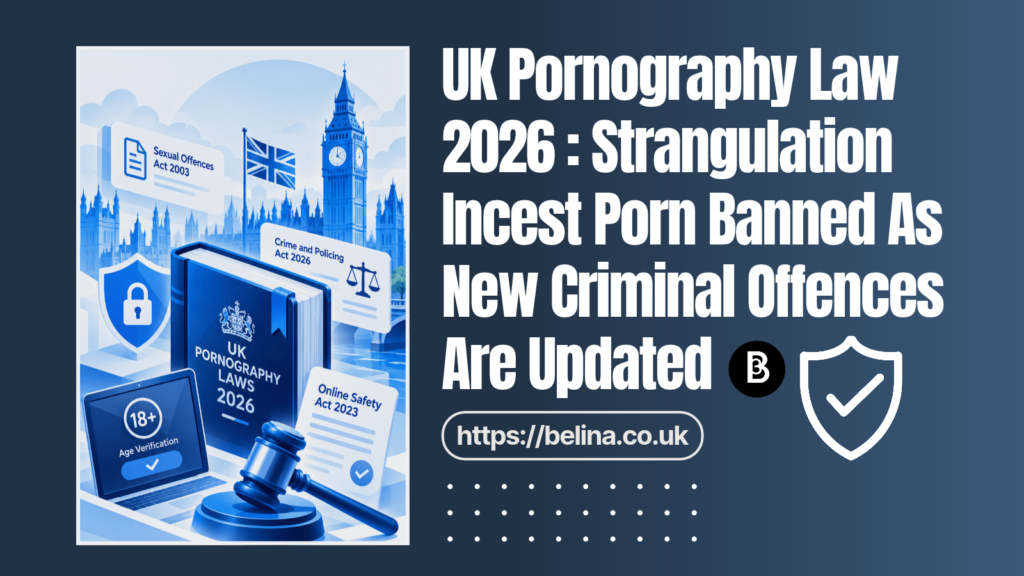
UK pornography laws 2026 introduce important changes to the possession and publication of certain sexual images, alongside existing restrictions on illegal content and stronger age verification requirements for adult websites. From 6 November 2026, new criminal offences will take effect in England and Wales under the Crime and Policing Act 2026.
For many internet users, the distinction between legal adult pornography and prohibited material remains unclear. Age-verification screens, reports of blocked websites and headlines about new criminal offences have added to that confusion.
This guide explains what the law permits, what it prohibits and how the latest changes affect adults, online publishers and user-generated content platforms. It also examines privacy, artificial intelligence, penalties and the differences between the UK’s legal jurisdictions.
Key Takeaways
- Adults can generally watch lawful pornography in the UK without breaking UK criminal laws.
- Since July 2025, relevant adult websites must use highly effective age-assurance measures.
- Criminal offences take effect in England and Wales on 6 November 2026 under new legislation.
- The bans cover specified realistic images of strangulation, suffocation and familial acts.
- Restrictions include realistic sexual images portraying someone as a child younger than 16.
- The offences can cover possessing or publishing realistic images generated using AI tools.
- Maximum prison sentences range from two to five years, depending on the criminal offences.
- Age-verification checks do not make unlawful pornography legal to possess or share online.
Are Pornography Websites Legal?
Pornography itself is not universally illegal in the United Kingdom. Adults can generally access lawful sexually explicit material, although the law restricts certain images and regulates how online services make pornography available.
The distinction matters because accessing a lawful adult website is not the same as possessing or distributing prohibited material.
Several laws operate together, including the Sexual Offences Act 2003, Criminal Justice and Immigration Act 2008 and Online Safety Act 2023.
These laws address different conduct. Some criminalise particular sexual images or activities. Others impose duties on websites, search services and platforms that host user-generated content.
Consequently, a website’s availability on Google does not establish that every image on it is lawful.
Is Watching Pornography Illegal?
For adults, watching lawful pornography is generally legal in the UK.
However, the position changes when someone deliberately obtains, retains or shares images covered by criminal prohibitions. The law can also apply to certain digital files stored on personal devices or online accounts.
A person who encounters questionable material should not assume that its public availability makes possession lawful.
The new November offences make this distinction particularly important because they expressly address specified images that people possess or continue to publish.
Changes In the Online Safety Act 2023?
The Online Safety Act 2023 established a regulatory framework for certain online services accessible in the United Kingdom.
The legislation places duties on in-scope providers to address illegal content and protect children from harmful material. Ofcom oversees and enforces substantial parts of the framework.
The Act distinguishes between services that publish their own pornography and services that allow users to upload content. Both types can face age-assurance obligations, but their precise duties depend on how the service operates.
The legislation does not make all pornography illegal. Instead, it seeks to prevent children from accessing pornographic material and requires regulated providers to manage relevant risks.
Why Do Adult Sites Require Age Verification?
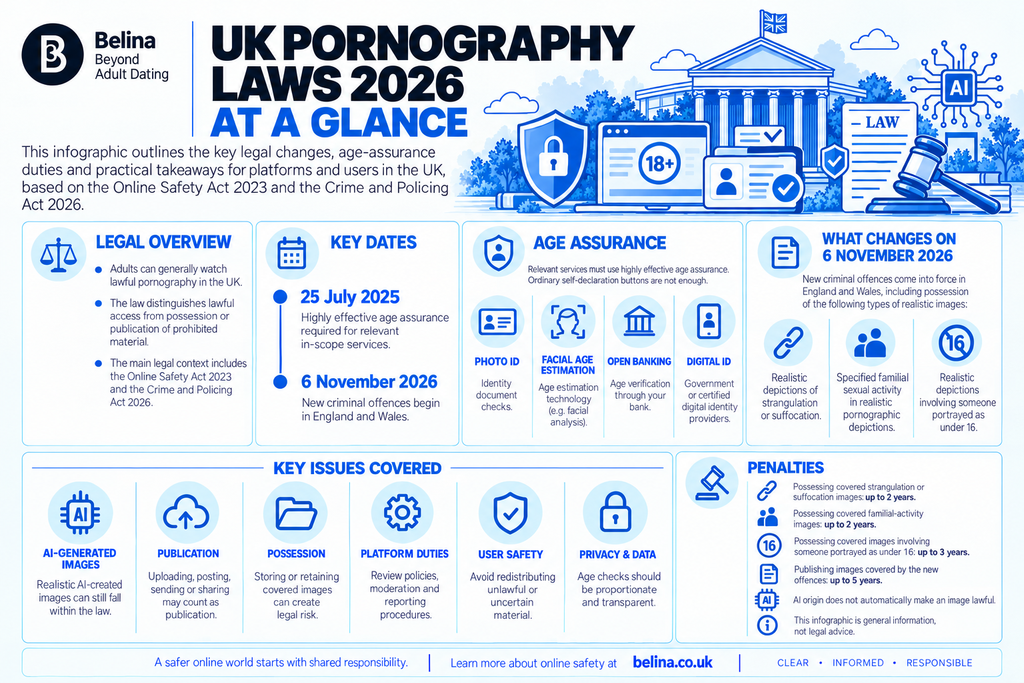
Since 25 July 2025, in-scope user-to-user services that allow pornography have needed highly effective age assurance to prevent children from encountering it. Providers publishing their own pornography also face age-assurance duties under the Act.
Ofcom expects age-assurance systems to establish effectively that a user is an adult before allowing access to relevant pornographic material.
An ordinary age-confirmation button does not meet this standard.
Which Age-Verification Methods Can Websites Use?
Ofcom identifies several methods capable of meeting its requirements when providers implement them correctly:
- Facial age estimation: Analyses facial features to estimate a person’s age.
- Photo-ID matching: Compares an identity document with the person’s photograph.
- Credit card checks: Uses qualifying credit card details to confirm adulthood.
- Open banking: Uses authorised banking information to confirm a person’s age.
- Mobile-network checks: Uses mobile account information to check a person’s age.
- Digital identity services: Uses an identity provider to confirm a person’s age.
Ofcom also recognises other potentially effective methods, including certain email based age estimation systems.
Crucially, Ofcom does not endorse individual age verification companies simply because they offer these technologies.
Providers must assess their systems against the regulator’s standards for technical accuracy, robustness, reliability and fairness.
Source: Ofcom — Age Assurance Duties.
What About Privacy and Personal Data?
Age verification can involve sensitive information, including identity documents, facial images or financial-account information. Organisations must still comply with applicable data-protection requirements, including the UK GDPR and Data Protection Act 2018.
Users should check which organisation processes their information, what it collects, why it needs the data and how long it retains it.
A legitimate age check does not automatically require a website to retain a copy of someone’s passport. Providers should select proportionate methods and explain their processing clearly.
What Pornography Is Illegal in the UK?
The UK pornography laws 2026 build upon existing criminal restrictions rather than replacing them. Several categories of sexual material already attract criminal penalties. The precise offences vary according to the content, the person’s conduct and the relevant UK jurisdiction.
Child Sexual Abuse Material
UK law criminalises specified conduct involving indecent images of children, including making, possessing and distributing such images. In England and Wales, the Protection of Children Act 1978 and Criminal Justice Act 1988 contain important provisions.
The law can also cover certain pseudo-photographs and computer generated material.
These offences are distinct from the new provisions addressing realistic images of adults pretending to be children. Anyone who encounters suspected child sexual abuse material should report it to the Internet Watch Foundation or the police. Do not download, forward or circulate it.
Extreme Pornographic Images
Section 63 of the Criminal Justice and Immigration Act 2008 criminalises possession of certain extreme pornographic images in England and Wales.
The statutory definition requires more than sexually explicit content alone.
It concerns images meeting specified conditions, including their pornographic character, offensive nature and realistic depiction of particular prohibited conduct.
The existing provisions address certain life-threatening acts, serious injury, sexual activity involving corpses or animals, and specified non-consensual sexual conduct.
Not every unconventional adult sexual image automatically satisfies these requirements.
The statutory elements and any applicable defences remain essential to determining the legal position.
Non-Consensual Intimate Images
Sharing someone’s intimate image without their consent can constitute a criminal offence.
The law has evolved through successive reforms, including changes introduced by the Online Safety Act 2023.
Consent to take or create an image does not automatically grant permission to publish it.
Similarly, consenting to share an image with one person does not authorise that person to distribute it publicly.
People affected by intimate-image abuse can seek support from the Revenge Porn Helpline, subject to the service’s eligibility criteria.
Cyberflashing
The Online Safety Act 2023 introduced offences concerning the sending of certain unsolicited genital images. Commonly known as cyberflashing, this conduct can lead to criminal liability when the statutory conditions apply.
The offence reflects the importance of consent in digital communication.
Sending an intimate image without a recipient’s agreement can cause serious distress, even when the sender considers the exchange harmless.
What Changes on 6 November 2026?
The UK pornography laws 2026 introduce three additional categories of prohibited pornographic material under the Crime and Policing Act 2026. The Ministry of Justice confirmed on 16 October 2026 that the relevant offences will commence in England and Wales on 6 November 2026.
They concern pornographic images that explicitly and realistically depict specified conduct involving people who appear real to a reasonable person.
The new provisions address both possession and publication.
Pornographic Images Depicting Strangulation or Suffocation
The first category concerns realistic pornographic depictions of one person strangling or suffocating another. Strangulation generally involves pressure applied to someone’s neck.
Suffocation involves depriving someone of air in a way that affects their breathing. It does not necessarily involve pressure to the neck.
The offence concerns the image’s content and statutory conditions, not simply the use of particular words in a description.
Importantly, the legislation can apply to realistic depictions even when the underlying scene involved performers acting rather than genuine physical harm.
Pornographic Depictions of Certain Familial Sexual Activity
The second category concerns explicit and realistic pornographic depictions of specified penetrative sexual activity involving people portrayed as having particular familial relationships.
The provisions include certain close relatives and defined step-family or foster-family circumstances. They can also cover people pretending to have those relationships.
However, the legislation does not create a blanket prohibition on every fictional reference to family relationships. The exact conduct, relationships, age conditions and realistic nature of the depiction determine how the offence applies.
Adults Portraying Children Under 16
The third category concerns realistic pornographic images depicting sexual activity between at least two people where a reasonable person would believe that at least one participant is, or is pretending to be, under 16.
This includes certain scenarios involving adult performers portraying children.
The provision is separate from longstanding criminal offences involving actual child sexual abuse material.
It also contains detailed statutory conditions that courts must consider when assessing an image.
For the official explanation, consult the Ministry of Justice’s guidance on pornography offences.
Does the Law Cover AI Pornography?
Yes. The UK pornography laws 2026 can apply to realistic computer-generated or AI-created images that satisfy the relevant statutory definitions.
An image does not necessarily escape the law because artificial intelligence generated it or because the depicted people do not exist.
The central questions include what the image portrays, how realistic it appears and how a reasonable person would interpret it.
This matters for websites that allow users to upload AI-generated content.
A platform cannot rely solely on an image’s synthetic origin to establish legality.
Other laws may also apply to AI-generated intimate images, including offences concerning non-consensual sexual imagery.
What Are the Penalties Under the New Laws?
| Offence | Maximum imprisonment |
| Possessing covered images depicting strangulation or suffocation | 2 years |
| Possessing covered images depicting specified familial sexual activity | 2 years |
| Possessing covered images involving someone portrayed as under 16 | 3 years |
| Publishing images covered by the new offences | 5 years |
These are maximum penalties, not automatic sentences.
Courts assess the evidence, applicable legal provisions and individual circumstances.
Existing offences involving other forms of illegal sexual material can carry different penalties.
Source: Crime and Policing Act 2026 — Pornography Factsheet.
What Counts as Possession or Publication?
Understanding these terms is essential because the new offences can apply to material created or uploaded before their commencement date.
The Ministry of Justice explains that possession generally concerns custody or control.
Depending on the circumstances, someone may possess an image stored on a phone, computer, cloud account or another digital service.
The legislation does not provide an exhaustive definition. Courts must consider the facts.
An image appearing temporarily during ordinary browsing does not necessarily establish criminal possession. However, deliberately retaining prohibited material may create legal exposure.
Publication Includes Making Images Available
Publication includes giving or making an image available to another person.
Examples can include uploading, posting, sending, sharing or distributing material.
Publication may continue after the original upload.
Therefore, a person who uploaded covered content before 6 November could still be publishing it after the offences commence.
The Ministry of Justice advises people possessing covered images to dispose of them before commencement and people continuing to publish them to stop making them available.
Anyone facing an investigation or a preservation obligation should seek legal advice before altering potentially relevant evidence.
Does the Law Apply Throughout the UK?
Although the UK pornography laws 2026 affect online users and platforms across the country, the Ministry of Justice’s commencement guidance for the new criminal offences expressly addresses England and Wales.
The wider Crime and Policing Act 2026 also contains provisions concerning Scotland and Northern Ireland, but the criminal law framework differs between jurisdictions.
It would therefore be inaccurate to assume that every new offence takes effect identically across all four nations on 6 November. The Online Safety Act 2023, meanwhile, establishes a UK-wide framework for relevant online services.
That distinction matters for platforms operating across England, Scotland, Wales and Northern Ireland. Businesses should review the specific commencement provisions and legal requirements applicable to their activities and users.
What Online Platforms Should Do?
The UK pornography laws 2026 create practical considerations for websites that publish or host user-submitted images.
Operators should review their content policies against the new offences and assess whether existing uploads contain potentially prohibited material.
They should also examine how users report suspected illegal content and how moderators escalate serious cases.
A practical review should consider:
- Existing images and videos that may fall within the new offences.
- Rules covering realistic AI-generated sexual material.
- Procedures for restricting access to suspected illegal content.
- Moderator guidance and escalation responsibilities.
- Reporting channels for users and affected individuals.
- Lawful handling of evidence and personal data.
- The placement and effectiveness of applicable age-assurance measures.
A service’s precise obligations depend on its activities, legal classification and jurisdiction.
For example, an independent adult-classifieds platform does not automatically share every regulatory obligation of a dedicated pornography streaming website.
Nevertheless, platforms that allow user-generated content must understand the risks associated with material submitted by advertisers or other users.
What Should Internet Users Do?
Users can reduce legal and privacy risks by taking a few straightforward precautions.
First, distinguish legitimate age-verification requirements from suspicious requests for personal information. Check that the service uses a credible verification process and provides a clear privacy notice.
Second, avoid saving or redistributing sexual images whose legality or consent status is uncertain.
Third, report suspected illegal material through appropriate channels.
In immediate danger or an ongoing emergency, contact the police on 999. For non-emergency police assistance, use 101 where available.
If you encounter suspected child sexual abuse images, report them through the Internet Watch Foundation, which provides a specialist reporting service.
Users can also consult Belina’s online safety guide for broader information about reporting, privacy and responsible online interaction.
Conclusion
UK pornography laws 2026 reflect two related developments: stronger regulation of online access to pornography and expanded criminal restrictions on specified sexual images.
The Online Safety Act 2023 places responsibilities on relevant online services, particularly concerning children’s access to pornography. Meanwhile, the Crime and Policing Act 2026 introduces additional offences involving possession and publication of defined material.
For adults, the central distinction remains clear: accessing lawful pornography is generally permitted, but retaining or distributing prohibited images can carry serious consequences.
The forthcoming November changes also highlight why online publishers must review existing material, understand their moderation responsibilities and provide effective reporting mechanisms.
As technology changes how people create and share sexual images, accurate legal information, respect for consent and responsible online behaviour remain essential.
This article provides general information about UK law as understood on 20 October 2026. It does not constitute legal advice. Laws, commencement dates and regulatory guidance may change. Seek qualified legal advice for individual circumstances.
Frequently Asked Questions
Is It Illegal to Watch Adult Content Online in the UK?
No. Adults can generally watch lawful pornography without committing a criminal offence. However, possessing or sharing certain prohibited images can constitute an offence. The content and conduct involved determine the legal position.
What Websites Are Blocked in the UK Now?
There is no single permanent list covering every website that users cannot access. Restrictions can arise from court orders, regulatory enforcement, internet-provider filters, parental controls or decisions by website operators. Ofcom publishes information about its online-safety enforcement activity.
Can the Government See Your Internet History in the UK?
The government does not automatically receive everyone’s complete browsing history simply because they visit adult websites. However, public authorities may obtain certain communications data through lawful processes, subject to applicable powers and safeguards. Website operators, internet providers and other organisations may also process different kinds of browsing-related data.
Why Is My Phone Not Letting Me Access Adult Sites?
Your mobile provider may apply age-related content restrictions. Parental controls, browser settings, workplace networks or the website’s own age-verification requirements can also prevent access. Contact your provider if you believe a restriction applies incorrectly.
Does Watching Adult Content Break UK Law?
Not automatically. UK law distinguishes lawful viewing from offences involving specific prohibited images, unlawful distribution and other criminal conduct.
How Can Adults Access Legal Content in the UK?
Adults should use services that comply with applicable UK requirements, complete legitimate age checks when necessary and avoid websites distributing unlawful or non-consensual material.