
PHP Security Vulnerabilities and What They Mean for Online Privacy

PHP security vulnerabilities have prompted urgent updates to software that powers websites, including WordPress services. For people using adult classifieds, the implications reach beyond an unfamiliar technical headline. Contact details, photographs and account information deserve careful protection, particularly when someone separates their public profile from their private life.
On 21 October 2026, PHP released fixes for two critical flaws. Further guidance followed on 23 October. This article explains the news, its relevance to Belina.co.uk, and the different responsibilities that Ofcom and the Information Commissioner’s Office oversee. Information reflects official guidance checked on 25 October 2026.
Key Takeaways
- PHP released fixes for two critical security flaws on 21 October 2026.
- Website operators must check PHP itself, alongside their website software.
- A vulnerability alone does not establish that attackers accessed personal data.
- Ofcom’s remit covers online safety; the ICO oversees data protection.
- Visitors cannot install a security update on someone else’s web server.
PHP Security Vulnerabilities Explained
PHP runs on a website’s server. It helps applications generate pages and process requests. Visitors usually interact with the resulting website through a browser, without installing PHP themselves.
The October disclosures concern the PHP runtime: the software that executes PHP code. WordPress confirmed that these flaws extend beyond WordPress and that updating WordPress alone does not resolve them. Its security announcement directs operators to check their hosting environment.
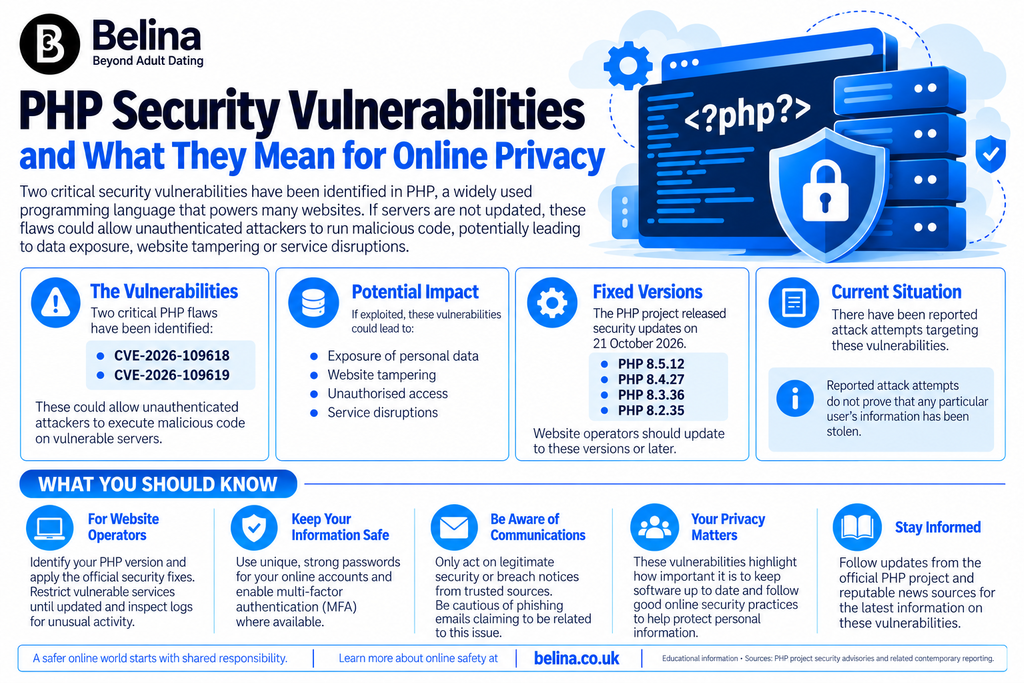
Two identifiers distinguish the PHP security vulnerabilities:
- CVE-2026-109618 concerns corruption during out-of-memory handling.
- CVE-2026-109619 concerns internal state that persists between requests.
PHP’s first advisory and second advisory explain the mechanisms. Under affected conditions, an attacker could execute code remotely without first signing in. That capability creates a serious risk, although an advisory cannot establish the outcome on any particular website.
What the Updates Fix
The PHP security announcement identifies these fixed releases: 8.2.35, 8.3.36, 8.4.27 and 8.5.12. Operators should use an appropriate supported release with the relevant fixes or a vendor package that incorporates them.
Package numbers require context. Ubuntu’s USN-8948-1 notice lists distribution packages that incorporate the repairs. A vendor may backport a fix without adopting PHP’s upstream version number.
Consequently, a number comparison alone can mislead.
On 23 October, PHP also described an unusual session-configuration path under:
- CVE-2026-115560.
Its additional guidance recommends disabling session upload progress pending the next regular bugfix release. Administrators should review that advice against their configuration.
Therefore, addressing PHP security vulnerabilities requires both patch verification and attention to subsequent advisories. Installing one update does not certify the whole server as secure or remove an attacker’s earlier changes.
Why Privacy Matters Here
An adult classifieds service can involve information that people consider intensely private;
- A public photograph might reveal identity through its background.
- A contact number might connect a profile with other accounts.
- Private support correspondence can create additional exposure if an unauthorised person gains access.
These examples explain the relevance of PHP security vulnerabilities to this platforms readership. They describe possible consequences, rather than findings about a specific incident.
For a platform such as Belina, a useful response should connect technical maintenance with data minimisation, controlled administrative access and reliable reporting routes. Operators should understand what information each feature handles before deciding how to protect it.
Readers can explore the wider context in this related article online safety and user engagement. The article does not announce a breach, establish a cause for any separate incident, or certify this platforms current security position.
How Ofcom Applies
Ofcom regulates duties under the Online Safety Act 2023. Its role concerns how services address online harm; it does not approve PHP versions or certify websites as cybersecure.
For regulated user-to-user services, section 10 requires proportionate systems and measures to address illegal content and associated risks. Ofcom’s guidance covers risk assessment, moderation, reporting and complaints. Applicable measures depend on the service’s features, size and risks.
The Connection to Belina
Belina’s user-submitted classifieds model makes these responsibilities relevant. Its assessment must reflect the service’s actual operation and applicable statutory scope, rather than a general description of an adult website.
The practical connection is straightforward: an attacker who changes listings or disrupts reporting could undermine a platform’s safety processes. PHP security vulnerabilities therefore matter to operational safety, even though Ofcom’s rules do not prescribe a particular PHP patch.
Keeping Responsibilities Clear
Operators should assess how an incident affects content controls, preserve relevant records and restore dependable reporting. These are practical considerations for maintaining safety functions, not a claim that every vulnerability triggers an Ofcom notification.
A PHP update cannot demonstrate compliance with the whole Online Safety Act. Equally, a content policy cannot substitute for maintaining the software that supports it.
Data Protection Responsibilities
UK GDPR Article 32 requires appropriate technical and organisational safeguards, taking account of risk. It addresses confidentiality, integrity, availability, resilience and testing. The UK GDPR and Data Protection Act 2018 provide a separate framework from Ofcom’s content-safety duties.
PHP security vulnerabilities can threaten personal information, but discovering vulnerable software does not automatically establish a personal data breach. A breach can involve unauthorised access, alteration, destruction or loss of availability; it need not involve theft.
The ICO’s breach guidance requires notification without undue delay and, where feasible, within 72 hours of awareness, unless the breach is unlikely to create a risk to people’s rights and freedoms. A likely high risk also requires communication to affected individuals without undue delay.
Organisations must document personal data breaches, including those that do not require notification. They should assess evidence and consequences for people, rather than treating the absence of proven theft as proof of no harm.
What Operators Should Check
Operators responding to PHP security vulnerabilities should identify every relevant PHP installation. A web server, command-line process and background task may use different runtimes. The version that serves public requests matters particularly.
In WordPress, Tools → Site Health → Info → Server shows the web PHP version. Administrators should then check vendor advisories, package revisions and running workers. A completed package installation alone does not demonstrate that every process now uses the repaired runtime.
Next, review extensions, application compatibility and the additional configuration advisory. Investigate suspicious activity separately, preserve useful logs and verify that reporting and moderation functions still work. Restrict or suspend affected services when the risk assessment calls for it.
This checklist supports responsible maintenance. It does not establish what Belina has already completed. Any platform-specific update should state the evidence, verification date and remaining limits.
How Security Failures Spread
Consider a hypothetical classifieds account. Someone publishes a profile with a photograph and contact number. If an attacker gains sufficient access to the hosting system, they might alter the destination of enquiries while leaving the visible page largely unchanged. The advertiser could miss the alteration, and a visitor could trust information that the advertiser never supplied.
This example illustrates why integrity matters alongside confidentiality. A security incident can harm people through changed information, even without a public database leak. Similarly, disruption to a reporting form could delay a complaint about impersonation or abusive content.
For Belina, the editorial lesson concerns the relationship between technical controls and the information readers trust. A sensible verification process should check important journeys after maintenance: opening an article, viewing public content and reaching support. Operators should also review permissions around any function that changes public information.
These checks cannot reconstruct every earlier event. However, they help establish that the current service behaves as intended. An investigation into historical access requires its own evidence and should continue independently of routine functionality checks.
Collecting Less Personal Information
The amount of information a platform holds also influences the consequences of a security failure. Before collecting a document, telephone number or explanation of someone’s circumstances, an operator should identify the purpose and decide what information that purpose actually requires.
The ICO’s data minimisation guidance explains that organisations should hold adequate, relevant information and limit it to what they need. This principle supports useful service design: a support request should gather enough detail to resolve the problem without inviting unrelated personal disclosures.
For example, someone reporting a broken page might only need to provide its address and describe the fault. A form that routinely requests identity documents for that task would need a clear justification. Different purposes, including legitimate verification requirements, need their own assessment.
Public visibility also differs from internal access. Operators should explain which details visitors can see and which information only authorized staff can access. Clear distinctions help people make informed choices before submitting material, while periodic reviews help operators identify information they no longer need.
What Useful Updates Explain
A useful security update answers readers’ immediate questions. What happened? Which service functions does it concern? What has the operator verified? What should the reader do next?
Operators should separate confirmed findings from open questions and include the date of the latest assessment. If an investigation continues, the update should explain its current limits. A claim about installing a patch answers a narrower question than a finding about personal information.
Communication should also match the audience. Administrators may need package revisions and configuration details. Members usually need a clear explanation of possible effects, specific actions and a dependable contact route. Publishing unnecessary internal system details rarely helps that reader.
Finally, maintain one recognizable place for updates and correct earlier statements when evidence changes. This approach gives readers something they can check rather than a broad promise of complete protection. For Belina’s news coverage, that standard helps turn a technical headline into information people can use.
Practical Steps for Users
Ordinary visitors cannot repair PHP security vulnerabilities on a website’s server. However, they can protect their own accounts and avoid opportunistic scams.
Use different passwords across services, protect your email account and enable two-step verification wherever a service offers it. Consult the NCSC’s security guidance for practical account protection.
Visit a platform through its known address before responding to an unexpected security message. Never install a supposed PHP update from an unsolicited message or provide login credentials to someone offering to repair a website on your behalf.
If a platform provides a verified notice about your information, follow its specific instructions. Ask for clarification through its published contact route when necessary. A familiar design, HTTPS connection or reassuring badge cannot establish that a server has received every security fix.
Conclusion
PHP security vulnerabilities turn a technical maintenance issue into a question about privacy and operational responsibility. Operators need to verify repairs, investigate possible compromise and check the services that people rely on for support.
For our readers, the useful distinction separates the server work that operators control from the account precautions that users can take. Ofcom’s online-safety duties and the ICO’s data-protection framework address related responsibilities through different rules. Clear reporting should explain both without treating a patch, policy or headline as proof of complete security.
Frequently Asked Questions
What’s going on with PHP?
The project has issued emergency security fixes and follow-up guidance while continuing its normal development programme. Website operators should check current official advisories rather than rely on an old news summary.
Is PHP a vulnerable language?
PHP can contain security defects, as other runtimes can. Application design and maintenance also affect risk. PHP security vulnerabilities require specific fixes; the language’s name alone cannot establish a website’s security.
Is the 2026 PHP vulnerability Issue fixed?
PHP released fixes for the two 21 October flaws. Administrators must apply them and review the 23 October configuration advice. An available patch does not establish that every website has installed it.
What is the recent PHP vulnerability?
The October news concerns two critical runtime flaws, CVE-2026-109618 and CVE-2026-109619. The advisories describe memory-handling problems that can permit unauthenticated remote code execution under affected conditions.
Is PHP still secure?
A supported, maintained PHP deployment can form part of a secure service. Security also depends on application code, configuration and access controls. No language or version guarantees protection against every attack.
Is PHP outdated in 2026?
PHP continues to receive development and security releases. Its support schedule lists maintained branches. An old installation can be outdated even while the language itself remains active.
Is PHP 7.4 still safe?
PHP ended upstream support for 7.4 on 28 November 2022, according to its unsupported branches register. Exceptional source patches or vendor support do not restore routine upstream maintenance. Operators should plan migration and verify any vendor-backed protection.
What language do most hackers use?
No universal language represents all hackers or security researchers. Different tasks involve different tools and languages. This story concerns PHP runtime weaknesses, rather than evidence that attackers share one preferred programming language.
Editorial Notes: This public news explainer makes no assertion about this platforms current remediation, a confirmed breach, or a causal link to a separate security investigation.