
Adina Mihai Drink Spiking & Poisoning Case: Two Men Dead in GBL Theft Plot During Escort Meetings

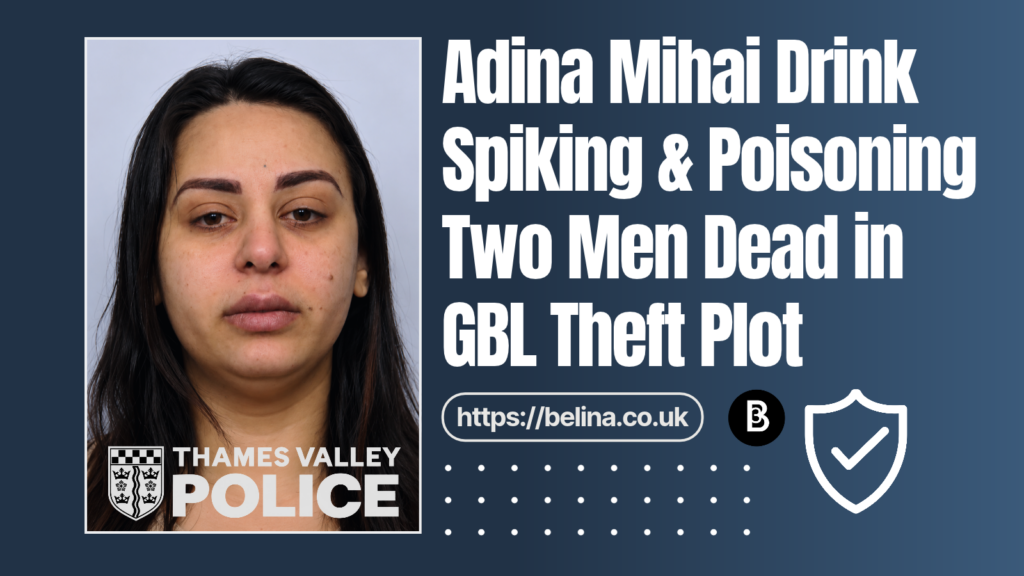
The Adina Mihai drink spiking case exposes a lethal risk during meetings arranged through escort advertisements. Mihai and Madalin Dumitru used those meetings to drug men and steal from them. Two men died, and two others survived.
Police identified the substance as gamma-butyrolactone, usually called GBL, which the body converts into GHB. That chemical connection is important. GBL can cause profound unconsciousness, and combining it with alcohol increases the danger.
Someone who collapses or struggles to breathe needs emergency help, regardless of the circumstances that brought them to a private address.
For escorts and prospective clients, the useful lessons concern recognising illness, getting assistance and reporting serious harm without shame.
This article explains the court findings and practical safety guidance.
The official accounts reviewed do not identify Belina as the platform involved.
The case concerns England and Wales.
Reporting routes differ elsewhere in the UK.
Sources reflect information checked on 28 October 2026.
Key Takeaways
- Mihai and Dumitru each received 17 years after two men died and two survived.
- GBL converts into GHB in the body and can cause unconsciousness, coma and death.
- Alcohol increases the danger of GBL and GHB, including breathing problems.
- Collapse, seizures or abnormal breathing require an immediate 999 call.
- Private meetings deserve the same emergency response as incidents in public venues.
- Missing memories or embarrassment should never prevent someone from seeking help.
Adina Mihai Poisioning by Drink Spiking
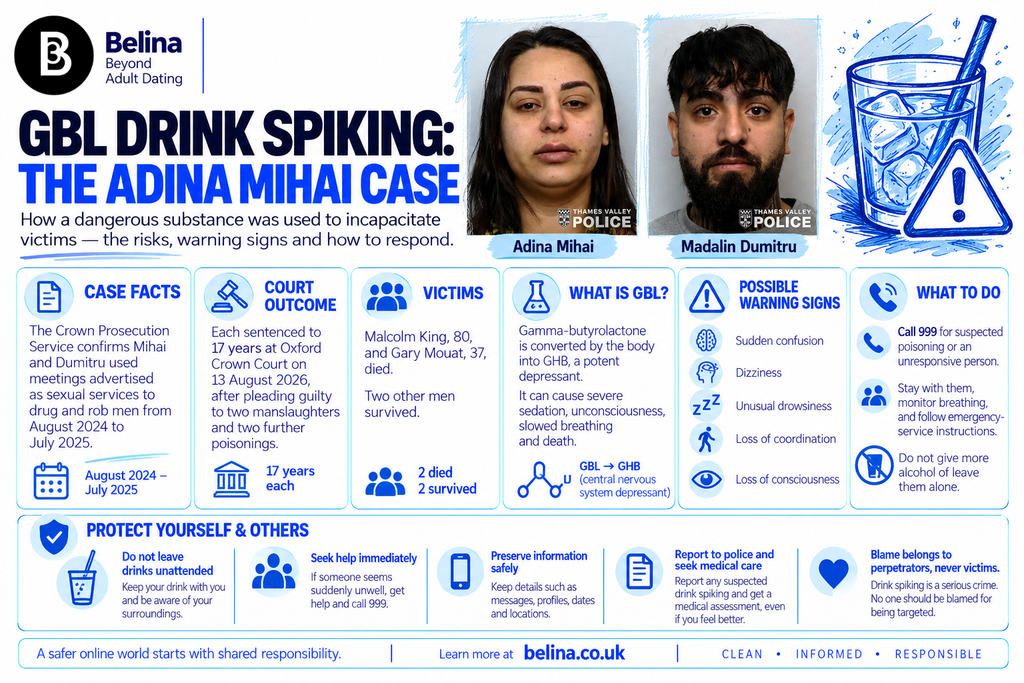
The Crown Prosecution Service account records that Adina Mihai, 31, and Madalin Dumitru, 30, each received 17 years at Oxford Crown Court on 13 August 2026.
They admitted two manslaughters and administering poison to two further victims.
- Malcolm King, 80, and Gary Mouat, 37, lost their lives.
- The surviving victims remain unnamed.
The offending ran from August 2024 to July 2025.
Prosecutors describe contact through an escort classifieds platforms, followed by telephone arrangements and visits to victims’ homes. The defendants intended to drug and steal from the men rather than provide the promised services.
The Adina Mihai drink spiking convictions concern these offenders. They do not establish that independent escorts generally threaten clients, or that the circumstances of a meeting reduce anyone’s right to protection.
How Investigators Connected Events
The joint police account describes how enquiries after Mr Mouat’s death led investigators to re-examine Mr King’s death. An existing health condition had initially made that earlier death appear non suspicious. Toxicology and forensic work helped connect the cases.
Investigators identified two survivors, while police appealed for other potential victims to come forward. Officers said they would handle reports sensitively.
Investigators can assess other evidence alongside someone’s account. Equally, an unexplained illness does not establish that a crime occurred. Tell professionals what you experienced and distinguish recollection from uncertainty.
Safety During Client Meetings
Independent escorts and clients can both encounter unfamiliar people in private settings. An advertisement starts a conversation; it cannot guarantee someone’s intentions or conduct. A polite exchange or an earlier uneventful meeting cannot provide that guarantee either.
The Adina Mihai drink spiking case involved men who responded to advertisements. Its lessons invoke care to sex workers who meet clients alone. Nobody’s occupation or reason for meeting changes their need for medical care after suspected poisoning.
The following article on; online safety for user to user engagement covers related questions about communications and personal information. Here, the focus is a risk that can render someone unable to protect themselves or call for help.
Any safety discussion should also avoid a misleading shortcut. A profile picture, nationality or accent cannot tell you who poses a threat. Concentrate on conduct, credible information and access to help and support.
Understanding GBL
GBL stands for gamma-butyrolactone. The body converts it into gamma-hydroxybutyrate, or GHB. FRANK’s drug information explains that these closely related substances have sedative effects and can cause unconsciousness, coma and death.
Police identified GBL in the Adina Mihai drink spiking case. The CPS also reports GHB in toxicology findings. Those accounts describe the same chemical connection, rather than necessarily identifying two separately administered substances.
GBL has legitimate industrial uses, but that does not make swallowing it safe. Ingestion can cause severe poisoning. Nobody should treat an unknown liquid as harmless because someone describes it casually or claims to know its effects.
Alcohol Increases Danger
Ireland’s Health Service Executive guidance explains that GHB or GBL combined with alcohol can slow breathing or heart rate and cause death. The combination can also cause memory loss, poor coordination and choking.
This helps explain why unexpected drowsiness during client meetings deserves attention.
Trying to walk someone around or waiting for them to sleep off the effects cannot replace medical assessment. Tell emergency responders about suspected exposure and any alcohol involved.
Appearance Cannot Confirm Safety
Do not rely on a drink’s appearance or an informal taste check to decide that it is safe. FRANK describes GBL as having a chemical taste and smell, so calling every spiking substance tasteless or odourless would also mislead readers.
If something seems wrong, stop drinking and seek help. Never taste a suspicious drink again to test it. Symptoms cannot identify GBL reliably, and nobody needs to establish the exact substance before requesting assistance.
Drugging and Theft
The Adina Mihai drink spiking case illustrates drug facilitated theft during meetings arranged through escort advertisements. Incapacitation prevented victims from protecting themselves while the offenders stole property. The risk extended far beyond financial loss.
- The reviewed sources document repeated offending by these defendants.
- They do not measure how often this happens across the adult sector or establish an increase.
Police believe there may be additional victims and have asked them to come forward.
That distinction still leaves a clear reason to raise awareness. Spiking prevention campaigns often focus on public venues, yet these offences occurred during visits to private homes. Safety guidance must reach clients and independent sex workers in those settings too.
When discussing the case with others, describe the confirmed facts. Avoid treating a dramatic headline or an unverified social media account as evidence of a wider bias increase.
Drink Spiking Explained
Police guidance defines spiking through the absence of knowledge or permission. It includes giving someone drugs without consent, adding alcohol to a non-alcoholic drink or supplying more alcohol than they agreed to consume.
The Adina Mihai drink spiking case concerns GBL, but other substances can cause harm.
Neither a particular drug nor a sexual motive defines every incident.
Offenders may seek theft, assault or another criminal outcome.
Accepting a drink does not grant permission to alter its contents. Choosing to consume alcohol also leaves responsibility for deliberate poisoning with the offender.
When seeking help, explain your symptoms and what you remember.
Recognising Sudden Illness
The Home Office’s spiking guidance lists;
- confusion
- poor coordination
- difficulty communicating
- vomiting and memory loss among possible signs.
Someone may appear far more impaired than you would expect.
These signs do not prove spiking. Medical conditions and substances taken voluntarily can also cause them. However, uncertainty about the cause should never delay help for someone whose condition deteriorates.
A person who suddenly cannot stay awake, speak clearly or move safely needs attention.
Tell paramedics about medication, alcohol and any other substances the person may have taken. Accurate information helps treatment. It does not excuse another person’s decision to administer something supciciously.
Getting Emergency Help
NHS poisoning guidance advises immediate medical assessment for suspected poisoning.
Call 999 for an ambulance if someone loses consciousness, has a seizure or struggles to breathe.
Follow the call handler’s instructions.
Tell the operator your location, what you observed and that you suspect drink spiking or poisoning. Explain if someone may still pose a threat at the address.
Do not delay the call while searching messages or checking valuables.
Avoid driving yourself for treatment if you may be impaired.
An apparently brief improvement does not establish that the danger has passed.
The priority is the person’s condition. Identifying a chemical, preserving a glass and reporting a suspicious profile can follow the emergency response; none should hold it up.
Rendering Support to Victims
Stay with the person if it is safe and keep checking their responsiveness and breathing.
Do not leave someone unconscious to sleep it off.
If they are unresponsive but breathing normally, use the recovery position and follow emergency instructions. If they are not breathing normally, tell the 999 operator immediately and follow their CPR guidance.
Do not try to make someone vomit. Do not give food or drink to someone you suspect has been poisoned unless medical professionals direct you to do so.
If another person is available, ask them to meet the ambulance while you remain with the casualty. Keep yourself safe rather than confronting a suspected offender.
Testing and Evidence
The Adina Mihai drink spiking investigation relied partly on toxicology. That does not mean a person needs a positive test before seeking help or reporting a suspected offence.
Medical Tests
Hospital staff assess symptoms and decide which tests will help treatment. Routine hospital testing does not necessarily identify every possible spiking substance. Tell staff about suspected poisoning, even if you have not decided about police involvement.
Police Forensic Tests
Police evidence guidance explains that some substances leave the body quickly. Contact police promptly so they can assess forensic options. Detection depends on the substance, sample and timing; do not assume every drug remains detectable for several days.
A hospital test and a forensic test serve different purposes. Ask professionals what they can arrange. Rapid drink tests can miss substances or give incorrect results. A negative result must never override symptoms or postpone medical attention.
Preserving Useful Information
Once immediate safety allows;
- keep relevant messages
- account identifiers
- listing and advertisements ID’s
- listing profile URLS
- addresses and call records.
Record dates and times you remember, while clearly marking anything uncertain.
If a glass, bottle or other item remains, tell police.
Avoid cleaning or discarding possible evidence when you can safely preserve it.
You do not need to handle an unknown substance or conduct your own tests.
Keep original digital material where possible. A cropped screenshot may omit useful context, so preserve the surrounding conversation too. However, collecting evidence should never require further contact with someone you fear or poses a potential threat.
An incomplete memory is not a reason to invent a sequence. Write down what you know and let investigators compare it with other comparable evidence.
Reporting Without Shame
Police reporting advice makes clear that people can report spiking-related theft or assault alongside the spiking itself. You do not need to separate a connected experience into unrelated reports. Use 999 for immediate danger and 101 for non-emergency police reporting.
Explain what happened in your own words, including gaps in your recollection.
Drink spiking can affect people of different ages, genders and sexualities.
Embarrassment about a private meeting should not prevent someone from seeking protection.
For readers in Scotland, Safer.scot’s reporting guidance describes the Police Scotland response. In Northern Ireland, PSNI advice explains local reporting and immediate safety steps.
Use the relevant jurisdiction’s services rather than assuming every English procedure applies throughout the UK.
Theft and Account Security
After a theft, attend to your health before trying to recover property.
Do not travel to confront someone because a tracking app displays a location.
Give that information to police.
If a phone is missing, police phone-security guidance recommends contacting financial providers, securing affected accounts and notifying the mobile provider.
Use a trusted device and known contact routes.
Tell your bank about missing cards or transactions you do not recognise.
For escorts, a compromised phone may also affect business contacts and private messages. Prioritise the email account that controls password resets, then secure other affected services.
Consent During Private Meetings
In England and Wales, section 74 of the Sexual Offences Act 2003 defines consent through choice, freedom and capacity. Payment, an advertisement or an earlier agreement does not replace those requirements.
- Someone who is vulnerable and unconscious is incapable of consent.
Drink spiking can raise concerns about several offences.
However, the general consent explanation here does not add sexual-assault findings to this particular prosecution. The official releases report manslaughter and poisoning convictions.
The following article covers sexual offences and consent, it explains the wider framework and jurisdictional differences. Apply the law relevant to the location rather than treating one statutory section as a complete UK application.
Legal Consequences of Spiking
Spiking is criminal conduct. Investigators assess the evidence, intention and consequences when considering offences. The Adina Mihai drink spiking sentences followed manslaughter and poisoning convictions; the theft motive did not make the drugging a minor matter.
Section 61 of the Sexual Offences Act 2003 separately addresses administering a substance without consent with the intention of enabling sexual activity involving the victim. That general explanation does not add a sexual-assault finding to this prosecution.
For anyone seeking assistance, identifying the precise charge should never become a barrier. Report what happened and explain any associated theft, threats or assault. Police and prosecutors assess the relevant applicable law. Use advice for the jurisdiction where the incident occured, since criminal legislation differs across the UK.
Planning Safer Meetings
Practical planning can improve access to help, although it cannot guarantee someone else’s behaviour. Responsibility for spiking remains with the offender.
For sex worker;
- consider access to your phone
- an exit and transport before a meeting
- check local crime rates for your intended desitnation
- inform a trusted person of your whereabouts
Clients can make similar arrangements. Hosting a meeting at home does not remove the need for a way to summon assistance. Nor should either person feel obliged to accept a drink or consume an unknown substance.
Homes may lack venue staff nearby. If you feel unexpectedly unwell, seek help rather than continuing because a meeting has begun or money has changed hands.
Reporting Suspicious Profiles
If a concerning interaction involves an online account, report the relevant profile or advertisement through the help and support page.
Include its address or identifier and explain the conduct that prompted concern.
Separate direct observations from assumptions.
Platform reporting serves a different purpose from emergency assistance and a police investigation. Where drink spiking or threats may have occurred, contact the appropriate services as well. Do not wait for a platform or website to reply while someone needs urgent assistance.
Avoid public suspect lists or requests for strangers to investigate. A mistaken identification can expose innocent people and interfere with legitimate enquiries. Preserve relevant material privately and share it with appropriate recipients.
Platform Safety Responsibilities
Ofcom’s illegal-content guidance explains risk assessment and safety duties for services within the Online Safety Act 2023. Assessments must reflect the service’s actual features and the risks associated with them.
For an adult classifieds platform, that means understanding potential misuse of advertisements and communications, alongside how people raise concerns. Providers should maintain proportionate procedures for reviewing reports and escalating credible threats.
Belina’s relevance is the shared need for responsible user interactions and clear reporting information. This article does not audit its safeguards or identify it as the platform involved in the prosecution.
Handling Reports Privately
A report may contain intimate details, medical information and allegations about a named person. Organisations need appropriate legal grounds, controlled access and secure handling under UK GDPR and the Data Protection Act 2018.
The ICO’s data-minimisation guidance explains that information should be adequate, relevant and limited to the purpose. A report should gather useful facts without inviting an unnecessary account of a persons private life or affairs.
For users, keep police reference numbers and relevant records somewhere secure. Avoid posting identification documents or medical results to persuade an online audience that an incident happened.
Support After An Incident
Reading about the Adina Mihai drink spiking case may bring back concerns about an earlier experience. You can seek support without proving what happened first.
Victim Support’s spiking information explains that support can remain available even if someone has not reported to police. Check the service covering your location, as provision differs across the UK. For sex workers, National Ugly Mugs offers specialist support, reporting tools and casework.
Check its current eligibility and contact information. These services complement emergency care rather than replacing it.
If you think sexual assault may also have occurred, NHS guidance explains medical help and sexual assault referral centres. You can discuss care and forensic options without first deciding to make a police report. Ask about the local service and confidentiality arrangements.
Friends can offer practical help with appointments and reporting.
Listen without demanding intimate details or questioning why someone agreed to meet. Recovery does not follow a fixed timetable, and the person affected should have a say in the support they receive.
Conclusion
The Adina Mihai drink spiking case shows how drugging during an arranged private meeting can have fatal consequences. Malcolm King and Gary Mouat died, two men survived poisoning, and the court held Mihai and Dumitru responsible.
Raising awareness to GBL helps readers recognise the seriousness of sudden impairment.
It does not require anyone to diagnose poisoning themselves.
Call for medical help, report suspected harm and preserve useful information once immediate safety allows.
Independent escorts and prospective clients deserve protection without judgement.
For users of this platform, that principle should guide both private interactions and the level of response required when emergency help is urgent.
Frequently Asked Questions
What is GBL?
GBL stands for gamma-butyrolactone, an industrial solvent that becomes GHB after ingestion. It can cause profound drowsiness, unconsciousness, coma and death. In this article’s context, understanding the substance helps readers recognise a potential medical emergency during a private meeting. Source: FRANK — GHB and GBL
Is Gamma-Butyrolactone legal?
In the UK, GBL is a Class B controlled drug, with an exemption for legitimate industrial uses. Possessing or supplying it while knowing or believing someone will ingest it generally constitutes an offence. Industrial availability does not make recreational use legal or safe.
Sources: Misuse of Drugs Regulations — GBL exemption; Home Office controlled drugs list
Where can I get gamma-butyrolactone?
GBL has legitimate industrial uses, but obtaining it for ingestion raises serious legal and health risks. This article does not recommend suppliers. If you suspect someone has used it to spike you, prioritise medical help and reporting rather than obtaining a sample yourself.
Sources: Home Office explanation of GBL controls; FRANK — GHB and GBL
What products contain gamma-butyrolactone?
Some industrial cleaning and solvent formulations contain GBL. Formulations vary, so a product category alone cannot establish its ingredients; check its label and safety data sheet. These products are not safe to swallow.
Sources: Home Office — Control of GBL and 1,4-butanediol; FRANK — GHB and GBL
How can you detect GBL?
You cannot reliably confirm or rule out GBL by looking at, smelling or tasting a drink. Laboratory analysis offers a more reliable assessment. Rapid drink-testing kits can miss substances or produce incorrect results, so never use a negative result to dismiss symptoms. If someone collapses, has a seizure or struggles to breathe, call 999 immediately.
Sources: Police guidance on spiking evidence and testing; NHS — Poisoning