
Age Verification Privacy Scrutinized as ICO Urges Protection of Personal Data

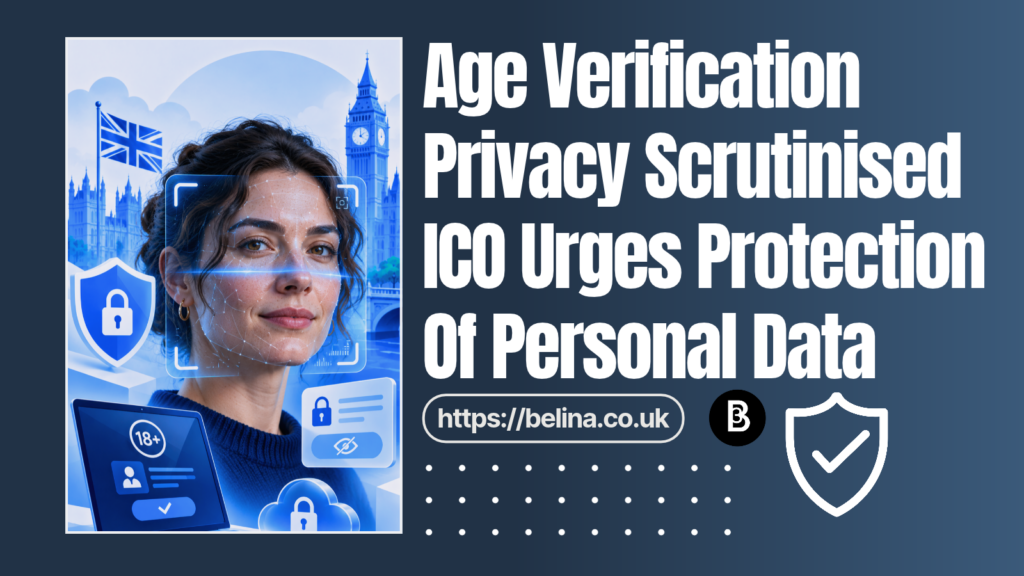
Age verification privacy concerns have returned to the spotlight after the ICO backed stronger online age checks while stressing that providers must protect personal information. For users of adult classified services, that raises a practical question: how much information should a website collect before allowing access?
On 29 October 2026, the UK’s data protection regulator welcomed Ofcom’s assessment of checks at the 16-year threshold. Its statement on highly effective age assurance placed privacy and information rights alongside protecting children from harm.
This article examines what the ICO’s position means for escorts and users of adult classifieds, from ID checks and facial age estimation to who receives verification data and how long it is kept.
It also distinguishes proposed social media restrictions from existing adult-content rules, explains how to challenge incorrect decisions and answers common questions about sharing personal information safely.
Key Takeaways
- The ICO says age checks must protect personal information and information rights.
- Proposed social media checks at age16 differ from existing adult-content rules.
- Age estimation and identity matching involve different processing of facial images.
- A website may need an adult-status result rather than a full identity document.
- Users can challenge incorrect age-check results, asking for alternative methods.
The Latest Statement
The ICO’s intervention accompanied Ofcom’s rapid assessment at 16.
Ofcom identified photo-ID matching, banking information, digital identity services and facial age estimation as methods capable of meeting that threshold effectively.
The assessment supports debate about proposed restrictions, including an under-16 social media ban. As of 1 November 2026, readers should distinguish that policy work from a fully implemented universal requirement.
Ofcom says further guidance will follow the laying of draft regulations.
Meanwhile, the ICO stresses that safeguarding children must include protecting the information that age checks collect.
Its statement does not announce that every adult must upload a passport.
Nor does it certify every verification service as secure.
This distinction matters when headlines travel faster than the underlying guidance.
Age verification privacy depends on the actual process, rather than the presence of an official looking badge or symbol of trust.
Existing Adult Rules
The latest debate does not replace existing protections around pornography.
Ofcom’s explanation for users describes strong checks for sites and apps that allow pornography, with wider requirements taking effect on 25 July 2025.
However, an adult classifieds label alone does not settle every legal question regarding a service.
Its functions, content and applicable duties, platforms need to assess their own circumstances rather than borrow from the arrangements of competitor’s.
Ofcom’s age assurance guidance lists several methods capable of highly effective checks at 18, including mobile network checks and digital identity services.
- Simply ticking an over-18 consent box does not meet that standard.
- A debit card alone also fails to establish adulthood because children can hold one.
Consequently, age verification privacy does not require choosing the least demanding screen.
A check must do its intended job while limiting unnecessary exposure of personal information.
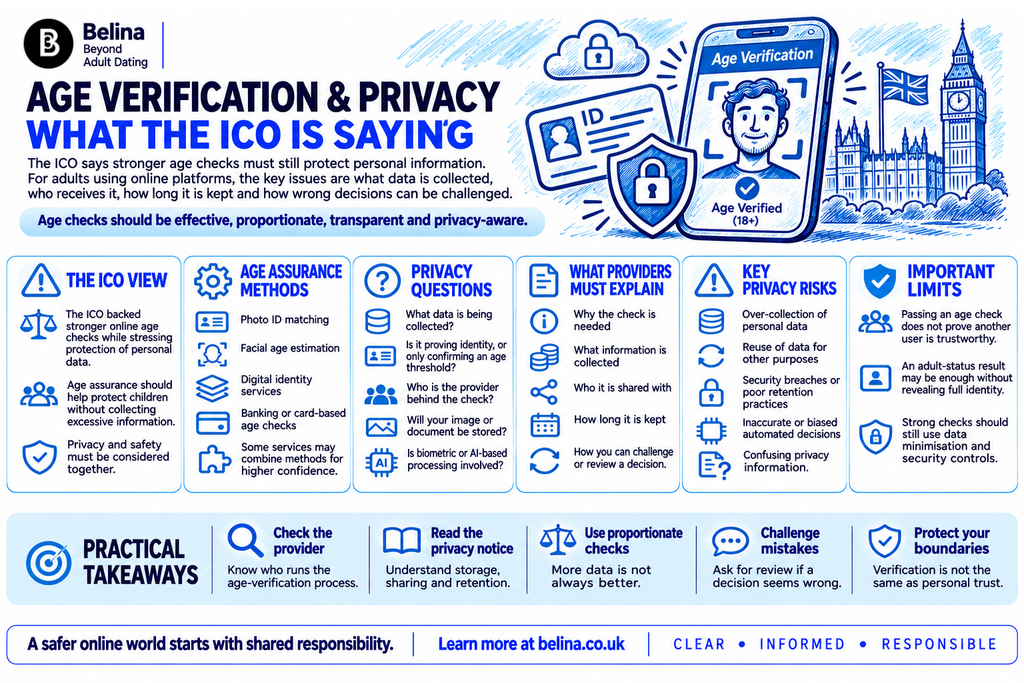
Age Verification Privacy
Age assurance covers approaches that establish or estimate age.
Verification uses evidence;
- estimation draws a conclusion about a likely age or range.
- Neither term tells users exactly what a particular provider stores.
The ICO’s introductory guidance explains that providers must choose proportionate methods, process information lawfully and address accuracy, security and fairness.
A useful design question follows: does the website need to confirm identity, or only confirmation that the user meets a certain threshold?
The European Commission’s age verification solution illustrates the distinction by describing proof of an age threshold without sharing a name or birthday with the receiving platform. Its deployment arrangements concern the EU; they do not establish any mandatory UK system.
Facial Age Estimation
A request for a facial biometrics deserves a clearer explanation than “AI verification”.
What does the software actually do with the image?
Parliament’s briefing on facial age estimation explains that a model analyses facial features to estimate age;
- Facial recognition instead seeks to identify someone.
- A document-matching process may compare a live image with a photograph on ID.
These differences affect age verification privacy, under the ICO’s biometric guidance, biometric processing for unique identification attracts special-category protection.
A selfie alone does not establish that every system performs that kind of identification.
Estimates also have error margins, a provider may ask an user who appears younger to complete additional checks.
Such a request does not automatically indicate wrongdoing or a false date of birth.
Before proceeding, read the explanation for that specific method.
Do not assume that a camera-based check uploads nothing, retains nothing or never involves a third party service.
Who Receives Your Data
The website displaying a verification button may not operate the checking system.
A separate business could receive the image, assess the evidence and return a result.
The ICO’s age assurance expectations require clear explanations of the information collected, third party involvement, use and retention.
In some circumstances, recording a yes or no result will suffice.
For readers evaluating age verification privacy, the practical task is to follow the whole journey. Identify the checking company, inspect its privacy notice and find out what the original website receives.
Also look for any explanation of transfers outside the UK and safeguards for those transfers.
Consider an illustrative situation: an advertiser completes a document check through an embedded window. A reassuring message on the classifieds page little informs about the document’s destination unless the process names the recipient.
Save the relevant notices or their dates if concerns arise.
That creates a record of the explanation available when the check occurred.
Retention and Reuse
“We delete your selfie” leaves important questions unanswered. The provider might delete the photograph but retain a result, transaction reference or account identifier.
Those records can still matter to privacy.
The ICO’s storage limitation guidance does not impose one universal retention period. Organisations must justify keeping identifiable information for the purposes they need to fulfil.
Ask separately about original images, document copies and verification records.
A clear notice should distinguish immediate processing from longer retention, including any stated security or legal purpose.
Age verification privacy also involves future use.
Information collected for a check does not become an unrestricted resource for unrelated activity.
UK data protection principles require specified purposes, appropriate security and proportionate collection. If a notice mentions research, model improvement or marketing, read the details.
A promise about image deletion does not answer a separate question about using information before deletion.
Risks for Independent Advertisers
For users who advertise under a professional name, linking a legal identity to a public profile can carry personal consequences. The concern deserves consideration without implying that every verification system exposes that link.
An illustrative risk involves two separate accounts: one under a working name, another connected to an everyday email address. A verification process that combines identifiers could narrow that separation. Its actual effect depends on the provider’s data flows and access controls.
Therefore, assess age verification privacy before uploading material.
Consider what information a document reveals beyond age and what the provider permits users to conceal. Do not alter required evidence contrary to the official instructions; ask about alternatives instead.
Belina’s guide to online safety provides broader context on identity exposure and user-to-user communication. The additional point here is specific: an access check should not quietly become a wider disclosure of someone’s private life.
Checks and Personal Boundaries
A platform’s official verification process differs from a stranger asking for a passport through a private message. The second request does not gain legitimacy because the sender mentions the Online Safety Act.
Before sharing documents, navigate to the service independently and check the instructions there. Government phishing guidance warns against disclosing private information or following uncertain links in unexpected messages.
Age verification privacy becomes especially relevant when an enquiry turns into pressure. Someone might claim that a document or payment will “unlock” a conversation.
Treat that as a claim to verify through official support, not an instruction to follow immediately.
Equally, an adult status result cannot guarantee honesty, consent or safe conduct.
It addresses a particular age question.
It cannot settle the wider decisions involved in communicating or meeting.
These examples describe possible risks, not documented incidents involving Belina.
They also offer no reason to evade genuine age restrictions or use another person’s identity.
What Providers Must Explain
Outsourcing a check does not remove a service’s responsibility for the overall arrangement. Ofcom’s Vet your vendor resource asks providers to examine testing, circumvention, appeals and relevant standards.
That scrutiny should translate into useful information for users.
A badge or vendor logo cannot replace an explanation of how the check operates.
Before proceeding, look for answers to these questions:
- Which organisation performs the check and handles questions about it?
- What does the website receive after verification?
- Which records remain, and for how long?
- Can users choose another effective method?
- How can an adult challenge an incorrect result?
Age verification privacy also depends on the surrounding website’s security. The following article on PHP security vulnerabilities further emphasises why operators must secure the systems that handle personal information. A well-designed verification method cannot compensate for every weakness elsewhere.
Challenging Wrong Decisions
A failed estimate can interrupt access even when someone meets the age requirement. Repeating uploads without understanding the failure may increase disclosure without resolving the problem.
Ask the service about an alternative check or its appeal route.
Describe the error and retain the reference number. Avoid attaching extra identity material until the recipient explains the secure process and what it needs.
For concerns about personal information, the ICO’s complaints guidance recommends raising the matter with the organisation. Explain the handling you dispute and the response you want.
Keep the correspondence if you later approach the regulator.
Users can also request access to information held about them.
The government’s access guidance explains that right.
Deletion rights have conditions and exceptions; closing an account does not automatically erase every record. An age verification privacy complaint should identify the organisation and the particular processing involved, rather than rely on the broad claim that all checks are unlawful.
Conclusion
The ICO’s latest statement puts personal information firmly within the age check debate.
For adult classifieds users, the meaningful questions concern the evidence requested, who receives it and what remains afterwards.
Age verification privacy requires scrutiny of each actual process.
Effective checks can protect children, while proportionate data handling protects adults who have legitimate reasons to keep parts of their lives separate.
A clear explanation, a workable appeal and a limited disclosure provide better grounds for a decision than a reassuring logo.
When those details remain unclear, ask the service before providing more information.
Frequently Asked Questions
Is it safe to verify age for adult sites?
It can be, but no method offers zero risk. Check the genuine website, named provider and privacy notice. Look for limited collection, secure handling, retention details and a way to challenge mistakes. Ofcom explains that effective checks can protect privacy; that does not guarantee the security of every provider.
How are people avoiding age verification?
Some attempt location masking, borrowed accounts or false evidence. Ofcom acknowledges that no method completely prevents circumvention and expects services to address weaknesses. Those attempts can undermine protecting children from harm and expose users to fraud or account restrictions. Adults who face errors should use an appeal or another approved method rather than bypass the check.
Is there a way to verify age without ID?
Sometimes. Ofcom recognises methods capable of highly effective checks at 18 beyond photo-ID matching, including facial age estimation, mobile-network checks and credit-card checks. Availability and suitability vary. A method without a document still processes information, so inspect its privacy terms. A debit card or a self-declared birthday alone does not meet that standard.
How do I let Google know I’m over 18?
Sign in through Google’s genuine account interface and follow its verification prompt. Google lists options including ID, a selfie and other methods, depending on the account, device and region. Enter accurate details and read the method-specific terms. Google says it will not ask you to supply ID or card information in an email.