
Age Checks at 16: Ofcom Evaluates Four Age Assurance Methods In Response to UK Social Media Ban

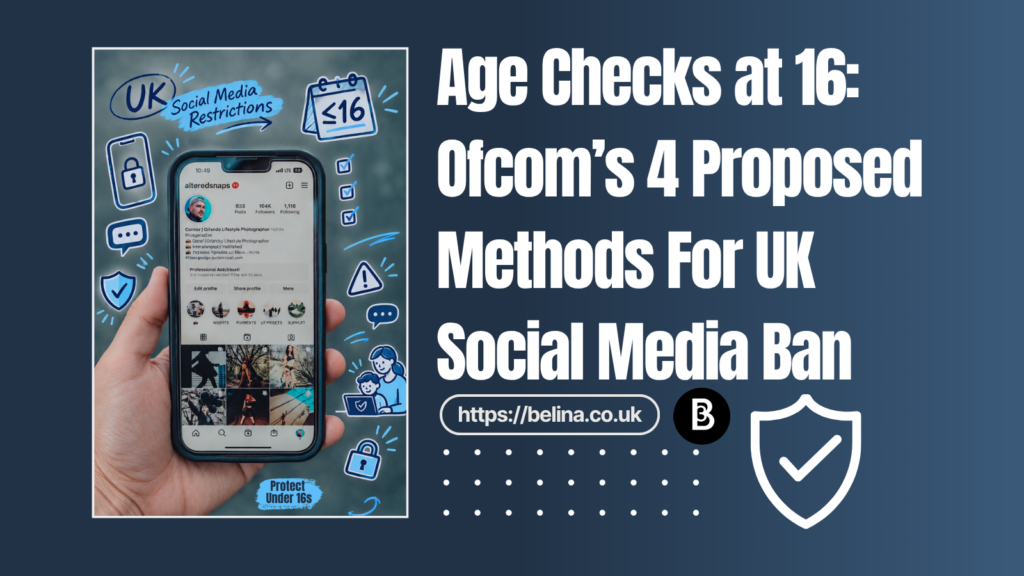
Age checks at 16 sit at the centre of the UK Government’s proposed social media ban for under 16s, on 29 October 2026, Ofcom published a rapid assessment of the technology that could enforce the restriction. It identified four methods that can potentially establish if someone has reached 16, while warning that access, privacy and attempts to bypass checks remain serious challenges.
The assessment does not itself start the ban or require every person to upload proof of age documents, parliament must still set out the detailed requirements, where Ofcom plans to consult on guidance, here is what the Office of Communications uncovered.
Key Takeaways
- Ofcom identified four methods capable of effective checks at age 16.
- The assessment informs proposed rules; it does not bring the ban into force.
- Facial estimates near 16 need a second route to confirm uncertain results.
- Some 16 and 17 year olds lack the proper documents these routes may require.
- App stores could help, but regulated services retain their own duties.
The Policy Behind It
The Government announced its plan in June 2026: social media services within the eventual rules should not offer accounts to children under 16.
It also proposed restrictions on risky functions, such as livestreaming and stranger communication, across a wider range of online services. Those wider restrictions form a distinct part of the policy; the planned social media ban does not automatically apply to every website where people interact.
The Government described services such as;
- TikTok
- Snapchat
- YouTube
- and X.com
As examples of its intended social media scope, detailed legal definitions and exemptions still depend on regulations. Its June progress statement says parliament must approve those regulations, consequently, a headline about a nationwide ban should not replace the actual implementation timetable.
Ministers asked Ofcom what a “highly effective” check could look like at 16.
Ofcom already has guidance for checks at 18 under existing online safety duties.
Age checks at 16 present a different practical test:
Some forms of evidence suitable for proving adulthood cannot establish a younger threshold.
Four Methods Identified
In its 34 page rapid assessment, Ofcom identified;
- photo ID matching
- digital identity services
- banking information
- and facial age estimation as methods currently capable of highly effective age assurance at 16.
“Capable” describes a method’s potential when a service implements it properly; it does not certify every commercial product that bears that label.
The regulator assessed technical accuracy, robustness, reliability and fairness. It also considered accessibility, interoperability and privacy.
These tests answer different questions;
- a technically accurate system can still block legitimate users if they cannot complete its steps
- a convenient system can still fail if children can easily evade it.
That is why age checks at 16 involve the entire process, including a route for results close to the threshold. Age checks at 16 need an effective process, though Ofcom does not prescribe a single mandatory screen for each social media platform.
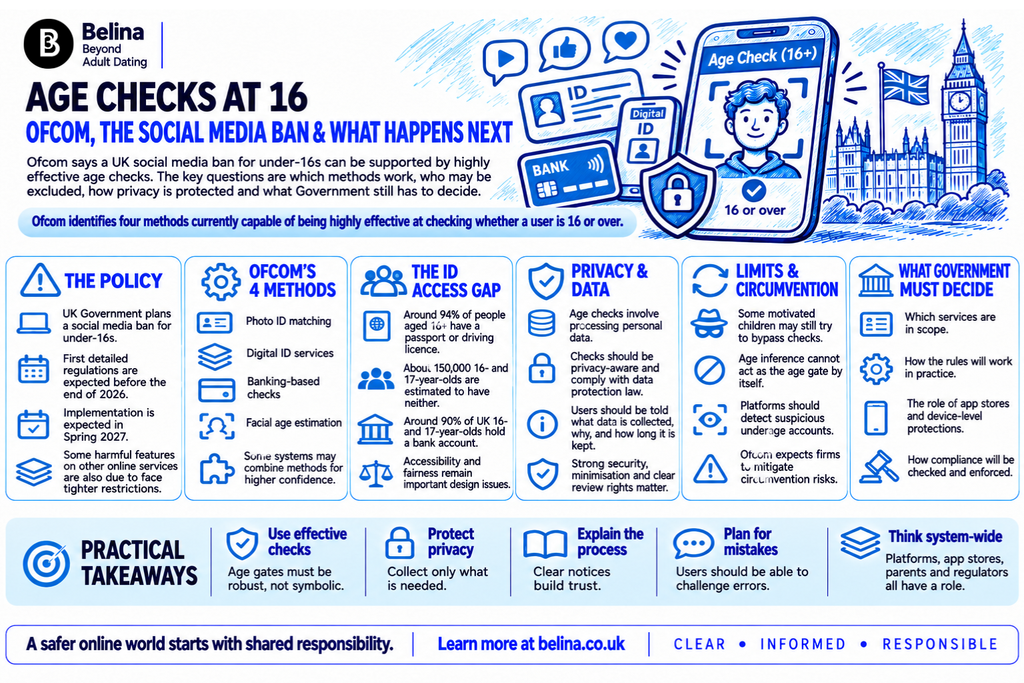
Photo ID Matching
This approach reads relevant information from a passport, driving licence or another suitable photo document, then compares its image with a live image of the person completing the check.
The comparison helps establish that the document belongs to that person. A birth date on a document alone cannot achieve the same assurance if someone else has borrowed it.
Ofcom estimates that 94% of UK residents aged 16 and over have a passport or driving licence. Yet its evidence also suggests around 150,000 people aged 16 or 17 have neither.
Those figures measure access to particular documents, not the accuracy of a particular vendor.
They explain why a process built entirely around a passport may leave some eligible young people without an easy route.
Photo ID matching can process more identifying information than a simple age threshold requires. Ofcom notes that a separate checking provider could send the social media service only a “yes” or “no” age result. That design may limit what the social media company sees, although the checking provider still handles personal data and must adhere strictly to data protection law.
Digital Identity Services
A digital identity service can verify an identity or an attribute such as age and then let a person reuse that proof. Someone might establish an age attribute once and share only confirmation that they meet a threshold with later services.
- This could reduce repeated requests to retrieve and submit an identity document.
Ofcom treats this as one of the four possible methods for age checks at 16, but reusable proof does not eliminate the initial verification step. Many people will first need a document or other trusted evidence to establish the digital identity.
The resulting convenience also depends on which services accept that provider’s credentials and on what information the provider shares with each platform.
Banking Information Checks
This method accesses the age information a bank or other financial institution holds about a user, with the user’s consent. The institution, the user or a third-party assurance provider could pass confirmation of an age, age range or birth date to the requesting service.
A tightly designed check might disclose only that the customer is at least 16.
- Around 90% of UK 16-17-year-olds held a bank account in the survey evidence by Ofcom.
Account ownership is not the same as availability of a working verification service, however.
Banks must participate or supply suitable tools before their customers can use this route at scale. Ofcom notes that solutions involving major banks remain at an early stage.
Nor should readers confuse this method with entering an ordinary debit-card number. Children can hold debit cards. The relevant test draws on trustworthy age information the financial institution already holds, rather than assuming that the act of paying proves a user’s age.
Facial Age Estimation
Facial age estimation analyses a live facial image to estimate a person’s age or age range.
It does not, by definition, need to establish the person’s name.
Because it may work without presenting a passport, the method can offer a quicker initial route for some users. Yet the accuracy of a particular model and the treatment of uncertain results decide how useful it is at 16.
- Ofcom cites testing of 50 algorithms;
- 19 had a mean absolute error below three years for the 13 to 17 age group.
That figure describes the average size of an error for those tested algorithms, not a guarantee that any individual 15 year old or 16 year old receives the correct answer. Accuracy can also vary across groups, so services must consider fairness as well as overall averages.
The regulator favours a “challenge age” approach near the boundary.
If an estimate does not provide enough confidence, a service should use a second method to confirm eligibility. A person who looks young should not have to accept a mistaken estimate as a final decision. Conversely, an estimate slightly above 16 cannot automatically settle the question for a child just below the threshold.
Why Four, Not Seven
Ofcom previously listed seven methods capable of highly effective checks at 18.
Its new assessment finds only four currently capable at 16.
Some adult methods prove that someone is at least 18, so they can still serve adults accessing a 16 plus service, but they cannot offer a route to eligible 16 or 17 year olds.
This distinction explains an apparent contradiction in coverage of age checks at 16.
A website could offer an 18-plus customer an adult-only proof method while still needing suitable options for a 16-year-old. The technical question is not simply “Can this identify an adult?”
It is “Can this accurately establish that a user has crossed the threshold the rule actually sets?”
Ofcom considered emerging methods, too. It did not identify another method ready to expand the available choices before the Government’s expected spring 2027 start. Future technology could change that assessment, but the October report evaluates the evidence available now.
The ID Access Gap
The four options have a shared access problem.
- Photo ID matching obviously requires a suitable document.
- Digital identity and banking routes may rely on identity evidence during initial setup.
- Facial estimation can avoid a document for a clear result, but users near the threshold may need a follow up check.
Ofcom therefore expects some 16 and 17 year olds without photo ID to obtain it before they can access a restricted service. Its report discusses barriers for young people in care, people from disadvantaged backgrounds and users who cannot easily complete a complex camera-based process. A device without a working camera can also interrupt a facial check.
Age checks at 16 will need workable alternatives; Ofcom does not claim that all 150,000 young people without a passport or driving licence will lose access.
Privacy and Fairness
Every one of these methods processes personal information.
Ofcom says providers can deliver age checks at 16 in a way that protects privacy and complies with data protection law, but the method alone cannot guarantee that result.
Implementation determines which company receives an image, what the social media service learns, how long records remain and how the provider secures them.
Ofcom worked with the Information Commission on its assessment.
The ICO’s accompanying statement supports effective checks while stressing information rights.
Our earlier article on age verification privacy examines the specific questions users can asked regarding, ID, selfies, storage and incorrect results.
This story concentrates on what Ofcom found concerning the proposed 16 plus threshold.
Fairness has a practical meaning here.
- A method should avoid unjustified bias or discriminatory outcomes.
Models need testing across diverse users; a person who cannot use a camera or whose result falls in an uncertain range needs a workable alternative. Broad claims that “AI knows your age” do not answer those questions.
Existing Adult Accounts
Will every adult have to pass a fresh check?
Ofcom says some existing account holders may not need one if a platform already has accurate and reliable information showing they exceed the threshold.
Many adults are still likely to receive requests, however.
Services cannot assume that an unverified birth date typed years ago supplies trustworthy evidence. For people over 18, platforms may also draw on methods from Ofcom’s existing adult guidance. That wider menu does not negate the narrower choice at 16.
The final mix will depend on the legal rules and the service’s implementation, not a general promise that a familiar account will always stay open without another step.
Age checks at 16 must also account for possible account sharing after an initial check.
Bypassing the Checks
Ofcom does not promise a perfect barrier.
Children may use borrowed accounts, altered evidence or tools that obscure location.
Its report says correct implementation should substantially reduce access, but some circumvention will remain, the regulator intends to study bypassing behaviour and publish research within 12 months after the ban takes effect.
The distinction between facial age estimation and behavioural age inference is important. Estimation analyses a face during the check.
Inference examines what an account does over time.
Ofcom says current inference cannot act as the initial gate because it needs a person to use the service first. It may later help identify an account that appears to belong to an under 16 user who passed or evaded a check.
Ofcom also discusses user reports of suspected underage accounts and location signals as possible supporting measures.
Those are examples for future guidance, not an announcement that every platform must track GPS data or block all VPN users.
The assessment explicitly notes that people may use VPNs for legitimate privacy reasons.
Any additional data processing needs its own justification.
App Stores and Responsibility
Alongside the age assessment, Ofcom published a separate report on app stores.
Three quarters of children who use the internet told its researchers that apps downloaded from an app store were their primary way of going online.
Yet the stores Ofcom analysed largely relied on users declaring their own age, with limited extra checks. App stores could make age assurance more effective, the regulator says, if they also hold reliable information about each app’s age suitability and risks.
Even then, an app store check would not replace every service level safeguard.
Ofcom states that regulated services remain responsible for their own online safety duties.
App stores themselves currently fall outside the relevant regulated service scope of the Online Safety Act, Ofcom’s report informs the Government if it considers changing that position.
Readers should therefore distinguish a potential future policy from a legal duty that already applies to every app store.
What Happens Next
Age checks at 16 still depend on the next steps issued by the government.
It intends to lay its first directive for the social media restriction before parliament by the end of 2026, with the first restrictions expected in spring 2027.
Parliament must approve the regulations before they become operative.
Until the detailed text appears, no one can definitively list every affected service, exemption, user journey or permitted age check arrangement.
Ofcom plans to consult on draft industry guidance after the Government lays the regulations.
It expects to monitor compliance once the measures begin.
Those steps leave a meaningful gap between this October assessment and a binding rule for a particular platform.
The assessment answers a technical and policy question; regulations will decide the legal scope.
There is already a separate regime for restricting children’s access to pornographic content and other harmful material under the Online Safety Act 2023.
The proposed social media age threshold does not reset those existing duties.
Reporting Underage Concern
Ofcom identifies user reports of suspected under 16 social media accounts as one possible safeguard after initial age assurance checks, presence of underage users on a service does not, by itself, prove sexual exploitation or identify a criminal offence is taking place.
The reporting route should be determined by the 18 Types of Specified Illegal content.
Suspected Underage User Accounts
Use the service’s reporting channel to flag suspected underage activity supplying sufficient evidence including;
- profile links
- URLS
- usernames
- and the reason for raising your request
Let the service assess your report and determine whether a breach is present.
Ofcom has discussed this measure for future guidance purposes only and has not announced a universal reporting form or placed a duty on members of the public to assume a user’s age themselves.
Child Sexual Abuse Material
Where suspected online child sexual abuse material is present; images or videos, use the Internet Watch Foundation’s Reporting Portal. The IWF accepts reports of online imagery involving children under 18, including AI-generated depictions.
- A URL helps its analysts assess and seek removal of (CSAM)
- Do not download, copy or forward the images as evidence.
The IWF does not take such reports by email, phone or social media.
Exploitation or Immediate Danger
Report suspected online grooming or sexual exploitation to the National Crime Agency’s CEOP Command Safety Center, for broader suspected child abuse, approcah your local authorities childrens social care team, you’ll be asked for your details but you can choose not to share them.
- Call 999 if a child faces immediate danger.
- use 101 or the police’s online route for a non-emergency.
You do not to prove abuse before raising a genuine concern.
Conclusion
Age checks at 16 now have a practical foundation:
Ofcom identifies four methods that could work if services use them accurately, fairly and robustly.
The findings also expose limits that an announcement alone cannot solve.
Some eligible teenagers lack easy access to photo ID.
- facial estimates can misclassify people near the age of 16
- These errors can permit underage access or block eligible users.
For the adult community, the relevant point lies in the distinction between the proposed social media restrictions and existing duties under the online safety act.
The eventual scope of the social media rules will depend on parliament; Ofcom has not declared every user to user service to this ban, this report explains the age check methods likely to inform the next phase of UK policy.
Frequently Asked Questions
Will the UK ban social media for under-16s still happen?
The Government still plans to introduce the restriction in spring 2027. It intends to put the first regulations before Parliament by the end of 2026, but Parliament must approve them before the ban takes effect. source.
Which social media is going to be banned in the UK?
The proposed restriction concerns access by under-16s, not a ban on social media for everyone. The Government has named Instagram, TikTok, Snapchat, Facebook, YouTube and X as examples of services it expects to cover. The final legal scope and exemptions await the regulations. source.
Is Snapchat getting banned for under-16s?
The Government explicitly includes Snapchat among its examples. If the rules take effect as proposed, Snapchat would have to prevent under-16s from using the covered service. source.
How does the under-16 ban work?
Under the proposal, covered social media companies would have to stop under-16s from accessing their services. Ofcom has identified four methods capable of effective checks at 16: photo ID matching, digital ID. source.
Is a 16-year-old still a minor in the UK?
Yes. A 16-year-old remains under 18 and receives legal protections as a child, although particular rights and responsibilities begin at 16 and can differ across UK jurisdictions. Turning 16 would make someone old enough for social media under the proposed threshold; it would not make them a legal adult. source.