

Medical Record Snooping Prompts ICO Action Over Patient Privacy

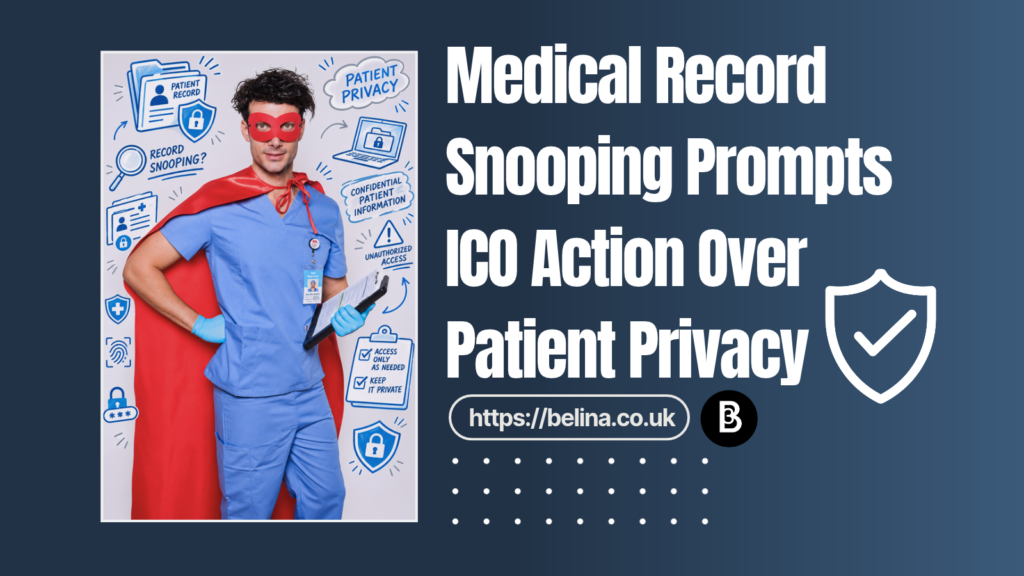
Medical record snooping prompted a warning from the Information Commission’s Office (ICO) on 12 November 2026. After assessing more than 300 health-sector access reports that year, it asked UK health leaders to check their safeguards.
The announcement concerns access by people inside healthcare organisations. It highlights employees viewing information about people they know or sharing information with others. Patients can ask their healthcare provider to investigate suspected access and explain how it has used their information.
Key Takeaways
- The ICO assessed over 300 health-sector unauthorised-access reports in 2026.
- The ICO asks health leaders to check that access safeguards work in practice.
- Staff need an authorised reason to view a patient’s record.
- Patients can request information about access to their records.
- Raise concerns with the healthcare provider, then the ICO if necessary.
The November Warning
The ICO’s announcement covers reports it received and assessed between 1 January and mid-October 2026. The total excludes reports still awaiting assessment. It does not represent 300 convictions or establish how many individual patients experienced unauthorised access.
Chief Executive Paul Arnold wrote to more than 200 senior health leaders. The regulator also reported 16 prosecutions of healthcare staff for unlawful access offences over the previous decade, a different period from the 2026 reporting total.
Medical Record Snooping Explained
Medical record snooping means viewing someone’s health information without a legitimate reason. An employee’s ability to open a record does not establish permission to inspect it for personal interest.
NHS England’s patient guidance identifies legitimate purposes such as providing or reviewing care, necessary work activities and authorised research. Therefore, the purpose of access determines its legitimacy, alongside the relevant permissions and rules.
The information itself can extend beyond diagnoses. The ICO classifies health information as special category data, which receives additional protection under UK GDPR. Its guidance includes information about physical or mental health and healthcare services that reveal someone’s health status.
This explains the concern behind medical record snooping. Someone who opens a record can encounter sensitive information even without downloading a file or passing details to another person. The access itself requires justification; a later disclosure creates an additional question.
What Leaders Must Check
The ICO’s letter to chief executives asks for assurance across four areas. Organisations should control access, monitor its use, train staff and respond consistently when concerns arise.
In practical terms, leaders should confirm that their organisation grants, reviews and removes permissions appropriately. Monitoring must support detection and investigation. Training should explain authorised access and its consequences. Investigations should consider the affected person, notification duties and appropriate disciplinary or regulatory action.
The letter gives leaders until 27 November 2026 to provide assurance. Separately, it asks them to confirm a review within the previous six months. Organisations that have not completed one, or whose arrangements fall short, should finish that review within three months.
These are separate deadlines. Furthermore, the assurance exercise does not replace existing duties to assess, report or respond to individual incidents. A provider cannot treat the review period as permission to postpone an existing patient concern about medical record snooping.
Earlier ICO Warnings
The November intervention follows Arnold’s June 2026 warning about patient confidentiality. He described inappropriate access as rare and emphasised that most healthcare staff respect confidentiality. However, he also identified a pattern that required action across the sector.
That earlier statement referred to high-profile incidents in Nottingham and Southport. It explained that major public events can increase curiosity about records, even among employees who normally use the same systems legitimately.
The regulator encouraged prompt reminders from senior leaders after high-profile incidents, alongside training that addresses particular roles. Access restrictions and audit logs should reinforce those instructions. Staff also need a clear route for reporting breaches.
Taken together, the June and November statements show the progression of the ICO’s response to medical record snooping. The earlier warning described preventive practice. The later letter asks leaders personally to check that protections operate effectively.
Who Can Access Records
NHS England’s professional guidance recognises authorised purposes beyond an immediate consultation. These include complaint investigations, clinical audits and operational support. As a result, a person outside the treating clinician’s immediate team can sometimes need access legitimately.
Nevertheless, staff should use only the information their work requires. The National Data Guardian’s Caldicott Principles require organisations to justify uses of confidential information, keep access necessary and limit it to people who need to know. The principles also recognise that appropriate information sharing supports safe care.
The distinction prevents two errors. Employment within the NHS does not give someone unrestricted permission to browse. Equally, an access entry does not prove medical record snooping simply because the patient does not recognise the employee’s role. Investigators need to establish the reason, authority and information involved.
The ICO’s warning covers the UK. However, the NHS England guidance discussed here describes arrangements in England; devolved health services maintain their own operational procedures.
How Access Leaves Evidence
NHS England’s information-governance guidance explains how organisations can detect medical record snooping. Electronic record systems should identify who accessed records. Organisations should investigate relevant logs when a patient or staff member raises a concern.
Monitoring can examine one employee’s activity or access to one patient’s record. Regular manual checks can also support detection where an organisation lacks automatic monitoring. In shared systems, investigators may need information from several organisations or applications.
Consequently, patients should identify the provider, approximate period and reason for concern when requesting a review. The organisation can then examine relevant activity and establish the work context. A timestamp establishes an access event; investigators still need to assess its justification.
The guidance also recommends keeping staff permissions current, removing access when employees leave and considering extra restrictions for particularly sensitive information. NHS England updated its data-security awareness training on 1 November 2026 to include unlawful access to health and care records.
Legal Consequences
Section 170 of the Data Protection Act 2018 makes knowingly or recklessly obtaining or disclosing personal data without the controller’s consent an offence. It also addresses procuring disclosure and retaining information without the required consent. The section contains statutory defences, so investigators must assess the circumstances.
Medical record snooping can therefore raise a criminal question even without a sale of information. The law does not require every access incident to involve commercial gain. However, a complaint or suspicious entry alone does not establish guilt.
Employment and professional consequences follow separate processes. NHS guidance warns that unauthorised access can lead to dismissal and referral to a professional regulator. Accordingly, an organisation must investigate what happened and follow the applicable process rather than assume a particular outcome from an allegation alone.
The relevant distinction is between access that serves an authorised purpose and access that exceeds it. Patients need not determine the precise offence before asking their provider to investigate medical record snooping.
Requesting Your Information
The ICO’s subject access guidance explains that anyone can request their personal information without instructing a solicitor. Organisations usually have one month to respond, although lawful extensions and exemptions can apply.
State the information you want and include dates that help the provider locate it. For an access concern, ask for information about access during the relevant period and an explanation of any activity you dispute. Keep a copy of the request and the response.
Different record systems can produce different reports. For England’s Summary Care Record, NHS England describes a subject access route that provides the accessing organisation and date and time. Patients can then approach that organisation with further questions. This is a specific system, not a promise that one request will reveal every record held across healthcare.
Also, disclosure rules protect other people’s information. The ICO’s guidance on third-party information requires organisations to assess those rights. A request does not guarantee an unredacted staff list or the employer’s complete disciplinary file.
Correcting Medical Records
Medical record snooping concerns access. An inaccurate entry presents a different issue, although a patient may raise both concerns together.
NHS England’s amendment guidance explains that patients can request corrections to factually inaccurate information. However, disagreement with a clinical opinion does not automatically make the historical entry inaccurate. Earlier information can explain the treatment decisions clinicians made at the time.
Therefore, the provider may retain an original entry while adding a correction or recording the patient’s disagreement. The clinical history and audit trail serve a purpose even after later findings change a diagnosis.
Deletion also has limits. The ICO’s erasure guidance explains that the right does not apply in certain circumstances, including necessary healthcare processing under professional confidentiality. Requesting deletion does not compel a provider to erase a complete medical history. Ask the organisation to explain its reason for retention and its decision on the specific information in dispute.
Reporting Unauthorised Access
Contact the Provider
Raise suspected medical record snooping with the organisation responsible for the record. NHS England identifies its data protection officer, information governance team, Caldicott Guardian or patient liaison service as appropriate contacts. Use the provider’s official contact details and describe the concern clearly.
Include relevant dates, the service involved, how you became aware of the issue and the outcome you seek. Ask the organisation to review access and provide a written explanation. Preserve correspondence and any evidence you already hold; you do not need to obtain another person’s records to raise your concern.
Escalate to the ICO
If the response does not resolve the data-protection issue, use the ICO’s complaint service. It asks for a timeline, your original complaint, the organisation’s response and supporting information about harm. This route concerns the handling of personal information, rather than deciding the merits of a clinical diagnosis.
The ICO cannot award compensation. A court or tribunal can do that where the relevant legal requirements apply. Moreover, a complaint does not guarantee prosecution or a particular employment sanction. It gives the provider and regulator information they can assess and investigate.
Conclusion
Medical record snooping involves a failure to respect the limits on access to sensitive information. The ICO now wants health leaders to show that their controls work. Patients can request information, question unexplained access and pursue a data-protection complaint without having to prove a criminal offence themselves.
For independent escorts and prospective users of this platform, those rights also apply when seeking sexual-health care. The NHS explains that sexual-health clinics provide confidential services. Ask the clinic how it handles records and contacts you, and direct access concerns to the healthcare provider. Belina’s online safety guide covers related privacy and reporting issues in user-to-user services. Keep the routes clear: healthcare providers and the ICO handle medical-record concerns; this platform handles concerns about its own service.
Frequently Asked Questions
Can I request who has viewed my medical records?
Yes. NHS England says patients can request information about access through a subject access request. Ask the record holder for relevant access information and dates. However, disclosure rules can limit third-party details. Request an explanation of any withheld information and ask the provider to investigate entries that concern you.
Can you get dismissed for looking at your own NHS records?
Yes, an employer can dismiss a worker after investigating unauthorised use of staff access. NHS England says employees must not open their own records through work systems unless an authorised role and local process permit it. Instead, use patient-facing services or a subject access request. Dismissal does not follow automatically in every case.
How do I report someone for illegally accessing my health records in the UK?
Contact the provider’s data protection officer or information governance team. Explain the access concern and request an investigation. If its response remains unsatisfactory, complain to the ICO with your correspondence and evidence. Describe suspected access accurately; the organisation and regulator will assess the facts and any potential breach.
Can anyone in the NHS see my medical records?
No. Staff need appropriate permissions and a legitimate purpose. The NHS does not give every employee unrestricted access to every record. Different services hold different information, while authorised sharing can support care. The provider can explain its systems and review suspected access that falls outside an employee’s duties.
Can a doctor’s receptionist look at my medical records?
Yes, where authorised duties require relevant information. For example, an NHS practice’s privacy guidance explains that reception staff need limited access for appointment booking and correspondence. However, their role does not permit curiosity or unrestricted browsing. Ask your practice which information its reception team needs and how it controls access.
How far back can I access my medical records in the UK?
There is no single time limit covering every record. You can request older personal information that the provider still holds, subject to applicable disclosure rules. England’s records-management guidance explains that retention periods vary, with many records lasting eight years after treatment and GP records lasting much longer. Ask the relevant provider what survives.
Is accessing someone’s medical records illegal?
Access without the required authority can constitute an offence. However, healthcare staff can lawfully view information for authorised work, and representatives may obtain records through appropriate permission and processes. Medical record snooping concerns unjustified access. The purpose, permissions and circumstances determine the legal position, not simply whose record someone opens.
Can you ask the NHS to delete your medical records?
You can ask, but the right to erasure is not absolute. Providers can retain information where legal duties or necessary healthcare processing justify it. You can also request correction of inaccurate facts or an entry recording disagreement. Ask the provider to explain its retention decision rather than assume it must delete the whole record.
How can I see my full medical records in the UK?
Contact each provider that holds relevant records, including your GP and hospital. A Commons Library briefing explains that patients in England may need separate requests. Online GP access may omit older information. Specify the full period and records you want; lawful exemptions can still restrict particular information.