
Sexual Offences Defined: The Implications of UK Legislation Relative to Independent Escorts

Escorts, clients and members of the public should understand how UK sexual offences legislation protects personal autonomy and criminalises abuse. The rules are especially important in a sector where advertising, personal meetings, payments and private information may intersect. This guide explains the distinction between consensual adult activity and criminal conduct, without assuming that everyone who advertises escort services offers sexual services.
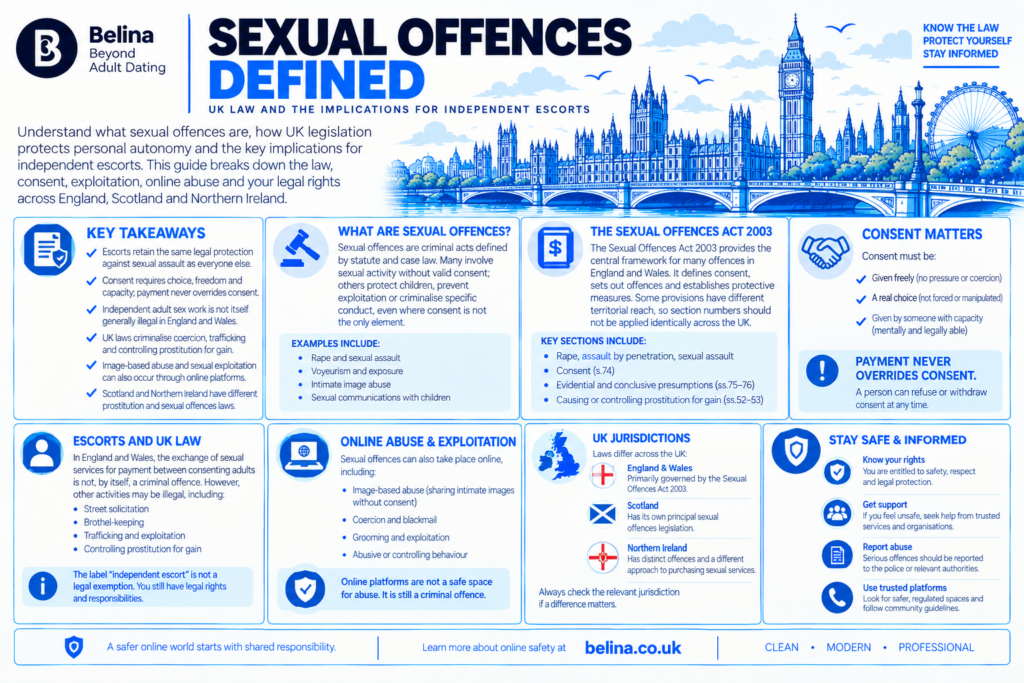
The Sexual Offences Act 2003 provides the central framework for many offences in England and Wales. However, it is misleading to describe one single legal regime for the whole United Kingdom. Scotland has its own principal sexual offences legislation, while Northern Ireland has distinct offences and a different approach to purchasing sexual services. Accordingly, the explanations below identify the jurisdiction whenever a difference matters.
This is general information rather than individual legal advice. Where coercion, an immediate threat or suspected child exploitation arises, seek urgent help rather than attempting to interpret complex law alone.
Key Takeaways
- Escorts retain the same legal protection against sexual assault as everyone else.
- Consent requires choice, freedom and capacity; payment never overrides consent.
- Independent adult sex work is not itself generally illegal in England and Wales.
- UK laws criminalise coercion, trafficking and controlling prostitution for gain.
- Image-based abuse and sexual exploitation can also occur through online platforms.
- Scotland and Northern Ireland have different prostitution and sexual offences laws.
What Are Sexual Offences?
Sexual offences are criminal acts defined by statute and case law. Many involve sexual activity without valid consent; others protect children, prevent exploitation or criminalise specified conduct even where ordinary consent analysis is not the only element. For that reason, the statement that every sexual offence necessarily involves a lack of consent is too broad.
Contact offences: include rape, assault by penetration and sexual assault.
Non-contact offences: can include voyeurism, exposure, intimate-image abuse and certain sexual communications with children. Investigations consider the statutory elements of each offence, its territorial reach and the evidence available.
For escorts, this means a professional description, an online listing or an earlier conversation does not authorise unwanted contact. A person may refuse or withdraw consent. Equally, advertising lawful companionship does not itself establish that a sexual offence has occurred.
Sexual Offences Act 2003
The Sexual Offences Act 2003 substantially modernised sexual offences law in England and Wales. Part 1 defines numerous offences involving adults, children and abuse of trust; Part 2 establishes notification requirements and protective measures for specified offenders. Some provisions have different territorial reach, so section numbers should not automatically be applied identically throughout the UK.
Sections 1 to 4 address rape, assault by penetration, sexual assault and causing sexual activity without consent. Section 74 defines consent, while sections 75 and 76 create evidential and conclusive presumptions in specified circumstances. Sections 52 and 53 address causing or inciting prostitution for gain and controlling another person’s prostitution for gain.
Readers should consult the updated text of the Act rather than rely exclusively on its original wording. Amendments introduced through later legislation have changed important areas, particularly digital and image-based sexual offences.
Escorts and UK Law
In England and Wales, the exchange of sexual services for payment between consenting adults is not, by itself, a criminal offence. That does not make every associated activity lawful. Street solicitation, brothel-keeping, trafficking, exploitation and certain other acts may create criminal liability depending on the circumstances.
The label “independent escort” is not a legal exemption. A person advertising independently must still comply with rules applying to premises, advertising, taxation, personal data and criminal conduct. Conversely, describing someone as an escort does not remove their legal rights or make them less deserving of protection.
An additional distinction concerns companionship services. Escort advertising can encompass social company without sexual services. The legal meaning of “prostitution” in a particular statute must therefore not be presumed from a listing title alone. Each situation turns on what occurred and the relevant legal test.
Prostituation and Exploitation
Section 52 of the 2003 Act addresses intentionally causing or inciting another person to become involved in prostitution for gain. Section 53 addresses intentionally controlling activities relating to another person’s prostitution for gain. The concept of gain can include financial or other advantages defined in the legislation.
Under section 53A, introduced by the Policing and Crime Act 2009, paying or promising payment for the sexual services of someone subjected to specified exploitative conduct by a third person can be a criminal offence in England and Wales. The payer’s knowledge of that third-party exploitation is not required under the statutory test. That is a narrower and more precise statement than claiming that all payment for sex is illegal.
Escorts may encounter warning signs such as third parties controlling communications, retaining identification documents, taking earnings under threats, restricting movement or instructing someone to misrepresent their age. Such signs warrant concern but do not establish a criminal offence by themselves. Report suspected exploitation through appropriate safeguarding channels rather than confronting an alleged controller.
Consent Under UK Law
Section 74 states that a person consents when they agree by choice and have the freedom and capacity to make that choice. In sexual offence proceedings, the question of whether the accused reasonably believed in consent also matters for several offences. Courts assess the circumstances rather than relying on a payment, a relationship or a previous encounter.
Consent is specific and can be withdrawn. Agreeing to meet an escort, paying for time or consenting to one kind of contact does not automatically mean consenting to another. Threats, force, incapacitation and certain forms of deception can prevent valid consent or trigger statutory presumptions.
Section 75 creates rebuttable evidential presumptions in specified situations, including certain violence or threats, unlawful detention, unconsciousness and administration of a substance capable of overpowering a person. Section 76 provides conclusive presumptions for particular deliberate deception about the nature or purpose of an act or impersonation of someone personally known to the complainant.
When a situation becomes unsafe, personal safety takes priority. Anyone facing imminent danger should contact emergency services. A person who experiences sexual violence may also seek medical care and specialist support even when they do not yet wish to make a police report.
Types of Sexual Offences
Under section 1 of the 2003 Act, rape involves intentional penile penetration of the vagina, anus or mouth without consent and without a reasonable belief in consent. Section 2 addresses assault by penetration involving intentional sexual penetration of the vagina or anus with a body part or object. Both offences can carry a maximum sentence of life imprisonment.
Section 3 covers intentional sexual touching without consent where the accused does not reasonably believe consent exists; its maximum sentence is generally ten years’ imprisonment. Section 4 addresses causing another person to engage in sexual activity without consent, with penalties depending on the conduct.
The statutory wording matters. For example, the legal definition of rape under section 1 is narrower than the everyday use of the term, but that does not mean serious sexual violence committed in other ways goes unpunished. Assault by penetration and other offences may apply. Neither gender nor occupation affects entitlement to protection.
Child Sexual Exploitation
Children and young people require particular safeguarding. The age of consent in England and Wales is 16, but that does not permit adults to purchase sexual services from anyone under 18. The legislation contains specific offences concerning sexual exploitation of children, arranging or facilitating sexual offences and child sexual abuse material.
Sections 9 to 12 address specified sexual offences involving children under 16. Additional provisions cover children under 13, grooming and abuse of positions of trust. The exact offences and defenses depend on age and circumstances; an adult should never treat a claimed age on a website as adequate assurance of adulthood.
If a listing, message or image suggests a person is under 18, do not arrange contact or redistribute images. Preserve only information necessary for a lawful report, use the platform’s reporting mechanism and contact police or relevant child-protection authorities. Immediate threats require emergency intervention.
Non-Contact Sexual Offences
Not every serious sexual violation involves physical touching. Voyeurism can concern observing or recording a person engaged in a private act under the conditions set out in section 67. Exposure is addressed by section 66. Other offences address prohibited conduct involving recording equipment, private images or sexual communication with children.
For escorts, practical examples may include covert recording at a meeting, threats involving private photographs or repeated distribution of intimate material without permission. Different acts may trigger different offences, and civil remedies or data protection rights may also arise.
Digital evidence can disappear quickly. Where safe, keep relevant messages, dates, account identifiers and links without forwarding intimate images to unrelated people. Reporting tools and specialist victim services may assist with removal requests or further steps.
Online Sexual Offences
The Online Safety Act 2023 introduced important intimate-image and unsolicited genital-image offences in England and Wales. These include specified sharing or threats to share intimate photographs or films without consent and sending images of genitals in circumstances covered by the legislation. The precise offence elements, mental requirements and available defenses vary.
Online safety duties for user-to-user services sit alongside criminal law. A classified-advertising platform must consider applicable illegal-content and reporting duties, but the existence of a profile or complaint does not itself prove a criminal offence. Moderation decisions should follow clear terms, documented evidence handling and proportionate safeguards.
People publishing escort advertisements should avoid uploading another person’s images without permission, disclosing personal details without lawful basis or using threatening communications. Readers can consult Belina’s Online Safety guide for practical reporting and account-security advice.
Sex Offenders Register
Part 2 of the Sexual Offences Act 2003 creates notification requirements for people who meet statutory conditions following specified convictions, cautions or related outcomes. These are commonly called the “sex offenders register”, although the legal scheme consists of notification duties rather than a public directory.
The duration and content of the duties depend on the offence, sentence and applicable rules. It would be inaccurate to say that everyone convicted of any sexual offence automatically has identical obligations. Certain notification requirements can be indefinite, while other periods are time-limited.
Sexual Harm Prevention Orders and Sexual Risk Orders can restrict specified conduct where legal thresholds are met. Breaching an order may itself be an offence. These mechanisms aim to prevent future harm and operate separately from the question of whether someone may lawfully advertise a companionship service.
Different UK Jurisdictions
England and Wales share much of the framework described above. Scotland principally relies on the Sexual Offences (Scotland) Act 2009 for consent-based sexual offences and has separate rules affecting solicitation, brothel-keeping and exploitation. As of October 2026, the proposed Prostitution (Offences and Support) (Scotland) Bill had fallen at Stage 1 in February 2026; it did not make paying for sex generally illegal in Scotland.
Northern Ireland principally uses the Sexual Offences (Northern Ireland) Order 2008 for many sexual offences. Selling sexual services is not itself a crime there, but paying or promising to pay for sexual services is a criminal offence under Northern Ireland legislation. It is therefore inaccurate to apply the England-and-Wales position on purchasing sex across the UK.
For cross-border advertising, travel or transactions, determine where the relevant conduct takes place and which legal rules apply. Platform availability throughout the UK does not make the substantive laws uniform. Specific questions should be referred to a suitably qualified solicitor.
Supporting UK Legislation
The Modern Slavery Act 2015 addresses slavery, servitude, forced or compulsory labour and human trafficking in England and Wales, with related legal frameworks elsewhere in the UK. Trafficking and coercion can overlap with sexual exploitation. Safeguarding responses should focus on a person’s safety and access to specialist help.
The Data Protection Act 2018 and UK GDPR govern relevant handling of personal information. Sensitive details, identity documentation and reports of alleged sexual abuse require particular care. The Online Safety Act 2023 imposes applicable duties on in-scope online services; the Equality Act 2010 also informs broader anti-discrimination obligations in relevant contexts.
Other relevant enactments include the Protection of Children Act 1978, Sexual Offences (Amendment) Act 1992, Serious Crime Act 2015, Voyeurism (Offences) Act 2019 and subsequent amendments. A single article cannot exhaust every legal condition, so official consolidated legislation remains the primary reference.
Sexual Offences Crime Statistics
The Office for National Statistics reported 209,079 police-recorded sexual offences in England and Wales for the year ending March 2025, an 11% increase on the previous year. More than half of that recorded increase was associated with two newer offences introduced through the Online Safety Act 2023. Excluding those offences, the increase was approximately 4%.
The Crime Survey for England and Wales estimated that around 898,000 people aged 16 or older experienced sexual assault, including attempts, in that year. These are not counts of identical units: the survey estimates victims, while police data counts offences recorded. Subtracting one from the other would not yield a defensible number of unreported incidents
The ONS advises that police-recorded figures are not a reliable standalone measure of changes in prevalence. Reporting practices, classification changes and public willingness to report affect the totals. Moreover, England-and-Wales data must not be labelled a single “UK crime rate”, because Scotland and Northern Ireland have separate data systems.
These findings underline why accurate reporting, evidence preservation and access to services matter. They do not support assumptions that escorts face the same level of risk as the general population, or that a particular website is responsible for a measured number of offences.
Reporting and Personal Safety
In an emergency, call 999. If there is no immediate danger, contact the police through 101 in the relevant jurisdiction or use official online reporting options. Sexual assault referral centres and NHS services can offer care, forensic options and support, including to people who have not decided whether to report to police.
Anyone advertising escort services should use strong account security, limit unnecessary disclosure of location or identity documents, and treat requests to move discussions to unfamiliar channels with care. If threats or extortion arise, preserve evidence and use a trusted reporting process. These are practical precautions, not substitutes for a perpetrator’s legal responsibility.
When reporting suspected illegal content to the platform, give enough specific information for a meaningful review, such as the listing URL, date and nature of the concern. Avoid sending intimate images of another person unless an authorised process explicitly requires it. For broader guidance, see the Belina online safety article linked in the references.
Conclusion
Escorts have the same right as everyone else to bodily autonomy, freedom from coercion and protection against sexual abuse. The Sexual Offences Act 2003 explains essential offences and consent principles in England and Wales, while related legislation addresses exploitation, children, digital abuse and offender management.
Clear legal information also requires geographical precision. Independent adult work is not the same thing as organised exploitation; likewise, the sale and purchase of sexual services have different legal treatment in Northern Ireland and elsewhere in the UK. Public discussion should distinguish consensual conduct from criminal wrongdoing without stigma or misplaced certainty.
For current legislation, consult official sources. For immediate safety concerns, report to emergency services, and for individual legal questions obtain qualified advice. Belina’s dedicated safety material offers additional practical guidance on reporting content and protecting personal information.
Frequently Asked Questions
Is escorting legal in the UK?
In England and Wales, independently selling sexual services is not itself illegal. However, activities such as brothel-keeping, certain forms of solicitation and controlling prostitution for gain are criminal offences. Different rules apply in Scotland and Northern Ireland.
Are escorts protected by UK sexual offences laws?
Yes. Escorts have the same legal protections against rape, sexual assault and other sexual offences as anyone else. Payment or an agreement to provide services does not remove the requirement for freely given consent.
Can an escort withdraw consent?
Yes. Consent can be withdrawn at any time, including after payment or after sexual activity has begun. Continuing sexual activity without consent may constitute a criminal offence.
Is paying for an escort illegal in the UK?
The law differs across the UK. Paying for consensual adult sexual services is not generally prohibited in England and Wales, but paying for services involving specified third-party exploitation is an offence. Northern Ireland criminalises paying for sexual services.
What is the difference between independent escorts and agencies?
Independent escorts arrange and control their own work. Agencies may perform administrative or advertising functions, but arrangements involving control of another person’s prostitution for gain can constitute criminal offences. Legal liability depends on the actual conduct.
What sexual offences can affect escorts?
Relevant offences include rape, sexual assault, assault by penetration, voyeurism and certain intimate-image offences. The applicable offence depends on the conduct and the jurisdiction.
Can two escorts work together legally?
Working together may create brothel-keeping risks, particularly where premises are used by multiple people for prostitution. Whether an offence occurs depends on the circumstances and the applicable jurisdiction.
Can escorts report sexual assault to the police?
Yes. Escorts can report rape, sexual assault, threats and exploitation to the police. Their occupation does not remove their legal protections. Anyone in immediate danger should call 999.