

Snacking Before Bed: Why Your Evening Cravings Could Be Keeping You Awake?

Snacking before bed can feel puzzling when dinner has already left you full.
A BBC report published on 6 November 2026 examines why evening cravings develop and what research says about their relationship with sleep.
Appetite follows daily biological rhythms, but scientists cannot conclude that every late snack causes a restless night.
The BBC’s report by health correspondent Nick Triggle brings together explanations involving appetite, food reward, habits and tiredness.
The wider evidence also distinguishes a small snack from a substantial meal, and a statistical association from proof of cause.
Understanding those differences gives readers a more useful answer than a blanket instruction to stop eating after a particular hour.
Key Takeaways
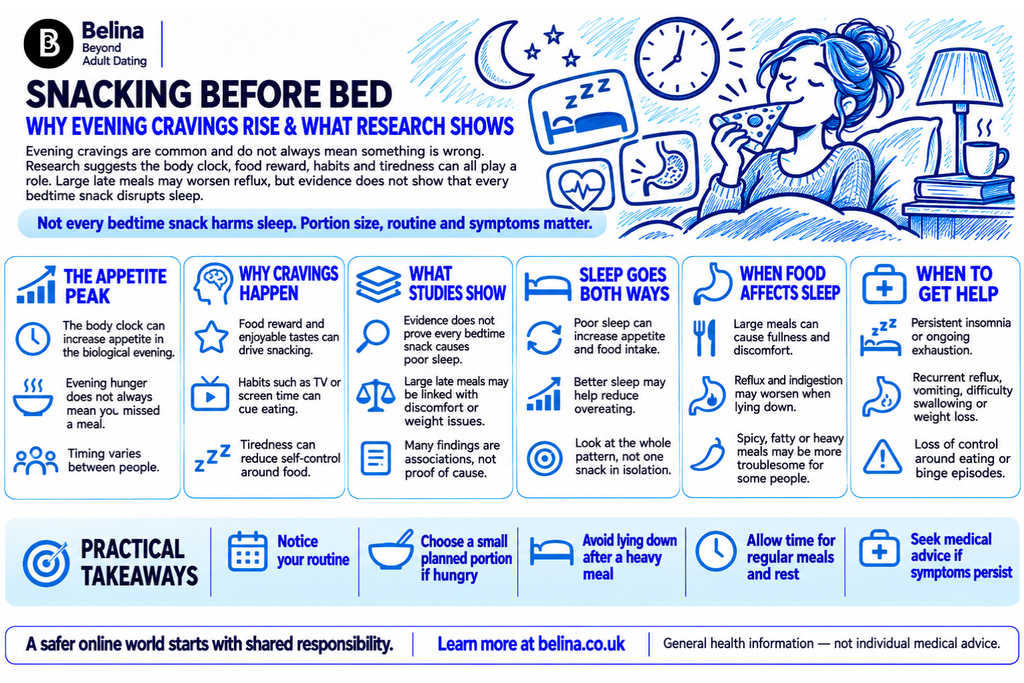
- The body clock can increase appetite during the biological evening.
- A craving after dinner does not always mean that the body needs more energy.
- Evidence does not show that every bedtime snack disrupts sleep.
- Large late meals can worsen reflux and make lying down uncomfortable.
- Persistent sleep problems or recurring loss of control around food deserve help.
Snacking Before Bed
The story concerns an ordinary experience: wanting more food after an adequate meal.
It does not announce a new diagnosis or a newly discovered danger from one biscuit.
Instead, it asks why that urge occurs and how to interpret advice about eating close to sleep.
The BBC consulted researchers including James Betts at the University of Bath, appetite researcher Suzanne Higgs at the University of Birmingham, dietitian Kristine Beaulieu and body clock researcher Jonathan Johnston at the University of Surrey.
Their explanations connect biological appetite rhythms with learned routines and the appeal of enjoyable foods. Importantly, “late eating” describes several different behaviours in research.
Some studies examine an entire day’s meal schedule.
Others measure the share of daily energy consumed near bedtime, or compare overall diet with sleep quality. Those results cannot all answer the narrower question of snacking before bed.
A careful account needs to explain what each study actually measured.
The Evening Appetite Peak
Hunger does not simply rise in a straight line with the time since the last meal.
The internal body clock also influences it.
A 2013 laboratory study tested 12 healthy adults aged 20 to 42 during a 13-day protocol.
Researchers distributed meals, sleep and other behaviours across the circadian cycle to separate the body clock’s influence from ordinary meal timing.
Participants reported their lowest hunger in the morning and their highest in the evening, corresponding approximately to 8am and 8pm in their usual schedules.
Appetite for several food categories followed a similar rhythm.
The results support a biological contribution to evening hunger, rather than an explanation based solely on missed meals or personal discipline.
However, this was a small controlled experiment.
Its approximate peak time does not set a universal deadline for eating, and it does not mean everyone becomes hungry at exactly 8pm.
For snacking before bed, the useful finding is the existence of a daily appetite rhythm, not a rule that a particular clock time makes food harmful.
Hunger and Food Reward
Wanting food and needing energy do not describe exactly the same process.
Physical fullness can coexist with a strong desire for something enjoyable.
The BBC discusses food reward as one explanation for that familiar gap between finishing dinner and still wanting dessert.
Ghrelin, a hormone involved in appetite, forms part of the biological picture.
Nevertheless, describing every evening craving as a “hunger hormone spike” would oversimplify it.
In a 2019 study of circadian timing and ghrelin, researchers found higher active ghrelin in the biological evening and examined its response to meals and disrupted schedules.
Hormonal signals, sleep and behaviour interact; one hormone does not determine every food choice.These findings help explain why snacking before bed can occur even without a long gap since dinner.
They do not establish that a person should ignore genuine hunger, or that cravings reveal a medical problem. A useful distinction is between feeling hungry, seeking a particular taste and repeatedly eating in response to a familiar cue.
More than one can occur together.
Habits and Distracted Eating
The setting can influence eating as well as the clock.
Repeatedly pairing television with food can create an expectation of a snack when the programme begins. That possibility fits the BBC’s discussion of habitual evening eating, but research on distraction adds an important qualification.
A 2026 systematic review and meta-analysis included 50 experimental studies.
Across the studies measuring food consumed during distraction, the overall effect did not reach conventional statistical significance.
Passive distractions such as watching television did, however, show an increase.
The review also found that distracted eating increased intake at a later eating occasion.
Consequently, the evidence supports paying attention to eating, but not the claim that every phone conversation or activity makes everyone overeat.
Different distractions produced different results.
In the context of snacking before bed, the relevant question is what happens in the actual routine: a planned portion eaten attentively differs from repeatedly reaching into a packet without noticing how much remains.
Meal Timing Evidence
One observational study published in 2019 examined 872 middle-to-older-aged adults using repeated dietary recalls.
People who consumed a larger proportion of their daily energy within two hours of bedtime had higher odds of overweight or obesity.
The association also varied with chronotype, a person’s tendency towards earlier or later timing.
That study did not randomly assign people to bedtime eating and follow resulting weight changes.
Therefore, it cannot show that snacking before bed independently caused obesity.
Other behaviours and differences between participants may contribute.
“Higher odds” also describes a group comparison; it does not predict what one snack will do to an individual’s body.
A 2022 controlled crossover trial explored possible mechanisms in 16 adults with overweight or obesity. With researchers controlling food intake and other conditions, later eating increased hunger and reduced waking energy expenditure.
It tested a shifted eating schedule, not an isolated snack.
These results make timing scientifically relevant, but they do not establish a universal eating curfew or a long term outcome for every reader.
What Sleep Studies Show
Research linking diet and sleep provides reasons for further investigation, rather than a simple list of foods that guarantee insomnia.
A Women’s Health Initiative analysis examined dietary patterns in postmenopausal women, including more than 53,000 with three-year follow-up data.
Higher dietary glycaemic index and greater consumption of added sugars and refined grains correlated with higher odds of new insomnia.
However, the study assessed overall diet, not just snacking before bed.
It also involved a specific population.
Its findings cannot establish that a late slice of bread causes insomnia in every adult.
Researchers need intervention studies to test the effects of changing those dietary patterns.
Another small laboratory study analysed diet and sleep in 26 adults.
Higher fibre intake correlated with more deep sleep, while higher saturated fat intake correlated with less. Sugar and other carbohydrate measures correlated with more arousals.
Again, these associations concern dietary intake across the day.
They do not prove that a particular bedtime food either cures or causes a sleep disorder.
Taken together, the studies support looking at the wider eating pattern.
They leave substantial uncertainty about the independent effect of a modest evening snack.
Sleep Affects Appetite
The relationship also runs in the other direction.
People who sleep poorly may change their eating, so research can struggle to separate food’s effect on sleep from sleep’s effect on food intake. This complicates confident claims about snacking before bed. A 2022 randomised trial offers evidence for that reverse pathway.
It involved 80 adults aged 21 to 40 with overweight who usually slept fewer than 6.5 hours.
An individualised sleep intervention increased sleep by about 1.2 hours a night compared with the control group. Energy intake fell by about 270 calories a day relative to the control group, without a prescribed diet.
Those figures describe a short trial in a selected group, not a target for everyone or a promise of weight loss. Still, the design helps show why sleep deserves attention alongside eating.
Treating tiredness as irrelevant while concentrating entirely on the last food eaten can miss part of the relationship. Equally, improving one habit does not remove every other cause of poor sleep.
Fullness and Acid Reflux
A large meal can cause discomfort even when research cannot establish that all late snacks disrupt sleep. NHS guidance on acid reflux explains that symptoms often worsen after eating and when lying down. Heartburn, a sour taste, nausea or bloating can therefore interfere with settling comfortably.
For people managing reflux, the NHS advises avoiding food in the three to four hours before bed. This advice addresses symptoms; it is not proof that everyone must fast for four hours after every small snack.
Individual treatment plans can differ, especially for people who need regular food with medication or have other medical conditions. Distinguishing symptoms also helps.
Feeling full, experiencing burning reflux and repeatedly waking without discomfort are different problems. An article about snacking before bed cannot determine which one explains a particular person’s sleeplessness.
A pharmacist can advise on occasional reflux treatment, while repeated or worsening symptoms need clinical assessment.
Changing Evening Routines
The evidence points towards observing the pattern rather than imposing a dramatic restriction. Note the meal size, the interval before lying down and the symptoms that follow.
That information can distinguish recurrent heartburn from a habit of eating while watching television, without requiring constant calorie counting.
A 2022 crossover study of 30 adults compared morning-loaded and evening-loaded diets over two four-week periods. Researchers found no difference in weight loss or energy expenditure between the matched diets, although a larger breakfast reduced hunger.
This helps explain why timing advice should avoid promises that rearranging meals automatically changes metabolism or produces a particular weight result.
For snacking before bed, the practical response can remain modest: consider how filling earlier meals are, put a chosen portion in a bowl and notice if the routine actually involves hunger.
Those are ways to examine eating behaviour, not treatments for insomnia.
A snack need not become a test of character, and an uncomfortable evening does not justify compensating with extreme restriction the following day.
Getting Medical Help
Seek a GP assessment if sleep difficulties persist for months, changes in routine do not help or tiredness makes daily life difficult. The NHS insomnia guidance lists several possible causes, including stress, medicines and sleep disorders.
Avoid assuming that snacking before bed explains every night of poor sleep.
Likewise, recurring indigestion, difficulty swallowing, repeated vomiting or unintended weight loss need assessment.
NHS indigestion guidance explains the symptoms that warrant medical attention.
Do not dismiss severe or unfamiliar symptoms as simply eating too much.
Regular episodes involving loss of control around eating deserve help too.
The NHS describes binge eating disorder as a treatable condition, not a failure of discipline.
One large meal does not establish that diagnosis.
During treatment, regular meals and snacks form part of recovery; the NHS warns against dieting during that treatment because it can make stopping binges harder.
Persistent fatigue also deserves a broader assessment, the following article on ferritin and low iron symptoms explains why appearance or tiredness alone cannot identify the cause.
Conclusion
Snacking before bed has several possible drivers, and the research does not support treating every evening craving as a lapse in self control.
- The body clock influences appetite
- routines shape eating
- poor sleep can change food intake.
Meanwhile, large meals and reflux can make bedtime uncomfortable.
Those findings support attention to patterns and persistent symptoms, without turning preliminary research into rigid food rules.
For escorts whose work sometimes involves late hours, the relevant response is practical: allow time for meals and rest where possible, note recurring symptoms and seek help when sleep or eating becomes difficult to manage.
The story does not establish that escort work itself creates a particular nutritional risk.
Protecting health means getting appropriate care, rather than skipping necessary food or attempting to work through persistent exhaustion.
Frequently Asked Questions
Does eating too much make it hard to sleep?
It can. An uncomfortable feeling of fullness, indigestion or reflux can make settling down harder, especially after a large late meal. However, that does not mean every small snack causes insomnia. If the problem repeats, describe the symptoms and timing to a healthcare professional rather than assuming one explanation.
When can I sleep after a heavy meal?
For reflux or indigestion, NHS advice recommends leaving three to four hours between eating and bed. There is no universal countdown that guarantees symptom-free sleep. Avoid lying flat immediately if it worsens symptoms, and follow any individual advice from your clinician.
What to do when I’m uncomfortably full?
Stop eating and remain comfortably upright if lying down worsens the discomfort. A pharmacist can advise on occasional indigestion or heartburn medicines. Seek medical advice for severe pain, repeated vomiting or recurring symptoms. Do not force vomiting or try to compensate with laxatives or extreme exercise.
How to reset stomach after overeating?
There is no established need for a stomach “reset” after one large meal. Avoid detox claims or a compensatory fast; return towards a regular eating pattern as the discomfort settles. Repeated episodes with loss of control, distress or attempts to compensate deserve assessment rather than increasingly strict food rules.
What foods cause sleepless nights?
No single food causes sleeplessness in everyone. Caffeine can interfere with sleep, while alcohol can disrupt its quality. Fatty or spicy foods may trigger reflux in susceptible people. Studies also associate some dietary patterns with poorer sleep, but they do not establish that every serving of sugar or refined carbohydrate causes insomnia.